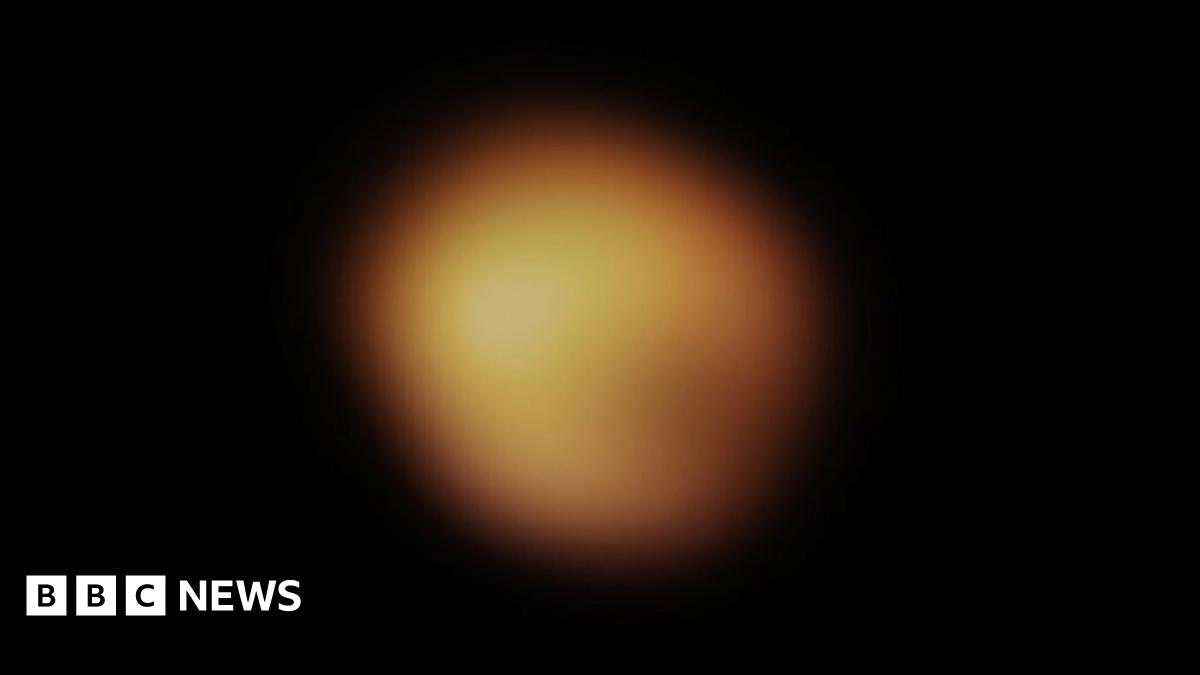
News Betelgeuse is acting strange

Marijn

Active member
Joined
Mar 5, 2008
Messages
755
Reaction score
168
Points
43
Location
Amsterdam
Normally, Betelgeuse is among the 10 brightest stars in the sky. However, the red giant began dimming in October, and by mid-December, the star had faded so much it wasn’t even in the top 20

It’s what’s known as a variable star, and its shifts in brightness have been closely studied for decades. However, it is unusual for one of the sky’s most prominent points of light to fade so noticeably, prompting scientists to consider the possibility that something more exciting could be about to happen

https://www.nationalgeographic.com/...ange-astronomers-are-buzzing-about-supernova/
 
It's definitely noticeable. I observed Betelgeuse last night and estimated its v-mag to be +1.3, about the same brightness as Bellatrix. That's a change in brightness by a factor of about 2.
 
I doubt its really the end of the star. But it clearly shows how exciting astronomy can get.
 
Even if the luminosity dip ends up being so far out of the ordinary that it totally upends our understanding of where the star is in its life cycle, and even if we were to determine that it's going to blow "soon", that would just mean it could blow any time within the next few thousand years or so. The outer convective layer isn't in direct contact with the core, and the dynamics of the two are decoupled on short time scales.

Because the last burning stages happen so quickly (from thousands of years down to days, depending which stage you're talking about), there's no way to know how far along things are in the core after the carbon-burning stage (or thereabouts, I forget exact details, and a quick trawl through Wikipedia didn't refresh my memory on the relevant points) except by neutrino emissions, and except for the supernova itself, you won't pick up enough neutrinos to get workable data unless you're close enough to be fried. (Actually apparently for the closest supernova candidates, which aren't anticipated to fry us, neutrino astronomers have some hope of picking up thermal neutrino emissions during the silicon burning phase, which would give about a day's warning. I don't know details, I've just heard it mentioned offhand).

 
Astronomers have concluded that the supergiant is now in the early phase of helium burning in its core, which means it could live another hundred thousand years before going supernova.
 
Whatever happens, has already happened 642 and a half years ago - We're just waiting until the light gets here so we get to find out...

I suppose astronomers everywhere would give a condescending "that's cute" look to any online gamer complaining of 200-ish millisecond pings...


Would be neat to see it go "pop" though, it's bound to, sooner or later... In the astronomic sense of "sooner" and "later", that is.
For once it'd be a show that those of us without expensive telescopes could just look up and see.
 
Astronomers say they've put to bed the mystery of why one of the most familiar stars in the night sky suddenly dimmed just over a year ago.
Betelgeuse, a red supergiant in the constellation of Orion, abruptly darkened in late 2019, early 2020.

 
It only happened 600 years ago, while first europeans established colonies in America. Yesterday. ?
 
Back
Top