An SSTO as "God and Robert Heinlein intended".

Gravity losses depend on trajectory and burn time, not propellant density. This is a fallacy. Only because most rockets with high propellant density also have a short burn time (solids!), this can backfire for SSTOs...

I agree this is counter intuitive. And the reason behind it is even more counter intuitive: it's because the gravity loss is reduced by using a lower Isp propellant. Since dense fuels have a lower Isp than hydrogen, their gravity loss will be reduced.
Here's one explanation of this effect:

Hydrogen delta-V (Henry Spencer; Mitchell Burnside Clapp).
http://yarchive.net/space/rocket/fuels/hydrogen_deltav.html

Here's a simplified case that makes it believable. The gravity loss occurs when the vehicle is traveling vertically to achieve the necessary altitude for orbit. This is done with orbital rockets by getting to some particular vertical velocity component so that the rocket's momentum will allow it to coast in the vertical direction to reach that altitude. The rest of the trip after the vertical portion is used to make the horizontal thrust needed to get to the necessary tangential velocity for orbit.
So in this simplified case I'll just look at the case where your rocket only needs to get to the needed vertical speed for the altitude for orbit, say 1,400 m/s, not to achieve orbital velocity. Suppose now you have two vehicles one hydrogen-fueled the other kerosene or other dense propellant fueled. Let them both have the same liftoff thrust/weight ratio, say, 1.4. Note that because the dense propellant has a lower Isp its mass ratio will be higher than the hydrogen to get to the same velocity, so it will have a higher propellant load.
Then near the end of the trip when most of the propellant is burned off, note that the dense propellant vehicle will have a higher thrust/weight ratio than the hydrogen one because its thrust needed to be several times higher compared to its dry mass because of the higher initial propellant load. This turns out to be the case through out the trip after the initial liftoff: the acceleration will be greater for the dense propellant vehicle. Therefore its gravity loss will be reduced because the time of the vertical trip is reduced.
Here's another way of seeing the needed burn time will be smaller for the dense propellant case. Recall that the thrust of a rocket is (thrust) = (propellant flow rate)x(exhaust velocity). We know there will be a greater amount of propellant for the dense case compared to the hydrogen case. So the thrust will have to be proportionally larger as well, and so the propellant flow rate will also need to be greater.
Now since the flow rate for the dense propellant will also be higher does that mean they will both burn up all their fuel in the same length of time? The key point is they won't. The dense propellant vehicle will burn up all its fuel in a shorter period of time (we're still looking at the simplified case of only looking at a vertical trip to 1,400 m/s.)
The reason for this is because of that exhaust velocity term in the equation for thrust. If the propellant load is some multiple times that of the hydrogen case the thrust will have to be similarly multiply times higher. But the increased propellant flow rate that gives that multiple times greater thrust will have to be higher than the multiple of the amount of greater propellant because that exhaust velocity term is smaller. For instance if the dense fuel thrust has to be, say, twice that of the hydrogen case, then the propellant flow rate will have to be more than twice as great to make up for the lower exhaust velocity term.
This means the length of time for the dense case to burn up its fuel will be shorter, resulting in a reduced gravity loss. The actual scenario for an orbital flight where there is also a horizontal thrust portion is only slightly more complicated but it also leads to the conclusion the gravity drag is reduced for the dense propellant case.
If you want to see an equation that expresses the idea the acceleration is greater for the dense propellant case, even with the same initial T/W ratio, see equation 4 on page 14 here:

A flexible reusable space transportation system.
by Dr. Steven Pietrobon
Journal of the British Interplanetary Society.
vol. 53, pp. 276-288, May/June 2000
http://www.sworld.com.au/steven/pub/nsto.pdf


Bob Clark
 
Here's one explanation of this effect:

Hydrogen delta-V (Henry Spencer; Mitchell Burnside Clapp).
http://yarchive.net/space/rocket/fuels/hydrogen_deltav.html

I recommend doing the math behind the assumptions chained there. This newsgroup posting only assumes (If a then b might happen"), but doesn't really calculate. Also, the posting contains a lot of cargo cult science, I recommend reading it as bad example, not as reference for designing anything more complex than a toaster. Take for example the "The mass line is more steep" argumentation. The error is that the people put the origin of the mass line at launch: A Hydrolox SSTO with the same burntime will have a lower mass flow (m-dot), that is right, but that doesn't make a denser fuel rocket good: The Hydrolox SSTO also already lifts off with far less fuel, both plots will meet at cut-off and that is the point from where you should look for the comparison. And there the "lower structural mass for smaller tanks" fallacy will also tumble, since the structural mass reduction for the smaller tank volume will not be as high as the fluffy assumption makes it sound, since you have to deal with higher forces acting on the structure. In reality, you will get punished by the heaviest parts of any LV: The engines. The lower performance fuels will mean you will have surplus engines quickly in flight, that you can't use effectively. And engines weight more than tank structure.

Also, you can always say the killer argument: Stop talking, build it. The universe is the best calculator.
 
SpaceX has noted that its Falcon 9 first stage has reached a milestone in achieving a better than 20 to 1 mass ratio:

SPACEX ACHIEVES ORBITAL BULLSEYE WITH INAUGURAL FLIGHT OF FALCON 9 ROCKET.
Cape Canaveral, Florida – June 7, 2010
"The Merlin engine is one of only two orbit class rocket engines developed in
the United States in the last decade (SpaceX’s Kestrel is the other), and is
the highest efficiency American hydrocarbon engine ever built. The Falcon 9
first stage, with a fully fueled to dry weight ratio of over 20, has the
world's best structural efficiency, despite being designed to higher human
rated factors of safety."
http://www.spacex.com/press.php?page=20100607

The early versions of the Atlas rocket also reached comparably high mass ratios using both "balloon" tank and common bulkhead design, though the latest version, the Atlas 5 first stage, has a poorer mass ratio in not using either of these methods.
As described in SpaceX news releases, the Falcon launchers are able to get their high mass ratios because they use both common bulkheads and lightweight aluminum-lithium alloys, instead of the balloon tanks of the earlier Atlas versions.
But then I was startled to see that some early Delta rocket first stages, which were kerosene fueled, also had better than 20 to 1 mass ratios, particularly ones using an extra long first stage tank, known as the Delta Thor ELT:

Delta 1914.
http://www.friends-partners.org/partners/mwade/lvs/dela1914.htm

Astronautix is sometimes inaccurate but this is probably about right since on this page as well the early Delta versions using the first stage long tank has a first stage mass ratio of over 20 to 1:

Delta vehicle designs
http://www.b14643.de/Spacerockets_2/United_States_5/Delta_I/Design/Delta_5.htm

This is notable because these Delta rocket first stages were able to achieve these high mass ratios without using balloon tanks or common bulkheads. Note that the Atlas 5 first stage remember in not using common bulkheads or balloon tanks results a much poorer first stage mass ratio.
We'll show the Delta Thor ELT can become a reusable SSTO with a vertical DC-X landing mode by replacing its RS-27 engine with the higher performance NK-33 engine and adding thermal protection and landing systems. The use of the NK-33 will add only 200 kg to the dry mass even though it has nearly twice the thrust. Interestingly the Delta Thor ELT can be made into a SSTO while keeping the vehicle close to the same size of the original DC-X.
The original DC-X created quite a stir when it was first flown because it was produced in such a short period, in less than two years, at relatively low cost, less than $60 million, and most importantly it demonstrated quick turnaround with a small ground crew.
The DC-X though was only able to make vertical takeoffs to a few thousand feet altitude and vertical landings using hydrogen fuel. To make an orbital version capable of 10,000 kg payload would require a much larger version at over a billion dollar cost, the DC-Y. Even the 1/2-scale version, the DC-X2, would cost $450 million and would only be suborbital using hydrogen fuel even though this 1/2-scale vehicle was twice the size of the DC-X. It is important then that by switching to hydrocarbon fuel that you can get a fully orbital vehicle of close to the size as the DC-X.
The Delta Thor ELT had a gross mass of 84,067 kg and an empty mass of 4,059 kg, for a propellant mass of 80,008 kg. The density of kerolox propellant is about 1,000 kg/m^3, so this corresponds to a propellant volume of about 80 m^3. The DC-X had a conical shape with a base about 4.1 m wide and length about 12 m, for a 3 to 1 ratio of length to base. A propellant tank of volume of that of the Delta 1914 first stage, but conically shaped at the same proportions as the DC-X, gives a base of 4.67 and a length of 14 m.
According to this, circular-cross section tanks, such as a cone, can get the same propellant mass to tank mass ratio of cylindrical tanks:

Space Access Update #91 2/7/00.
The Last Five Years: NASA Gets Handed The Ball, And Drops It.
"...part of L-M X-33's weight growth was the "multi-
lobed" propellant tanks growing considerably heavier than promised.
Neither Rockwell nor McDonnell-Douglas bid these; both used proven
circular-section tanks. X-33's graphite-epoxy "multi-lobed" liquid
hydrogen tanks have ended up over twice as heavy relative to the
weight of propellant carried as the Shuttle's 70's vintage aluminum
circular-section tanks - yet an X-33 tank still split open in test
last fall. Going over to aluminum will make the problem worse; X-
33's aluminum multi-lobed liquid oxygen tank is nearly four times as
heavy relative to the weight of propellant carried as Shuttle's
aluminum circular-section equivalent."
http://www.space-access.org/updates/sau91.html

Now we have to mass the thermal protection and landing systems. For thermal protection, we'll assume it'll make a ballistic reentry, base first. The base will only be 4.67 meters wide, giving an area of 17 m^2. Using base first reentry we'll have to cover primarily the base only:

Blue Origin New Shepard.
"A passenger and cargo spacecraft has considerably less need for cross-range."
...
"As a result, the craft is much "rounder" than the DC-X, optimized for tankage and structural benefits rather than re-entry aerodynamics. It has not been stated if the vehicle is intended to re-enter base-first or nose first, but the former is most likely for a variety of reasons. For one, it reduces heat shield area, and thus weight, covering only the smaller bottom surface rather than the much larger upper portions. The area around the engines would likely require some sort of heat protection anyway, so by using the base as the heat shield the two can be combined. This re-entry attitude also has the advantage of allowing the spacecraft to descend all the way from orbit to touchdown in a base-first orientation, which would seem to offer some safety benefits as well as reducing aero-loading issues."
[ame="http://en.wikipedia.org/wiki/Blue_Origin_New_Shepard"]Blue Origin New Shepard - Wikipedia, the free encyclopedia[/ame]

We'll use the high temperature resistant but low maintenance metallic shingles developed for the X-33:

REUSABLE METALLIC THERMAL PROTECTION SYSTEMS DEVELOPMENT.
http://reference.kfupm.edu.sa/content/r/e/reusable_metallic_thermal_protection_sys_117853.pdf

These have an areal density of 15 kg/m^2. This will require 255 kg to cover the base only. This plus the 200 kg extra mass for the more powerful NK-33 engine brings the dry mass to 4514 kg.
The landing gear for an aerial vehicle is commonly taken as 3% of the landed weight:

Landing gear weight.
http://yarchive.net/space/launchers/landing_gear_weight.html

So 4,650 kg dry mass with the landing gear.

To make a powered vertical landing the common estimate is 10% of the vehicle landed weight has to be used in propellant:

Reusable launch system.
Vertical landing.
http://en.wikipedia.org/wiki/Reusable_launch_system#Vertical_landing

So 5,115 kg has to be lofted to orbit.

For the average Isp over the flight we'll use the value 338.3 s estimated for high performance kerolox engines using altitude compensation given in table 2 of this report:

Alternate Propellants for SSTO Launchers.
Dr. Bruce Dunn
Adapted from a Presentation at:
Space Access 96
Phoenix Arizona
April 25 - 27, 1996
http://www.dunnspace.com/alternate_ssto_propellants.htm

For the delta-V to orbit use 8,900 m/s, approx. 300 m/s less than that required for hydrogen fueled rockets due to the reduction in gravity loss using dense propellants:

Single-stage-to-orbit.
4 Dense versus hydrogen fuels.
http://en.wikipedia.org/wiki/Single-stage-to-orbit#Dense_versus_hydrogen_fuels

Then this will allow about 750 kg to orbit:

338.3*9.8ln(1 + 80,008/(5,115 + 750)) = 8,898 m/s.

More energetic fuels than kerosene are also discussed in Dunn's report. Methylacetene for example with altitude compensation gets an average Isp of 352 s. This will allow about 1,450 kg to orbit:

352*9.8ln(1 + 80,008/(5,115 + 1,450)) = 8,897 m/s.

The cost? The original DC-X cost $60 million. Since this reusable kerosene-fueled version is of similar size it might be estimated to be of approx. the same cost. However, there is this surprising cost for the Delta Thor ELT:

Delta Thor ELT.
"Lox/Kerosene propellant rocket stage. Loaded/empty mass 84,067/4,059 kg. Thrust 1,030.21 kN. Vacuum specific impulse 296 seconds.
Cost $ : 11.600 million."
http://www.astronautix.com/stages/delorelt.htm

Astronautix though is sometimes inaccurate, but I haven't found any other source estimate for the cost of this stage.
Typically the cost of the engine is the largest portion of the cost of a rocket stage, so more than half of the $11.6 million would be for the original RS-27 engine. But this would be for more than the price of the more powerful NK-33 currently at $4 million. The metallic shingle TPS though would also be an additional add on to the cost.
Still, it is possible the cost could be in the $10 million to $20 million range. Considering we have a reusable launcher with engines that could get perhaps 10 flights and with possibly a 1,450 kg payload capacity, the price per kilo might be as low as $700/kg, or $350/lbs.


Bob Clark

 
Last edited:
Interestingly, though orbital flight has been considered much more difficult than suborbital flight, and indeed the "cost" in energy and velocity is much higher, surprisingly it can be done now actually at a lower monetary cost than at least that of the Virgin Galactic suborbital system.
As I mentioned here a reusable launch vehicle can be constructed for an amount in the range of $10 million to $20 million. Compare that to the estimated $150 million to $200 million Virgin Galactic will be paying to develop the WhiteKnightTwo/SpaceShipTwo suborbital system.

This reusable SSTO is of the DC-X powered-landing format not the X-33 lifting-body format and is derived from 1970's technology Delta Thor lightweight structures and NK-33 high efficiency engines, which is why I have argued SSTO's with significant payload capability have been possible for decades. However, to get the SSTO you need to use both weight optimized structures and high efficiency engines at the same time. Previously, and frustratingly still now, launchers have been given one or the other but not both.
Of the suborbital flight companies mentioned Blue Origin and Virgin Galactic have sufficient financing to easily build this SSTO. And indeed it is of such simple design an operational prototype could probably be flying by the time they have their manned suborbital flights in operation.
As I said this SSTO is of the DC-X design. Since Blue Origin is already going to use this powered landing approach for their suborbital vehicle they may have a leg up in the race to first field this SSTO. However SSTO's of comparable size that used instead horizontal landing would work just as well. Then Virgin Galactic with partnerships both with Scaled Composites with the winged SpaceShipTwo and now with Sierra Nevada with the lifting-body Dream Chaser could also easily field a horizontal landing type SSTO.


Bob Clark
 
Last edited by a moderator:
Another option for a manned launcher. NASA is in a quandary right now about what to do about their manned flight capability. Congress wants this reinstituted quickly but NASA says they can't do it with the money being provided by Congress.
In regards to this proposal it is notable McDonnell Douglas, now a subsidiary of Boeing, was also the contractor on the DC-X, legendary for its low development cost, quick turnaround time, and small ground crew.
In this report Boeing proposes heavy lift launchers using existing components:

Heavy Lift Launch Vehicles with Existing Propulsion Systems.
Benjamin Donahue, Lee Brady, Mike Farkas, Shelley LeRoy, Neal Graham
Boeing Phantom Works,Huntsville, AL 35824
Doug Blue
Boeing Space Exploration,Huntington Beach, CA 92605
http://www.launchcomplexmodels.com/Direct/documents/AIAA-2010-2370-650.pdf

One of the proposals is of a manned launcher with the Orion capsule using a shuttle ET propellant tank and four RS-68 engines. This does not use an upper stage but is not a single-stage-to-orbit vehicle because the final push to orbit is made by the onboard thrusters on the Orion spacecraft.
However, it is interesting in this report comparison is made to the S-IVB upper stage on the Apollo rocket. I was reminded of a suggestion of Gary Hudson that the S-IVB would be single-stage-to-orbit with significant payload if it used the high efficiency SSME rather than the J-2 engine:

A Single-Stage-to-Orbit Thought Experiment.
Gary C Hudson
http://www.spacefuture.com/archive/a_single_stage_to_orbit_thought_experiment.shtml

In Hudson's proposal the vehicle could lift 10,360 lbs, 4,710 kg. This would be just enough to carry the crewed version of the Dragon spacecraft without cargo. Boeing's proposal for a manned capsule the CST-100 might be launchable by this also since it is of comparable size and design to the Dragon:

Boeing space capsule could be operational by 2015.
BY STEPHEN CLARK
SPACEFLIGHT NOW
Posted: July 21, 2010
http://www.spaceflightnow.com/news/n1007/21boeing/

NASA has shown in their crewed spacecraft versions to want to hearken back to Apollo in their use of capsules. This SSTO idea of Hudson would have the advantage of using a proven Apollo component that is already manrated. The SSME's are also already manrated rather than the RS-68 of the Boeing proposal.
Because of its small small size compared to the shuttle ET propellant tank it would also be relatively low cost as well as only needing one SSME engine. In fact it would even be smaller than the Falcon 9, Delta IV, and Atlas V expendable launchers. Note as well NASA is leaning now to using SSME's or their expendable versions rather than the RS-68 for their shuttle derived manned launchers.
Hudson in his article stated the S-IVB was designed by the Douglas Aircraft Company, which merged with McDonnell Aircraft to form McDonnell Douglas. McDonnell Douglas is now a division of Boeing, so Boeing should have access to the design documents of the S-IVB.
NASA in their shuttle-derived launcher studies have focused on getting a cheaper version of the SSME by making an expendable version. However, the greatest advantage of a SSTO is in being reusable. Then I suggest studies be made on the SSME going the opposite direction: how can it be made to be reusable at much reduced maintenance cost?
Now the SSME's have to be overhauled after every flight costing ten's of millions of dollars. However, Henry Spencer a highly regarded expert on the history of space flight has said Rocketdyne studies show that with a lot of work to upgrade it, maintenance could be reduced to $750K per flight:

Engine reusability (Henry Spencer)
http://yarchive.net/space/rocket/engine_reusability.html

Spencer here said this would not be satisfactory for really large reductions in space costs. But this would be a reduction in SSME maintenance costs by 1 to 2 orders of magnitude, a major reduction in the costs for using the engine. The question is: how much would it cost to make the necessary upgrades to the engine?


Bob Clark
 
Another option for a manned launcher. NASA is in a quandary right now about what to do about their manned flight capability. Congress wants this reinstituted quickly but NASA says they can't do it with the money being provided by Congress.
In regards to this proposal it is notable McDonnell Douglas, now a subsidiary of Boeing, was also the contractor on the DC-X, legendary for its low development cost, quick turnaround time, and small ground crew.
In this report Boeing proposes heavy lift launchers using existing components:
Heavy Lift Launch Vehicles with Existing Propulsion Systems.
Benjamin Donahue, Lee Brady, Mike Farkas, Shelley LeRoy, Neal Graham
Boeing Phantom Works,Huntsville, AL 35824
Doug Blue
Boeing Space Exploration,Huntington Beach, CA 92605
http://www.launchcomplexmodels.com/Direct/documents/AIAA-2010-2370-650.pdf
One of the proposals is of a manned launcher with the Orion capsule using a shuttle ET propellant tank and four RS-68 engines. This does not use an upper stage but is not a single-stage-to-orbit vehicle because the final push to orbit is made by the onboard thrusters on the Orion spacecraft.
However, it is interesting in this report comparison is made to the S-IVB upper stage on the Apollo rocket. I was reminded of a suggestion of Gary Hudson that the S-IVB would be single-stage-to-orbit with significant payload if it used the high efficiency SSME rather than the J-2 engine:
A Single-Stage-to-Orbit Thought Experiment.
Gary C Hudson
http://www.spacefuture.com/archive/a_single_stage_to_orbit_thought_experiment.shtml
In Hudson's proposal the vehicle could lift 10,360 lbs, 4,710 kg. This would be just enough to carry the crewed version of the Dragon spacecraft without cargo.

It is notable that the upper stage of the Ares I is based on this S-IVB stage. Then this upper stage as well should be able to act as an SSTO with an SSME engine. This is important because the Ares I upper stage was originally planned to use the SSME, so this means much of the technical and financial analysis of using the SSME for the upper stage of the Ares I has already been done.
However, because of the cost of the SSME engine and technical risk in making it airstartable, the decision was made to use the J-2X engine instead. But for the SSTO purpose you don't have the problem of making it airstartable, and as I discussed the reusability maintenance costs can be reduced by an order of magnitude for the SSME.
This report contains some of the specifications on the Ares I upper stage:

NASA’s Ares I Upper Stage.
http://www.nasa.gov/pdf/231430main_UpperStage_FS_final.pdf

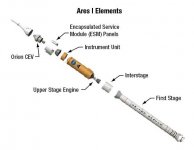
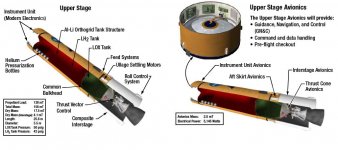
The propellant mass is listed as 138 mT, the dry mass of the stage as 17.5 mT, and the interstage mass, as 4.1 mT. See the second attached image below taken from page 2 of the report. The interstage supports the weight of the upper stage on top of the lower stage so won't be needed for the SSTO version. So we can take the dry mass now as 13.4 mT.
We need to add onto this now the extra weight of using the SSME over the J-2X engine. The report lists the J-2X mass as 2.5 mT. The SSME mass is 3.1 mT, .6 mT heavier. This brings the dry weight to 14 mT.
A puzzlingly high value of 2.5 mT however is given for the avionics. You wouldn't think it would need to be this high if it consisted of just electronics and computer systems with modern miniaturization. Most of the avionics is included in the "instrument unit". As you can see from the first attached image below, the instrument unit is regarded as a separate element of the upper stage and is contained within the forward skirt of the stage. The forward skirt serves to support the weight of the Orion CEV, so needs to have significant strength and mass to support the 20,000+ kg weight of the Orion spacecraft. So I'm wondering if that 2.5 mT mass is including the mass of this forward skirt.
The forward skirt mass can certainly be reduced if using a Dragon spacecraft at only one quarter the mass of the Orion. So that part of the dry mass will be reduced, though it's uncertain if the avionics mass itself can be reduced. In any case using 14 mT dry mass of the Ares I upper stage, the 138 mT propellant mass, the 425 s average Isp of the SSME, and a 9,200 m/s required delta-V to orbit, we can calculate the payload to orbit can be 3 mT:

425*9.8ln(1 + 138/(14 + 3)) = 9,205 m/s.

This payload mass would not be enough for the Dragon spacecraft but might be enough for an innovative new spacecraft proposal from the University of Maryland:

Phoenix: A Low-Cost Commercial Approach to the Crew Exploration Vehicle.
http://www.nianet.org/rascal/forum2006/presentations/1010_umd_paper.pdf

This uses a cylindrical shape for the capsule so would have more space for the crew/passengers. It also uses a new design for a thermal protection system called a "parashield" that would save weight over the traditional ablative design. The mass of the capsule in this study is given as 3,268 kg, so would only have to be reduced by a small proportion to fit within the payload mass constraints.
However, it might be possible to increase the payload capability of the SSME-powered Ares I upper stage to be able to carry even the Dragon spacecraft. First, more propellant can be carried in the same size tanks by densifying the propellant by subcooling:

Liquid Oxygen Propellant Densification Unit Ground Tested With a Large-Scale Flight-Weight Tank for the X-33 Reusable Launch Vehicle.
http://www.grc.nasa.gov/WWW/RT/RT2001/5000/5870tomsik.html

As much as 10% more propellant can be carried by subcooled densification. This corresponds to 10% greater mass that can lofted to orbit. So from a 17 mT total of launch vehicle + payload, up to 18.7 mT. This extra mass can go to extra payload so to 4.7 mT
Secondly, recent research has shown that from 10% to 20% weight savings can be made off the structural weight on launch vehicles:

NASA Recalculates To Save Weight On Launchers.
Jan 5, 2011
By Frank Morring, Jr.
http://www.aviationweek.com/aw/gene...tes To Save Weight On Launchers&channel=space

The structural mass sans engine is 11 mT. If 10% weight can be saved off this then that can be transfered to extra payload, bringing the payload capacity to 5.8 mT. This would then be within the payload capacity to carry the Dragon spacecraft.


Bob Clark
 

Attachments

  • Ares I elements.jpg
    Ares I elements.jpg
    17.9 KB · Views: 13
  • Ares I upper stage.jpg
    Ares I upper stage.jpg
    70.4 KB · Views: 11
Last edited:
Don't forget gravity and ambient air pressure effects.... 4250 Ns/kg is vacuum performance, not against a counter-acting sea-level pressure at launch.
 
You can't average just by "trajectory", you would need to integrate thrust force during the ascent and then divide it by the propellant mass. if you ascent slowly, and loose a lot of thrust to atmosphere (as the SSME or J2X would), you would also have a much worse "average specific impulse", due to the fact that most fuel is used at a time when the engine is operating less effective.

A single value is purely statistical - it helps you no where, since calculating it properly means roughly simulating the trajectory, and the 425 (which are bloody close to the middle between sea-level and vacuum ISP) are not even telling you how it went up.
 
You can't average just by "trajectory", you would need to integrate thrust force during the ascent and then divide it by the propellant mass. if you ascent slowly, and loose a lot of thrust to atmosphere (as the SSME or J2X would), you would also have a much worse "average specific impulse", due to the fact that most fuel is used at a time when the engine is operating less effective.
A single value is purely statistical - it helps you no where, since calculating it properly means roughly simulating the trajectory, and the 425 (which are bloody close to the middle between sea-level and vacuum ISP) are not even telling you how it went up.

The middle point is at about 408 s. The value 425 s is sufficiently far enough away that it is clear that the fact that most of the flight is taking place at high altitude is being taken into account.
The trajectory averaged Isp clearly depends on the trajectory. But you can assume some common trajectory is used to reach altitude and velocity for orbit and calculate the average Isp on that basis.
I would just like to see that calculation made and the trajectory used to make it.
One possibility for how it could be done if you had the data for the thrust of the SSME's for the shuttle over the entire trajectory to orbit, a "thrust profile". Then you could calculate what is the average Isp over this trajectory.


Bob Clark
 
One possibility for how it could be done if you had the data for the thrust of the SSME's for the shuttle over the entire trajectory to orbit, a "thrust profile". Then you could calculate what is the average Isp over this trajectory.

Assuming Orbiter lacks the accuracy and Matlab is too much effort, I would just use a simple spreadsheet: Every 5 seconds one new line of state data. enter a pitch profile into the lines get standard atmosphere pressure for the specific impulse... should work out. Isn't the most accurate solution, but cheap and quickly done.

425 seconds still means that the majority of the fuel consumption happens at vacuum specific impulse, 408 seconds should still be pretty optimistic... my first order estimate (using 10 second steps and pretty crude vector math) was at 385 seconds, assuming no throttle down and no drag force. Just pure atmosphere effect on thrust and specific impulse, interpolated between selected samples. And no really optimized trajectory. I would say 405 seconds is feasible, 425 s would be based on a lot of hope as third fuel component.
 
Another option for a manned launcher.NASA is in a quandary right now about what to do about their manned flight capability. Congress wants this reinstituted quickly but NASA says they can't do it with the money being provided by Congress.
In regards to this proposal it is notable McDonnell Douglas, now a subsidiary of Boeing, was also the contractor on the DC-X, legendary for its low development cost, quick turnaround time, and small ground crew.
In this report Boeing proposes heavy lift launchers using existing components:
Heavy Lift Launch Vehicles with Existing Propulsion Systems.
Benjamin Donahue, Lee Brady, Mike Farkas, Shelley LeRoy, Neal Graham
Boeing Phantom Works,Huntsville, AL 35824
Doug Blue
Boeing Space Exploration,Huntington Beach, CA 92605
http://www.launchcomplexmodels.com/D...0-2370-650.pdf
One of the proposals is of a manned launcher with the Orion capsule using a shuttle ET propellant tank and four RS-68 engines. This does not use an upper stage but is not a single-stage-to-orbit vehicle because the final push to orbit is made by the onboard thrusters on the Orion spacecraft.
However, it is interesting in this report comparison is made to the S-IVB upper stage on the Apollo rocket. I was reminded of a suggestion of Gary Hudson that the S-IVB would be single-stage-to-orbit with significant payload if it used the high efficiency SSME rather than the J-2 engine:
A Single-Stage-to-Orbit Thought Experiment.
Gary C Hudson
http://www.spacefuture.com/archive/a...periment.shtml
In Hudson's proposal the vehicle could lift 10,360 lbs, 4,710 kg. This would be just enough to carry the crewed version of the Dragon spacecraft without cargo.

The point of the matter is that if you use highly weight optimized structures and high efficiency engines at the same time then what you wind up with will be a SSTO capable stage. The Ariane 5 core stage is another weight optimized structure using common bulkhead design for its propellant tanks. The Ariane 5 core stage will also become SSTO if using high efficiency SSME's instead of the Vulcain engines.
The specifications of the Ariane 5 are given here:

Ariane 5 Data Sheet.
http://www.spacelaunchreport.com/ariane5.html

The Ariane 5 generic "G" version could be lofted by a single SSME. It's gross mass is listed as 170 mT, and the propellant mass as 158 mT, for a dry mass of 12 mT. The Vulcain engine is listed on this page as weighing 1,700 kg:

Vulcain - Specifications.
http://www.spaceandtech.com/spacedata/engines/vulcain_specs.shtml

Switching to a heavier SSME engine would add 1.4 mT to the vehicle dry mass, so to 13.4 mT for the dry mass. Using a 425s average Isp again for the SSME, this would allow a 6,000 kg payload:

425*9.8ln(1 + 158/(13.4+6)) = 9,218 m/s.

We wish to use this for a man-rated vehicle though. The Ariane 5 was originally intended to be man-rated using the Hermes spaceplane to carry crew. However, it's not certain the degree this was followed-through when the Hermes was canceled.
As with the Ares I upper stage, there are means to increase the payload capacity. Subcooled densification allows 10% greater propellant to be carried, so then 10% greater mass can be lofted to orbit. This brings the total lofted weight from 19.4 mT to 21.3 mT. This extra weight can go to extra payload, so from 6 mT to about 8 mT in payload.
The Ariane 5 uses an aluminum alloy, but not the aluminum-lithium alloy being used now for the lightest weight designs. Switching to aluminum-lithium allows approx. 10% weight saving over the previous aluminum alloy. The structural mass sans the SSME engine is 10.3 mT, so about 1 mT would be saved that could go to extra payload.
I also mentioned before the new research that suggests 10% to 20% can be saved in structural mass because of overly conservative design now used. This would be another 1 mT that could be saved off the dry weight. These weight savings could go to extra payload, bringing the payload capacity to 10 mT.
ESA appears to be amenable to adapting the Ariane 5 core stage for other uses, considering its agreement with ATK to use it for an upper stage. So NASA or a private company should be able to make an agreement with the ESA to use it for this purpose, based on getting sufficient financing. In this regard, to get a prototype done at low cost I suggest using the RD-0120 russian analogue of the SSME's. These are in mothballs and probably can be obtained at greatly reduced price. As a point of comparison the NK-33 was mothballed by the russians and Aerojet was able to buy 36 of them for only $1.1 million each(!) Aerojets version of the NK-33 is now on track to be used by Orbital Sciences on their Taurus II launcher.
Then the Ariane 5 core version of this SSTO has the advantage over the Ares I upper stage and S-IVB versions in being already built and in current use. It also has now the capability when powered by an SSME or RD-0120 to launch a SpaceX Dragon sized spacecraft to orbit without having to use special fuel densifying or lightweighting methods.
NASA has said they want to support commercial space. Support for this launcher would allow for a small, relatively low cost launcher that would permit independent private companies to launch their own manned, or cargo flights to space.


Bob Clark
 
Last edited:
I wouldn't call 69 Million USD per SSME low cost or even thinkable for commercial operations. Even the RD-0120, despite being much cheaper, would be anything attractive for commercial operations, if you want to reuse.

Blending the best of Russian rocket engine technology with the best of western avionics would likely be a much more attractive base for commercial rocket engines... like a Full Flow Staged Combustion engine with 1.5 MN thrust (100 times more than the test bed NASA is currently researching into nirvana). The engine cycle isn't really the problem, the largest bipropellant rocket engines ever build in human history had been full-flow staged combustion engines.

The NK-33 is of course much cheaper - somebody else already paid the lunch. Attractive for a while, but not offering chances for future growth, since you can't expect upgrades.
 
Assuming Orbiter lacks the accuracy and Matlab is too much effort, I would just use a simple spreadsheet: Every 5 seconds one new line of state data. enter a pitch profile into the lines get standard atmosphere pressure for the specific impulse... should work out. Isn't the most accurate solution, but cheap and quickly done.

425 seconds still means that the majority of the fuel consumption happens at vacuum specific impulse, 408 seconds should still be pretty optimistic... my first order estimate (using 10 second steps and pretty crude vector math) was at 385 seconds, assuming no throttle down and no drag force. Just pure atmosphere effect on thrust and specific impulse, interpolated between selected samples. And no really optimized trajectory. I would say 405 seconds is feasible, 425 s would be based on a lot of hope as third fuel component.

I found this page that gave the altitude of the shuttle during flight in 1 second intervals:

STS-114 Trajectory
COMPILED BY WILLIAM HARWOOD
Updated: July 25, 2005
http://spaceflightnow.com/shuttle/sts114/fdf/114trajectory.html

Do you have a reference for the formula for calculating the thrust based on the surrounding air pressure?


Bob Clark
 
Do you have a reference for the formula for calculating the thrust based on the surrounding air pressure?

The closest approximation is a linear interpolation of specific impulse. for the exact measured numbers, you need a look-up table for a nozzle, since the data is highly non-linear and also no longer just depending on atmospheric pressure, but also chamber pressure.
 
Suppose an SSTO based on Ariane 5 can lift 8 tons. Then by adding a second stage and staging at some 4 - 5 km/s you should be able to get significant increase in payload likely getting lower $/kg than as SSTO because small upper stage should be much cheaper than big first stage with expensive high performance engine.

SSTO would be the most advategous when launching crew because it is less likely for something to go wrong during ascent if there are no staging events and all engines are ignited and checked on ground before rocket is released from pad.
 
The closest approximation is a linear interpolation of specific impulse. for the exact measured numbers, you need a look-up table for a nozzle, since the data is highly non-linear and also no longer just depending on atmospheric pressure, but also chamber pressure.

I've been informed by email that one way of calculating the difference in thrust with altitude is by using the formula:

F = q*Ve+(Pe-Pa)*Ae

Isp = F/(g*q)

where,
q = propellant mass flow rate
Ve = exhaust gas velocity
Pe = pressure at the nozzle exit
Pa = ambient air pressure
Ae = area of nozzle exit
g = standard acceleration of gravity = 9.80665 m/s2

So if you assume the propellant flow rate and exhaust velocity are the same, then the difference in the thrusts at two different altitudes will be the difference in the ambient pressures at the two altitudes times the area of the nozzle exit.
Here are thrust numbers for sea level and vacuum for the SSME:

Space Shuttle main engine.
Thrust specifications
* 100% thrust (sea level / vacuum): 1670 kN / 2090 kN (375,000 lbf / 470,000 lbf)
* 104.5% thrust (sea level / vacuum): 1750 kN / 2170 kN (393,800 lbf / 488,800 lbf)
* 109% thrust (sea level / vacuum): 1860 kN / 2280 kN (417,300 lbf / 513,250 lbf)
http://en.wikipedia.org/wiki/Space_Shuttle_main_engine#Thrust_specifications

Using the 4.7 m^2 nozzle area given on this page, the calculated value of the sea level thrust calculated from the vacuum thrust is off by about 3% from the actual value.
This is probably good enough to get a good idea of the validity of the Hudson value for the average Isp. You would use the data on that page that gave the altitude of the shuttle during the flight and the exponential decrease in the air pressure with altitude.
Still I am curious about the factors that would cause the 3% discrepancy. Perhaps variations in mixture ratio during the flight cause differences in exhaust velocity?


Bob Clark
 
Still I am curious about the factors that would cause the 3% discrepancy. Perhaps variations in mixture ratio during the flight cause differences in exhaust velocity?

Much more simpler in a way: If the nozzle is operated at an ambient pressure, at which it is not designed for, the gas flow inside it can not follow the cross section of it properly.

If you for example have higher ambient pressure, the gas flow separates from the nozzle walls already before the nozzle exit, additionally producing shock waves that slow the exhaust down (over-expanded case). Or if you have lower ambient pressure, the exhaust is under-expanded and keeps on fanning out after the nozzle exit, so a part of the exhaust is only contributing partially to thrust.

But 3% is good enough for government work. The orbiter way is simply

[math]I_{sp} = \frac{I_{sp,vac} \cdot \left ( p_{sl} - p_a \right ) + I_{sp,sl} \cdot p_a}{p_{sl}}[/math]
 
Back
Top