
-
ORBITER-FORUM will be temporarily closed at 2026-07-23 18:00 UTC while we complete some OF maintenance tasks. The amount of downtime is expected to take up to one hour, but probably less.
You are using an out of date browser. It may not display this or other websites correctly.
You should upgrade or use an alternative browser.
You should upgrade or use an alternative browser.
Humor Random Comments Thread
- Thread starter Tex
- Start date

- Joined
- Feb 6, 2008
- Messages
- 38,938
- Reaction score
- 3,937
- Points
- 203
- Location
- Wolfsburg
- Preferred Pronouns
- Sire
Mallard is probably less well known to most folk.
Probably more famous than its German counterpart, that is STILL driving today.
(Only 182.4 km/h though, 20 km/h slower than the Mallard, the direct rival BR 05 002 was only a few m/h slower than the A4 Mallard.)

TheShuttleExperience
Well-known member
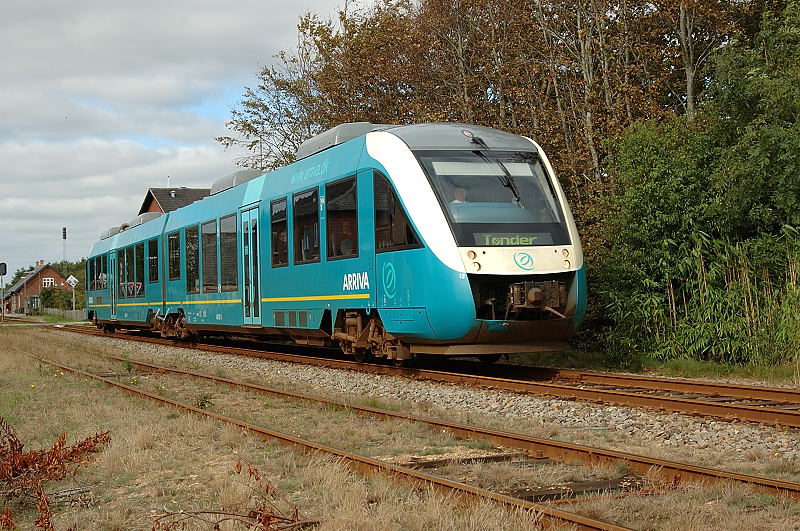
Those speed records are actually amazing if we consider the locomotives were powered by coal/steam. Today it feels already fast (in the front though) to drive 120 Km/h or 140 Km/h with modern diesel railcars or electric units like the ones I drive. But I guess it's due to their relatively low weight.

 en.wikipedia.org
 en.wikipedia.org
DBAG Class 422 - Wikipedia
Alstom Coradia LINT - Wikipedia
- Joined
- Feb 6, 2008
- Messages
- 38,938
- Reaction score
- 3,937
- Points
- 203
- Location
- Wolfsburg
- Preferred Pronouns
- Sire
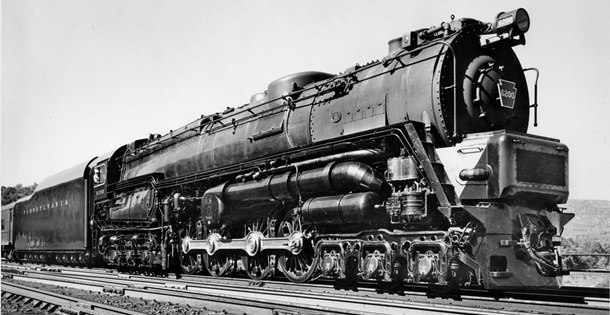
I know it is too much on topic for random comments... but I just found this great article about how Diesel engines changed the railway world, and I thought it might also be interesting for others here:
 www.saturdayeveningpost.com
Why You Don’t See Steam Locomotives Anymore | The Saturday Evening Post
For National Train Day, we recall the moment when coal gave way to diesel power.
www.saturdayeveningpost.com
Lizard spaceship: https://www.artstation.com/artwork/g0JYRE

We got docking support and terrain elevation - this thing was obviously made for Orbiter.
We got docking support and terrain elevation - this thing was obviously made for Orbiter.

Usually lizards can drop their tails, not their necks, though... 

steph
Well-known member
Can't copy the original text for some reaaon, and the person quoting it didn't link to the original, but I just took a screenshot of the original translated text. I'm still not 100% sure it is all this, as there's La Nina too, and stuff like the drought we'ee witnessing in France has been happening since before 2020, but this may be worsening it.
And, unfortunately, that northern shift is real. There was a sort of 'invisible' line, situated around La Rochelle or that bay nearby, that divided climates and the way storm systems moved etc. That line has moved north over the years, and is now probably more like around the Loire estuary or even Brittany
edit: Not to mention warmer ocean would mean more storms, but it doesn't really seem to be the case
Edit 2: well, Google Lens has a function to copy text from images . This is cool. I'll just quote


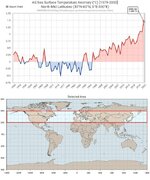

And, unfortunately, that northern shift is real. There was a sort of 'invisible' line, situated around La Rochelle or that bay nearby, that divided climates and the way storm systems moved etc. That line has moved north over the years, and is now probably more like around the Loire estuary or even Brittany
edit: Not to mention warmer ocean would mean more storms, but it doesn't really seem to be the case
Edit 2: well, Google Lens has a function to copy text from images . This is cool. I'll just quote
For a long time thought that one of the reasons why we easily get almost unmoved warm weather is mainly the shift of Haddley circulation northward - subtropical heights are anomaly stretched across the western Mediterranean and the Iberian Peninsula and towards us, etc. But there is something else too. A new regulation came into force in 2020, reducing the limit of sulfur oxide in shipping from 3.5% to 0.5%. This shock change has caused that in places of frequented shipping 30-60N the ocean has to absorb more solar radiation than before this change and so the oceans and regions 30-60N warm perhaps the most. SO2 in the atmosphere is like a volcanic eruption in the role of reflecting the incoming solar radiation. You take SO2 from the atmosphere and the heat absorbs the ocean. So the dilemma, what's better to have a smaller environmental burden, an anomaly rapidly warming atmosphere, or to regulate SO2 less and not experience such a shock therapy?
What is to blame for a very rapid temperature increase in mid latitudes 30-60N since 2020? Well it appaers we can partially blame the new shipping regulation in 2020 reducing max S02 emisions from 3.5 to 0.5 pct. S02 absorbs solar radiation and if taken out from the atmosphere its up to oceans to store all this excessive heat.
Last edited:

- Joined
- Nov 20, 2007
- Messages
- 11,969
- Reaction score
- 768
- Points
- 188
UK in chaos after a day of several inches of snow.
steph
Well-known member
UK in chaos after a day of several inches of snow.
And freezing rain coming in some parts. ALthough, if there is snow cover, that might lessen the impact. Or maybe not. A friend in the UK kept mocking the hysteria this morning, because the layer was thin at his place. He now complains about having to shovel
 .
.I don't know for the northern parts, but I'd assume that for the areas not used to snow, it's like around here. Most people have summer tires, lack experience driving in the snow, so plenty of cars end up in the ditch, crashes happen etc. But I'm not sure if it will disrupt train travel etc.
The thing I don't get about the UK is how there can be people "not used to snow". Doesn't the whole country see some snow each year?I don't know for the northern parts, but I'd assume that for the areas not used to snow, it's like around here.

Evil_Onyx
Well-known member
- Joined
- Jun 27, 2008
- Messages
- 1,045
- Reaction score
- 61
- Points
- 63
It maybe snows once a year, and most people take the day off as an excuse/look after children who's school is closed. Those of us that drive for a living just expect large amounts of idiots on the roads. I spent yesterday sliding around in a tug.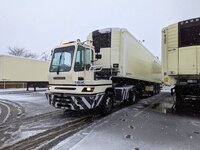
- Joined
- Nov 20, 2007
- Messages
- 11,969
- Reaction score
- 768
- Points
- 188
For Steph and Jedidia above.
UK "snow memory" is very poor, and we don't get enough heavy snow to make it economically viable to keep transport routes open.
Being a small island, its debatable which part is cut-off from the other, so nobody bothers.
The media doesn't help either, sending reporters to the most cut-off places and not wearing proper headgear. Must be a macho thing.
UK "snow memory" is very poor, and we don't get enough heavy snow to make it economically viable to keep transport routes open.
Being a small island, its debatable which part is cut-off from the other, so nobody bothers.
The media doesn't help either, sending reporters to the most cut-off places and not wearing proper headgear. Must be a macho thing.
Linguofreak
Well-known member
I just had a horrible, awful idea:
The advantage of little-endian byte order is that the same value in memory can be read at any width without changing the address: 0xff000000 is 255 whether you read it at byte width, 16-bit width, or 32-bit width. But you can actually make this work for big-endian too! If, instead of having an address refer to a location in memory, you have it refer to a boundary between locations, and write big and little endian values on opposite sides of the boundary, big endian values gain the same width-agnostic property as little-endian values. Of course, this is likely to be a pain to implement in hardware, and to breed a locust-swarm of off-by-one bugs of apocalyptic proportions, so there are reasons not to do it...
The advantage of little-endian byte order is that the same value in memory can be read at any width without changing the address: 0xff000000 is 255 whether you read it at byte width, 16-bit width, or 32-bit width. But you can actually make this work for big-endian too! If, instead of having an address refer to a location in memory, you have it refer to a boundary between locations, and write big and little endian values on opposite sides of the boundary, big endian values gain the same width-agnostic property as little-endian values. Of course, this is likely to be a pain to implement in hardware, and to breed a locust-swarm of off-by-one bugs of apocalyptic proportions, so there are reasons not to do it...
As somebody always on the lookout for good scifi webcomics, I was pretty shocked when I discovered Runners, because I never heard of it and it's excellent:

It actually started back in the early 2000's as an actual comic book, so the art is way up there. Thematically it's a very star wars-ish firefly space opera kinda thing (all complete with a girl with no memory and mysterious powers that started out as payload, though it looks like the original comic issue may actually have predated firefly).
It's a slow burn with periods of haitus (one of them we seem to be in since this january, unfortunately), but the individual volumes (of which there are 2 complete ones and one halfway through) are very self-contained and don't rely much on a strong overarching plot to drive them.
If you like comic books and space opera, it's absolutely worth the read (won't take you more than a couple hours to read through what's there either).
Vol 1 Bad Goods – Ch 1 – Cover – runnersuniverse.com
runnersuniverse.com
It actually started back in the early 2000's as an actual comic book, so the art is way up there. Thematically it's a very star wars-ish firefly space opera kinda thing (all complete with a girl with no memory and mysterious powers that started out as payload, though it looks like the original comic issue may actually have predated firefly).
It's a slow burn with periods of haitus (one of them we seem to be in since this january, unfortunately), but the individual volumes (of which there are 2 complete ones and one halfway through) are very self-contained and don't rely much on a strong overarching plot to drive them.
If you like comic books and space opera, it's absolutely worth the read (won't take you more than a couple hours to read through what's there either).


TheShuttleExperience
Well-known member
It's just awesome to have a look at METAR, TAF and GAFOR data in order to perform realistic VFR/IFR flights in MSFS using real charts for navigation and live weather in MSFS. And then have a random look outside the window at home just out of curiosity, to realize that the sky looks almost exactly the same as it does in MSFS (departure airport just being a few miles away from home). While the new flight model/turbulences just completes the almost perfect illusion of flying (not to mention my "Buttkicker" I just got a few days ago).
Who knows what the future of virtual flying might look like. But one can only expect more awesome stuff to come...

Who knows what the future of virtual flying might look like. But one can only expect more awesome stuff to come...
- Joined
- Feb 6, 2008
- Messages
- 38,938
- Reaction score
- 3,937
- Points
- 203
- Location
- Wolfsburg
- Preferred Pronouns
- Sire
It's just awesome to have a look at METAR, TAF and GAFOR data in order to perform realistic VFR/IFR flights in MSFS using real charts for navigation and live weather in MSFS. And then have a random look outside the window at home just out of curiosity, to realize that the sky looks almost exactly the same as it does in MSFS (departure airport just being a few miles away from home). While the new flight model/turbulences just completes the almost perfect illusion of flying (not to mention my "Buttkicker" I just got a few days ago).
Who knows what the future of virtual flying might look like. But one can only expect more awesome stuff to come...
Sadly, this doesn't work well on sailing Sims, too many discontinuities, instead of a smooth transition from extrapolation to current weather.
TheShuttleExperience
Well-known member
You mean sailing with boats?Sadly, this doesn't work well on sailing Sims, too many discontinuities, instead of a smooth transition from extrapolation to current weather.
- Joined
- Feb 6, 2008
- Messages
- 38,938
- Reaction score
- 3,937
- Points
- 203
- Location
- Wolfsburg
- Preferred Pronouns
- Sire
You mean sailing with boats?
The solar wind sailing sim is here.
Similar threads

- Replies
- 7
- Views
- 4K


- Replies
- 34
- Views
- 9K
