Nuclear propulsion advocates

The title of this thread is about "propulsion", so keeping my opinion narrowly focused on that subject, I would say that nuclear power is your only realistic option for aggressive space exploration. It's expensive due to development and safety costs, and there are limitations, of course, but for space travel it's all we've got.

Fusion has always been, and so far still is, a pipe dream at this point. Until somebody figures out how to make it work outside of a bomb no realistic planning or design work can be done.
 
Another point is, that if the energy suppliers would have to pay for insurances for the possible damage of landscapes, buildings and so on and if they have also to pay for the true storage coasts corectly, then they would neve make profit and other forms to produce energy would be much more cheaper. And if a disaster happents, they just register insolvency if they can't pay for the damage.

All this coasts must be payed by the taxpayer, know and for the next millons of years. For example, see what happent in Asse. Who has to pay for that?
 
Last edited:
The problem I see with thermal nuclear propulsion is that in its current state, it's almost useless.

The only thing we have ever tested is the NERVA, and the NERVA is not suited to the challenges we are facing. Sure, the thing has a very nice ISP, but considering its mass very low thrust.

Now, low thrust drives with high ISP are a feasible concept for long range missions, but the NERVA doesn't reach that ISP. Not by far. While it has significantly more thrust than a VASIMR, its ISP is too low to make it a feasible candidate for such missions.

All in all, we have chemical engines with the promise of being able to compete with the NERVA, by delivering a quarter of its ISP at a thrust orders of magnitude higher wile having only a fraction of the mass, that already don't get developed because the funding is lacking (I'm thinking of the J-2 specifically) that, thanks to more dense propellant that is much easier to store, are a much better candidate for any mission the NERVA might be suited for.

Anything else thermal nuclear propulsion promises would require a staggering ammount of R&D, the costs of which would be astronomical due to it all being nuclear, which drives costs of experiments and facilities through the roof.

The only thing I could currently see any use for nuclear power in space is thermal electric: The ammount of R&D is still somewhat high, but at least we have a working prototype of a VASIMR, and it can be tested and refined without actually attaching a nuclear reactor to it (well, not directly, anyways). The nuclear part of the whole thing would consist of a simple fission reactor stripped down to its bare bones and built of lightweight materials, which has never been built but at least is not a whole new concept of nuclear reactor (as, say, a liquid or God forbid a Gas-core NTR).

The problem with this, of course, is that we don't have a mission for it. While the VASIMR vastly outperforms Ion-drives, it scales down about as badly as an Ion drive scales up. I.E. the VASIMR would be a good solution if we ever intend to send anything really heavy (like, say, a manned mission) to somewhere that isn't the Moon, but even for a Mars mission we might achieve similar results with brute force application of proven concepts that are easier to expand (again thinking of next-gen chemical engines). A VASIMR only really shines at larger distances (as if earth-mars was a short distance). But if we just want to send a few hundred kilograms, Ion with an ejection kick by a booster stage is simply the far better solution.

Anyways, my two cents on nuclear thermal propulsion...
 
Last edited:
I've read statements by these people, saying that environmentalist fears about nuclear propulsion are exaggerated, and talking about how "we need to get over our fear of the 'n-word'" and use nuclear thermal rockets, or even nuclear bombs (i.e. Project Orion).

One thing you need to remember that fresh nuclear fuel is not (very) radioactive. Uranium isotopopes are quite stable. What makes fallout from a power plant (i.e. Chernobyl) nasty are middle-lived isotopes which are produced during reactor operation.

In case of a NERVA-like engine, it would be used as an upper stage on a chemical rocket. If the rocket blows up on launch, the launch site would probably require decontamination (more because uranium dust is chemically toxic, as Iraqis can attest, than due to radiation hazard), but there would be no large scale disaster. If the upper stage fails to ignite during ascent, and it crashes into the ocean, there is even less problem. (Except for the fear that a terrorist organization recovers the stage to obtain large quantities of HEU).

A Chernobyl-level incident would however happen if a spent NTR core were to re-enter Earth's atmosphere. (An upside is that it would break up high in the atmosphere, so the fallout would be distributed over a very large area.(*)) This is why NTR-based missions designs must account for disposing the spent nuclear stage into a solar orbit which does not encounter Earth. This usually means perhihelion at 1.1AU or higher. (Alternative concepts include crashing the NTR on Moon or Mars).

Still, this danger cannot be completely eliminated, because you can imagine a situation where the NTR ignites for parking orbit insertion, but fails to ignite for trans-Mars injection. To mitigate this, NTR-based mission designs assume initial orbit attitude of 500km (instead of 200km) to increase orbital lifetime. Still, to be completely fault-proof, you'd need to have a mission design which takes the NTR stage from suborbital path to target not-Earth-encountering orbit in one burn.

I've actually used this concept as a plot device in a sci-fi story I was working on some time ago. I had an NTR-powered mission to Jupiter, which would use Jupiter's gravity to slingshot into disposal orbit if the NTR failed to ignite for orbital insertion at Jupiter... The mission was manned (or, to be precise, womanned).

ETA: (*) This claim may not be true. I remember that when Columbia broke up, some engine parts weighting hundreds of kilos rained down -- as the NTR core is quite dense, it is probable that large parts of it would survive break-up.

---------- Post added at 07:45 PM ---------- Previous post was at 07:18 PM ----------

The only thing we have ever tested is the NERVA, and the NERVA is not suited to the challenges we are facing. Sure, the thing has a very nice ISP, but considering its mass very low thrust.

However, Stan Borowski has solved the Isp/TWR dillemma quite nicely with LANTR.

Anything else thermal nuclear propulsion promises would require a staggering ammount of R&D, the costs of which would be astronomical due to it all being nuclear, which drives costs of experiments and facilities through the roof.

If I remember correctly from Borowski's papers, his engine ended up being quite underpowered, because a larger engine would be illegal to ignite on a test stand (but not infeasible). The problem, I think, has to do with core erosion (parts of core flying out of the engine, basically).

The only thing I could currently see any use for nuclear power in space is thermal electric: The ammount of R&D is still somewhat high, but at least we have a working prototype of a VASIMR, and it can be tested and refined without actually attaching a nuclear reactor to it (well, not directly, anyways). The nuclear part of the whole thing would consist of a simple fission reactor stripped down to its bare bones and built of lightweight materials, which has never been built but at least is not a whole new concept of nuclear reactor (as, say, a liquid or God forbid a Gas-core NTR).

That's some heavy handwaving.

Yes, VASIMR has high TWR -- without the powerplant. If you include the power plant, the TWR drops dramatically. If I remember correctly, achieving a reasonable TWR with VASIMR would require a nuclear rector with a W/kg ratio some two orders of magnitude above what was tested (I'm too lazy to search the numbers right now). So given the amount of R&D required for VASIMR power plant, you could as well resurrect NERVA or start working on liquid- and gas-core NTRs. And, VASIMR advocates still haven't answered how they expect VASIMR to work in vacuum without violating Maxwell's laws...

 
Last edited:
Yes, VASIMR has high TWR -- without the powerplant.

A VASIMR has a godawful TWR any way you turn it. But it has so strong ISP that it doesn't really matter... for long distances. Earth-Mars might just work out, but Earth-Asteroid Belt would be a really nice distance.

And, VASIMR advocates still haven't answered how they expect VASIMR to work in vacuum without violating Maxwell's laws...

Huh? that one must have passed me by. What exactly would be the problem in a Vacuum?
 
And, VASIMR advocates still haven't answered how they expect VASIMR to work in vacuum without violating Maxwell's laws...

Are we talking about the same VASIMR? The one that has been tested already in a vacuum chamber?

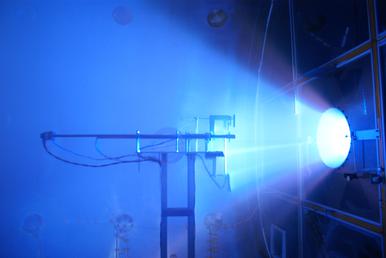
VX-200_operation_full_power.jpg
 
It has no problem working in a vacuum chamber. There are significant doubts if it will work in space. Here's why:

magfield2.gif


These magnetic field lines on the right side must loop over to the left side, and charged particles move along the magnetic field lines. So exhaust must, ultimately, come around and hit the front of the spacecraft!

Unless they can make the exhaust charge-neutral, or they have invented a magnetic monopole.

The effect does not manifest itself in a chamber, because the exhaust just hits the chamber wall.

---------- Post added at 10:08 PM ---------- Previous post was at 10:02 PM ----------

A VASIMR has a godawful TWR any way you turn it.

You realize that VASIMR was touted as enabling "39 days to Mars", which implies a quite high TWR?
 
These magnetic field lines on the right side must loop over to the left side, and charged particles move along the magnetic field lines. So exhaust must, ultimately, come around and hit the front of the spacecraft!

Ever considered that inertia is involved?

---------- Post added at 11:16 PM ---------- Previous post was at 11:15 PM ----------

You realize that VASIMR was touted as enabling "39 days to Mars", which implies a quite high TWR?

You are wrong. 39 days to mars don't require high TWR, only a very high DV.
 

The magnetic field strength drops rapidly by increasing distance from the nozzle. If the speed of the particle is high enough, even the remaining charged particles after neutralizing the plasma again are unable to return, since the point where they would be travelling perpendicular to the thruster axis in a theoretical infinite vacuum without gravity or other magnetic fields, would be at infinite distance to the thruster.

Who abolished a=F/m?

Kepler. Before Newton defined a=F/m.
 
Who abolished a=F/m?

Noone. Noone abolished v = a*t, either. And because of its high ISP, the t component of a VASIMR burn is insane, which more than makes up for a only being 0.01 G or so (depending on your payload, of course).

That's why it sucks at short distances. As I said, Mars works, but you could (probably) compete with next-gen chemical engines with denser propellant, because of the much lower mass that can be used for propellant instead.
 
Theoretically, there can be a [ame="http://en.wikipedia.org/wiki/Nuclear_lightbulb"]closed-cycle nuclear rocket engine[/ame] that "does not involve the release of any radioactive material from the rocket". Which would be great for surface-to-orbit transport.

But:
Atomic Rockets said:
Having said all this, it is important to keep in mind that a closed-cycle gas-core nuclear thermal rocket is a hideously difficult engineering feat, and we are nowhere near possessing the abilty to make one. An open-cycle gas-core rocket is much easier, but there is no way it would be allowed as a surface to orbit vehicle. Spray charges of fissioning radioactive plutonium death out the exhaust nozzle at fifty kilometers per second? That's not a lift off rocket, that's a weapon of mass destruction.
 
One thing you need to remember that fresh nuclear fuel is not (very) radioactive. Uranium isotopopes are quite stable. What makes fallout from a power plant (i.e. Chernobyl) nasty are middle-lived isotopes which are produced during reactor operation.
In case of a NERVA-like engine, it would be used as an upper stage on a chemical rocket. If the rocket blows up on launch, the launch site would probably require decontamination (more because uranium dust is chemically toxic, as Iraqis can attest, than due to radiation hazard), but there would be no large scale disaster. If the upper stage fails to ignite during ascent, and it crashes into the ocean, there is even less problem. (Except for the fear that a terrorist organization recovers the stage to obtain large quantities of HEU).
A Chernobyl-level incident would however happen if a spent NTR core were to re-enter Earth's atmosphere. (An upside is that it would break up high in the atmosphere, so the fallout would be distributed over a very large area.(*)) This is why NTR-based missions designs must account for disposing the spent nuclear stage into a solar orbit which does not encounter Earth. This usually means perhihelion at 1.1AU or higher. (Alternative concepts include crashing the NTR on Moon or Mars).
Still, this danger cannot be completely eliminated, because you can imagine a situation where the NTR ignites for parking orbit insertion, but fails to ignite for trans-Mars injection. To mitigate this, NTR-based mission designs assume initial orbit attitude of 500km (instead of 200km) to increase orbital lifetime. Still, to be completely fault-proof, you'd need to have a mission design which takes the NTR stage from suborbital path to target not-Earth-encountering orbit in one burn.
I've actually used this concept as a plot device in a sci-fi story I was working on some time ago. I had an NTR-powered mission to Jupiter, which would use Jupiter's gravity to slingshot into disposal orbit if the NTR failed to ignite for orbital insertion at Jupiter... The mission was manned (or, to be precise, womanned).
ETA: (*) This claim may not be true. I remember that when Columbia broke up, some engine parts weighting hundreds of kilos rained down -- as the NTR core is quite dense, it is probable that large parts of it would survive break-up.
---------- Post added at 07:45 PM ---------- Previous post was at 07:18 PM ----------

However, Stan Borowski has solved the Isp/TWR dillemma quite nicely with LANTR.
If I remember correctly from Borowski's papers, his engine ended up being quite underpowered, because a larger engine would be illegal to ignite on a test stand (but not infeasible). The problem, I think, has to do with core erosion (parts of core flying out of the engine, basically).
That's some heavy handwaving.
Yes, VASIMR has high TWR -- without the powerplant. If you include the power plant, the TWR drops dramatically. If I remember correctly, achieving a reasonable TWR with VASIMR would require a nuclear rector with a W/kg ratio some two orders of magnitude above what was tested (I'm too lazy to search the numbers right now). So given the amount of R&D required for VASIMR power plant, you could as well resurrect NERVA or start working on liquid- and gas-core NTRs. And, VASIMR advocates still haven't answered how they expect VASIMR to work in vacuum without violating Maxwell's laws...

Yes, that is the TWR argument Robert Zubrin made about VASIMR:

VASIMR Hoax
By Robert Zubrin | Jul. 13, 2011
http://www.spacenews.com/article/vasimr-hoax

Also, if we have a manned base on the Moon, then since the Moon contains uranium we could mine it there and launch from there.

Bob Clark
 
Last edited:
Yes, that is the TWR argument Robert Zubrin made about VASIMR:

VASIMR Hoax
By Robert Zubrin | Jul. 13, 2011
http://nextbigfuture.com/2011/12/tiny-solar-cell-could-make-big.html

Also, if we have a manned base on the Moon, then since the Moon contains uranium we could mine it there and launch from there.

Bob Clark

There is still just one more thing... do you know, where the 200 MW reactor of the 39 day VASIMR reference mission comes from? ;) It is not like Chang-Diaz took the numbers and performance data out of the thin air.

Its NASA. You can actually read how NASA arrived at this data and why they expect reactors to have such power densities. That such reactors are still impossible is not the problem.

That it doesn't compare to the Topaz satellite reactor is no surprise, because both are completely different technologies. The high-power NASA reactors are all based on the more effective Brayton cycle - which also Zubrin uses in his publications, BTW, since it is reference for all NASA studies since at least the early 1980s.

TL;DR: Zubrin is relying on smoke and mirrors there as well in his criticism, by not telling the whole story and sparing himself from his own criticism.
 
There is still just one more thing... do you know, where the 200 MW reactor of the 39 day VASIMR reference mission comes from? ;) It is not like Chang-Diaz took the numbers and performance data out of the thin air.
Its NASA. You can actually read how NASA arrived at this data and why they expect reactors to have such power densities. That such reactors are still impossible is not the problem.
That it doesn't compare to the Topaz satellite reactor is no surprise, because both are completely different technologies. The high-power NASA reactors are all based on the more effective Brayton cycle - which also Zubrin uses in his publications, BTW, since it is reference for all NASA studies since at least the early 1980s.
TL;DR: Zubrin is relying on smoke and mirrors there as well in his criticism, by not telling the whole story and sparing himself from his own criticism.

Zubrin has used nuclear reactors for nuclear thermal propulsion and for power supplies on Mars. However, for nuclear thermal engines or for stationary power stations the weight requirements are not so critical as it is for VASIMR where the thrust levels are so comparatively small compared to chemical or nuclear thermal propulsion.
A 100-fold improvement in weight for the nuclear power supply is not a trivial task over what has been done before. It would be like reducing the weight of a car engine from 500 lbs to 5 lbs and at the same power level just by changing the thermodynamic cycle used.


Bob Clark
 
It would be like reducing the weight of a car engine from 500 lbs to 5 lbs and at the same power level just by changing the thermodynamic cycle used.

We already managed a 100 fold improvement in power per weight in car engines without even changing the thermodynamic cycle. Ever heard of downsizing? We already build tiny three piston engines, that have more power than a 12 piston engine of 1930.
 
NERVA - The Tech Behind It..


The simplistic nature of this propulsion just seems downright sexy. Launch via conventional chemical rocket, ignite nuclear to leave earths gravity at a predetermined distance.

If I understood this correctly, its running liquid hydrogen through a reactor and the specific impulse is around double what we are doing now. Is the exhaust gases radioactive? This was developed during the "Nuclear-Cowboy" era which leads me to think there was some fatal flaw in regards to pollution. If not, then why would anyone not use this? But hopefully someone can set me right. Polluting space with radioactive material is... Well, we cant make a dent in anything that nature has already done out there. But if you ignited in space, I cant imagine it hurting much if anything considering what the sun spews out every waking second.

The other thread it looks like it got into the politics of No-nukes vs the Pro-Nukes. I dont want to rehash that aspect, but talk about the tech itself. Thanks. :)


EDIT: Love me some Oldschool NASA docs!
 
Last edited by a moderator:
Is the exhaust gases radioactive?

The exhaust gas should be pure hydrogen, which is not radioactive.

But because the gas passes through the reactor core and comes into direct contact with the fuel elements, it tends to erode the fuel a little bit, tearing out tiny bits of fuel and other transmuted radioactive materials and carrying it out the tail pipe.

It's not alot, but every time you fire up the thing it's a little bit more, and that is enough to cause concern.

If you use it only in (deep, not LEO) space, that eliminates the environmental problem, but you still have to test it and then launch it, which is a political problem because of the consequences of a launch failure.

There are also technical problems; to get higher Isp you need higher heat, so you are limited by the melting temperature of the core. Theoretically you can get over 1000s, but I don't know if NERVA ever achieved that in testing. The reactor core has to be able to handle the eroding effects mentioned above. Also, you have to be careful to shield not only the crew and electronics, but also any nearby people or vehicles you may be docking with or flying near.
 
Back
Top