I've read statements by these people, saying that environmentalist fears about nuclear propulsion are exaggerated, and talking about how "we need to get over our fear of the 'n-word'" and use nuclear thermal rockets, or even nuclear bombs (i.e. Project Orion).
One thing you need to remember that fresh nuclear fuel is not (very) radioactive. Uranium isotopopes are quite stable. What makes fallout from a power plant (i.e. Chernobyl) nasty are middle-lived isotopes which are produced during reactor operation.
In case of a NERVA-like engine, it would be used as an upper stage on a chemical rocket. If the rocket blows up on launch, the launch site would probably require decontamination (more because uranium dust is chemically toxic, as Iraqis can attest, than due to radiation hazard), but there would be no large scale disaster. If the upper stage fails to ignite during ascent, and it crashes into the ocean, there is even less problem. (Except for the fear that a terrorist organization recovers the stage to obtain large quantities of HEU).
A Chernobyl-level incident would however happen if a spent NTR core were to re-enter Earth's atmosphere. (An upside is that it would break up high in the atmosphere, so the fallout would be distributed over a very large area.(*)) This is why NTR-based missions designs must account for disposing the spent nuclear stage into a solar orbit which does not encounter Earth. This usually means perhihelion at 1.1AU or higher. (Alternative concepts include crashing the NTR on Moon or Mars).
Still, this danger cannot be completely eliminated, because you can imagine a situation where the NTR ignites for parking orbit insertion, but fails to ignite for trans-Mars injection. To mitigate this, NTR-based mission designs assume initial orbit attitude of 500km (instead of 200km) to increase orbital lifetime. Still, to be completely fault-proof, you'd need to have a mission design which takes the NTR stage from suborbital path to target not-Earth-encountering orbit in one burn.
I've actually used this concept as a plot device in a sci-fi story I was working on some time ago. I had an NTR-powered mission to Jupiter, which would use Jupiter's gravity to slingshot into disposal orbit if the NTR failed to ignite for orbital insertion at Jupiter... The mission was manned (or, to be precise, womanned).
ETA: (*) This claim may not be true. I remember that when Columbia broke up, some engine parts weighting hundreds of kilos rained down -- as the NTR core is quite dense, it is probable that large parts of it would survive break-up.
---------- Post added at 07:45 PM ---------- Previous post was at 07:18 PM ----------
The only thing we have ever tested is the NERVA, and the NERVA is not suited to the challenges we are facing. Sure, the thing has a very nice ISP, but considering its mass very low thrust.
However, Stan Borowski has solved the Isp/TWR dillemma quite nicely with LANTR.
Anything else thermal nuclear propulsion promises would require a staggering ammount of R&D, the costs of which would be astronomical due to it all being nuclear, which drives costs of experiments and facilities through the roof.
If I remember correctly from Borowski's papers, his engine ended up being quite underpowered, because a larger engine would be
illegal to ignite on a test stand (but not infeasible). The problem, I think, has to do with core erosion (parts of core flying out of the engine, basically).
The only thing I could currently see any use for nuclear power in space is thermal electric: The ammount of R&D is still somewhat high, but at least we have a working prototype of a VASIMR, and it can be tested and refined without actually attaching a nuclear reactor to it (well, not directly, anyways). The nuclear part of the whole thing would consist of a simple fission reactor stripped down to its bare bones and built of lightweight materials, which has never been built but at least is not a whole new concept of nuclear reactor (as, say, a liquid or God forbid a Gas-core NTR).
That's some heavy handwaving.
Yes, VASIMR has high TWR --
without the powerplant. If you include the power plant, the TWR drops dramatically. If I remember correctly, achieving a reasonable TWR with VASIMR would require a nuclear rector with a W/kg ratio some two orders of magnitude above what was tested (I'm too lazy to search the numbers right now). So given the amount of R&D required for VASIMR power plant, you could as well resurrect NERVA or start working on liquid- and gas-core NTRs. And, VASIMR advocates still haven't answered how they expect VASIMR to work in vacuum without violating Maxwell's laws...



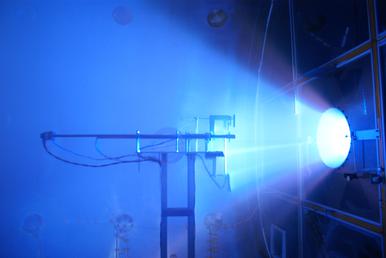


 It is not like Chang-Diaz took the numbers and performance data out of the thin air.


