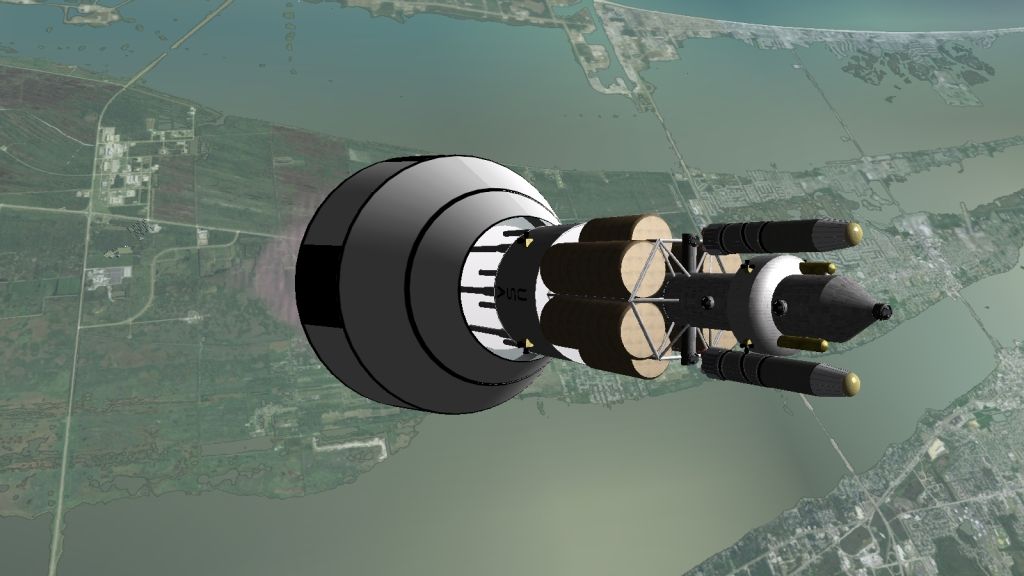
A daring rescue attempt for an old freighter, Cairo:

Just 16 days ago, a UN patrol craft rendezvoused with this vessel, which was carrying 10 passengers from Luna to Mars. A malfunction had occurred early on in the mission when the navigation and system control computer failed to end the blowdown cycle in the craft's thermonuclear engines on-time, resulting in a large quantity of the ship's propellant venting into space before the crew discovered and corrected the error, leaving them with far too little propellant for braking at Mars, and without enough food to last them much longer than the planned duration of their transit. After rendezvous, the passengers were immediately disembarked, and the fate of the vessel was debated over. After some discussion, it was decided to attempt to aerobrake it at Mars unmanned, in an effort to avoid wasting the functional vessel. A structure carrying this aeroshield was assembled over the engines by Cairo and Minerva (the military vessel which made rendezvous,) and the ship was nudged by the interceptor into a nominal braking trajectory before being abandoned to computer control. Minerva is now overcrowded, but the passengers and crew are glad to be safe aboard, and the company operating Cairo is just as pleased with the publicity of this high-profile rescue. Hopefully the attention won't turn sour in the next few hours as Cairo makes its mark on Mars' atmosphere. Colonists in the Argyre region are encouraged to watch the skies tonight for the plasma trail of what is already being called a 'modern-day Apollo 13.' It will pass within 25km of Mars' surface.
Just 16 days ago, a UN patrol craft rendezvoused with this vessel, which was carrying 10 passengers from Luna to Mars. A malfunction had occurred early on in the mission when the navigation and system control computer failed to end the blowdown cycle in the craft's thermonuclear engines on-time, resulting in a large quantity of the ship's propellant venting into space before the crew discovered and corrected the error, leaving them with far too little propellant for braking at Mars, and without enough food to last them much longer than the planned duration of their transit. After rendezvous, the passengers were immediately disembarked, and the fate of the vessel was debated over. After some discussion, it was decided to attempt to aerobrake it at Mars unmanned, in an effort to avoid wasting the functional vessel. A structure carrying this aeroshield was assembled over the engines by Cairo and Minerva (the military vessel which made rendezvous,) and the ship was nudged by the interceptor into a nominal braking trajectory before being abandoned to computer control. Minerva is now overcrowded, but the passengers and crew are glad to be safe aboard, and the company operating Cairo is just as pleased with the publicity of this high-profile rescue. Hopefully the attention won't turn sour in the next few hours as Cairo makes its mark on Mars' atmosphere. Colonists in the Argyre region are encouraged to watch the skies tonight for the plasma trail of what is already being called a 'modern-day Apollo 13.' It will pass within 25km of Mars' surface.
Last edited:







 ...
...