My thoughts about the presentation:
- I expected the integrated second stage + transfer vehicle to be a cylindrical lifting body (because it presents a larger surface area than a capsule shape during aerocapture into Mars's thin atmosphere).
- Need to improve cost for a trip to Mars by 5,000,000% (30:15). Compare that with
Kankoh-maru, another ambitious proposal that was a Japanese LEO tourism SSTO which was planned to bring prices down to $20,000 with a market of 1,000,000 passengers per year (a factor of 100,000% compared to the $20+ million one might pay to get into LEO today). (Might TSTO have made things more efficient?)
- Very large windows might be a structural weakness (or contribute a significant amount to dry mass)
- Vertical integration, with a crane, on the pad! What is a VAB even for, then? He also mentions the booster and spacecraft being constructed in the Gulf States (1:27:34), so there will be water transport. Also, absolute precision required for RTLS landing.
- If a "Mars Colonial Fleet" (44:03) needs to be gathered in LEO, ITS tankers acting as depots might be necessary in between the 2-year launch windows to Mars, so a crewed ITS can refuel soon after launching and the ECLSS can be prioritized for the transfer and not the loitering. (also note the reference to "Battlestar Galactica,"
which used to be used derisively for the expendable, expensive 90-Day Report architecture)
- The deployment of cargo such as rovers for water mining an issue. How big would those rovers need to be, anyway? The payload would be at the very top, as well (was expecting it to be below the tanks, like
this). A crane would be needed, but how does the crane get to the surface in the first place?
- 300 (reusable) to 550 (expendable) tonnes to LEO,
Sea Dragon-class! But how will acoustics be managed during launch?
(also, does 300 include the dry mass of BFS [150 t] itself?)
- I wish he would have gone into more detail about how the in-situ water extraction systems would work.
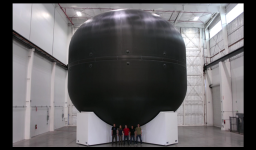
- Ship and booster testing is supposed to begin in 2018-2019, Mars flights in late 2022 (1:14:30). A huge technological leap from Red Dragon to Heart of Gold (name of the first MCT/ITS lander) in about 5 years. Not sure if they will meet this on time, but it'll be very impressive if they do. At least they already have 12 meter tanks, so there's that.
- "Planet-hopping" with ISRU facilities everywhere (1:23:58) will be used to get to the outer planets (e.g. Mars to Jupiter). But what about all that radiation? Much worse than a Earth -> Mars trip.
- (1:48:34) When talking about interstellar travel, "very tricky" is an understatement. And so is "going from a Wright Flyer to a 747."
- Most of the Q&A was dumb but one thing that could be taken away was that Musk doesn't want SpaceX to be a monopoly on interplanetary transport; he wants to encourage others around the world to develop their own interplanetary vehicle architectures. (1:54:25)
Ultimately, I am both excited and skeptical.




 h:
h:


