
You are using an out of date browser. It may not display this or other websites correctly.
You should upgrade or use an alternative browser.
You should upgrade or use an alternative browser.
News Roscosmos News
- Thread starter SiberianTiger
- Start date

- Joined
- Oct 30, 2009
- Messages
- 14,018
- Reaction score
- 4
- Points
- 0
RIA Novosti: Russian Space Agency Faces Major Reform:
Universe Today: Rocket Failures May Spur Change In Russian Federal Space Agency: Report
NOVO-OGARYOVO, October 9 (RIA Novosti) – The Russian government is set to radically centralize its space industry in a bid to combat major inefficiencies and cut down on the misuse of funds under plans unveiled Wednesday by Deputy Prime Minister Dmitry Rogozin.
Speaking to President Vladimir Putin about the plans, Rogozin said a new state corporation will be created to take over manufacturing facilities from the Federal Space Agency, whose prestige has been severely dented in recent years by a string of failed rocket launches.
The proposed United Rocket and Space Corporation will enable the trimming away of redundant departments replicated elsewhere in the space industry, Rogozin told Putin.
A variety of manufacturing facilities in the rocket and space industry are currently bundled in 10 integrated structures and there are also a large number of independent organizations operating outside those structures that operate to their own plans, said Rogozin, who oversees the country’s defense sector.
The new corporation will introduce a unified technical policy and save financial resources by consolidating developers and manufacturers, he said.
Rogozin said that the space industry needs to diminish its reliance on imported components, especially in the production of satellites, and should focus on domestic production.
The plan would improve on the current state of affairs by effectively combining the civilian and defense capabilities, Rogozin said.
The proposed corporation will comprise all rocket and space-manufacturing facilities and design bureaus, except for a number of defense-related firms, Vedomosti business daily reported Wednesday.
Federal Space Agency chief Vladimir Popovkin told Vedomosti it would take about a year to create such a corporation.
Under the plan, the Federal Space Agency, or Roscosmos, will act as a federal executive body and contracting authority for programs to be implemented by the industry, Rogozin said.
He said Roscosmos' future functions remain to be ascertained and that its management will be boosted.
{...}
Universe Today: Rocket Failures May Spur Change In Russian Federal Space Agency: Report

and that its management will be boosted.
Good idea, attach 2 SRMs to the manager...

- Joined
- Feb 13, 2008
- Messages
- 5,398
- Reaction score
- 8
- Points
- 0
- Location
- Khimki
- Website
- tigerofsiberia.livejournal.com
http://en.ria.ru/russia/20131010/184053658/Russia-Appoints-New-Space-Chief.html
Russia Appoints New Space Chief
19:02 10/10/2013
Originally published at 17:33
MOSCOW, October 10 (RIA Novosti) – Former Deputy Defense Minister Oleg Ostapenko will head up Russia’s Federal Space Agency, Prime Minister Dmitry Medvedev said Thursday. The move comes as part of a major reshuffle of the country’s troubled space industry.
During a meeting with Ostapenko Thursday, Medvedev said he hoped that, as head of the Federal Space Agency Roscosmos, Ostapenko will help streamline the country’s space program, which has experienced numerous setbacks in recent years.
Earlier Thursday, Ostapenko, 56, was relieved of his duties as deputy defense minister and discharged from military service by President Vladimir Putin, in a move preceding his new appointment.
Ostapenko started his military career in the Soviet Strategic Missile Forces in 1979. He was promoted to commander of the Russian Space Forces in 2008, and led them until his November 2012 appointment as deputy defense minister.
Rumors of a looming shakeup at Roscosmos, following a series of embarrassing space launch failures, have been circulating in the Russian media since Monday.
However, no announcement has yet been made about the agency’s outgoing head Vladimir Popovkin.
Popovkin, who turned 56 in September, has headed Roscosmos since April 2011. In August, Prime Minister Dmitry Medvedev officially reprimanded Popovkin over his agency's performance.
Most of the setbacks in the space industry have been blamed on faulty hardware and poor management.
In the most recent mishap on July 2, a Proton-M rocket carrying three Glonass navigation satellites exploded shortly after it was launched from the Baikonur space center in Kazakhstan.
An Audit Chamber report in July slammed Roscosmos as ineffective and plagued by poor management and misuse of funds. It noted that over the period 2010 to 2012 the agency had only completed 47 percent of the satellite launches planned.
The chamber also blamed the space agency for relegating control over major projects to individual state-run or private companies.
The Russian government is set to radically overhaul the structure of its space industry in a bid to boost efficiency and cut down on the misuse of funds, under plans unveiled Wednesday by Deputy Prime Minister Dmitry Rogozin, who oversees the defense and aerospace sectors.
Speaking to President Vladimir Putin about the plans Wednesday, Rogozin said a new state corporation will be created to take over manufacturing facilities from Roscosmos, whose prestige has been severely dented in recent years by a string of failed rocket launches.
Russia Appoints New Space Chief
19:02 10/10/2013
Originally published at 17:33
MOSCOW, October 10 (RIA Novosti) – Former Deputy Defense Minister Oleg Ostapenko will head up Russia’s Federal Space Agency, Prime Minister Dmitry Medvedev said Thursday. The move comes as part of a major reshuffle of the country’s troubled space industry.
During a meeting with Ostapenko Thursday, Medvedev said he hoped that, as head of the Federal Space Agency Roscosmos, Ostapenko will help streamline the country’s space program, which has experienced numerous setbacks in recent years.
Earlier Thursday, Ostapenko, 56, was relieved of his duties as deputy defense minister and discharged from military service by President Vladimir Putin, in a move preceding his new appointment.
Ostapenko started his military career in the Soviet Strategic Missile Forces in 1979. He was promoted to commander of the Russian Space Forces in 2008, and led them until his November 2012 appointment as deputy defense minister.
Rumors of a looming shakeup at Roscosmos, following a series of embarrassing space launch failures, have been circulating in the Russian media since Monday.
However, no announcement has yet been made about the agency’s outgoing head Vladimir Popovkin.
Popovkin, who turned 56 in September, has headed Roscosmos since April 2011. In August, Prime Minister Dmitry Medvedev officially reprimanded Popovkin over his agency's performance.
Most of the setbacks in the space industry have been blamed on faulty hardware and poor management.
In the most recent mishap on July 2, a Proton-M rocket carrying three Glonass navigation satellites exploded shortly after it was launched from the Baikonur space center in Kazakhstan.
An Audit Chamber report in July slammed Roscosmos as ineffective and plagued by poor management and misuse of funds. It noted that over the period 2010 to 2012 the agency had only completed 47 percent of the satellite launches planned.
The chamber also blamed the space agency for relegating control over major projects to individual state-run or private companies.
The Russian government is set to radically overhaul the structure of its space industry in a bid to boost efficiency and cut down on the misuse of funds, under plans unveiled Wednesday by Deputy Prime Minister Dmitry Rogozin, who oversees the defense and aerospace sectors.
Speaking to President Vladimir Putin about the plans Wednesday, Rogozin said a new state corporation will be created to take over manufacturing facilities from Roscosmos, whose prestige has been severely dented in recent years by a string of failed rocket launches.
- Joined
- Oct 30, 2009
- Messages
- 14,018
- Reaction score
- 4
- Points
- 0
RussianSpaceWeb: Russia conducts course correction of its planetary program:
Russian space officials confirmed all but inevitable postponement of the nation's unmanned missions to explore the Moon.
A new schedule unveiled this week at the 4th Solar System Symposium in Moscow calls for the launch of the Luna-Glob lander to a polar region of the Moon in 2016, followed by the Luna-Glob orbiter, designed to circle the Moon, in 2018. The mission of the Luna-Resurs lander (aimed to land near the Moon's South Pole) was pushed back to 2019.
During the conference, Russian officials also confirmed a long expected withdrawal of the Indian space agency, ISRO, from the Luna-Resurs mission. A very small and largely symbolic Indian rover had been originally timed to hitch a ride to the Moon with the Luna-Resurs as early as 2013 or 2014 in an effort to match a similar Chinese mission, however, the plan collapsed after the failure of the Russian Phobos-Grunt mission in 2011 had led to years of delays in all subsequent Russian missions to the Moon and Mars.
Luna-Glob and Luna-Resurs landers will conduct in-situ experiments on the Moon, with the latter spacecraft drilling into the surface in search for lunar ice. The Luna-Resurs orbiter would conduct remote-sensing experiments from orbit.
Following the Lunar-Resurs mission, the Luna-Grunt spacecraft (a.k.a. Luna-28) was now projected to fly at the beginning of the 2020s with a goal of returning soil samples from the polar regions of the Moon back to Earth.
The new launch dates for all three missions slipped from six months to two years from those in the previous official schedule, which had been reported to be practically unachievable as early as April.
Even these postponed launch dates remain far from being guaranteed, because lunar missions alternate in the flight manifest with two joint Russian-European launches to Mars, which themselves face a considerable time pressure but have a much better chance of getting the priority in development due to their international nature. (Many aspects of the Russian planetary exploration program are developed and supported by the same institutions with a relatively small team of scientists and engineers, limiting parallel work on multiple projects.)
The failure to meet the nearest Mars launch deadline in 2016 would mean an automatic two-year domino effect of delays for the 2018 Mars mission, likely catapulting most of the Russian lunar exploration missions toward 2020s.
Only after accomplishing two landings on Mars and the return of soil from the Moon, could Russian space scientists make another attempt to return soil samples from the Martian moon Phobos, fulfilling the original goal of the disastrous Phobos-Grunt mission. The new mission to Phobos, currently dubbed Bumerang (Boomerang), is not expected to fly until 2022, at the earliest. In turn, a much more complex and long-sought attempt to return soil from Mars itself could proceed next. According to a very preliminary (and optimistic) schedule, the dual mission to bring rocks from the Red Planet could be launched by a pair of Proton rockets around 2024, but, given all the hurdles ahead, it could easily slip until the end of 2020s.
{...}

I have some very disturbing news about the Russian MLM module for the ISS. Originally officially planned for launch in April 2014, the module was already years late and rumors were already speaking of launch slipping to late next year when the situation turned from worse to disastrous - apparently during testing at RSC Energia the newly installed propulsion system of the module (which would propel itself to the ISS, provides additional roll control to the station and transport/store fuel for the station from Progress spacecrafts) was found to be defective and had to be completely overhauled (by Khrunichev). It appears that the launch could slip by up to 18 months - to late 2015! :facepalm:
(source: http://www.interfax.ru/world/news.asp?id=336233 / http://ria.ru/space/20131022/971916727.html)
The story of "the module that never launches" is reaching ridiculous territory.... :suicide:
(source: http://www.interfax.ru/world/news.asp?id=336233 / http://ria.ru/space/20131022/971916727.html)
The story of "the module that never launches" is reaching ridiculous territory.... :suicide:
I more and more think that the Shuttle retirement was the beginning of the end for the ISS...
You're confusing symptoms with causes.
The Shuttle retirement was nothing but an indicator of a re-orientation in the US space program. Towards private companies working on government contracts and actual NASA concentrating on BEO exploration.
Yes, the Shuttle retirement shows something. But it's not the cause.
In this case the delayed MLM is also just a symptom of the Russian Space Program lacking funding, quality and proper professional work.
@topic: I wonder what ESA thinks about having their "new" robotic arm lying around for years because the Russians can't get their stuff together. I think there would be a lot of interest in the agency but also in the industry to finally see that thing in action...
Russia Mulls Development of New Super-Heavy Carrier Rocket
Russia’s Federal Space Agency, Roscosmos, is to discuss with leading Russian scientists development of a new launch vehicle capable of carrying up payloads to 70 tons, its head said Friday.
“We will analyze and use all the existing potential…to choose the optimal solution [for the super-heavy rocket],” newly-appointed Roscosmos chief Oleg Ostapenko told reporters.
The results of the discussions will be used to outline the design and technical characteristics of the rocket, including its environmental safety.
The new rocket should be capable of delivering spacecraft to geotransitional (up to eight tons), geostationary (five tons) and low-Earth (at least 20 tons) orbits.
Russia’s Energia space corporation earlier proposed the development of a new launch vehicle based on the Soviet-era Energia rocket that was used in the late 1980’s as the launcher for the Buran space shuttle.
Two Energia launches were carried out - on May 15, 1987 with a mockup Buran model, and on November 15, 1988 with the actual Buran shuttle.
However, the Energia-Buran project was suspended in the 1990s. Five Energia rocket frames at various stages of construction were broken up at the Baikonur space center in Kazakhstan and at the Energia corporation assembly facilities.
The RD-170 rocket engine, developed for the Energia project, has been upgraded and is used in Russian-Ukrainian Zenit carrier rockets as the RD-171, and in American Atlas 5 launch systems as the RD-180.
According to some Russian space industry experts, an alternative solution could be the use of the Angara family of carrier rockets, designed by the Khrunichev center, as the basis for a future launch vehicle.
The Angara development program was launched in 1995, but has suffered a number of setbacks and delays since then.
Angara is intended mainly for launch from the Plesetsk space center in northern Russia and the future Vostochny spaceport in Russia’s Far East to reduce Moscow's dependence on Kazakhstan's Baikonur, the main launch facility for the current generation of Russian rockets.
MOSCOW, October 25 (RIA Novosti)
Photo Anataloy Zak; http://www.russianspaceweb.com/

Russia’s Federal Space Agency, Roscosmos, is to discuss with leading Russian scientists development of a new launch vehicle capable of carrying up payloads to 70 tons, its head said Friday.
“We will analyze and use all the existing potential…to choose the optimal solution [for the super-heavy rocket],” newly-appointed Roscosmos chief Oleg Ostapenko told reporters.
The results of the discussions will be used to outline the design and technical characteristics of the rocket, including its environmental safety.
The new rocket should be capable of delivering spacecraft to geotransitional (up to eight tons), geostationary (five tons) and low-Earth (at least 20 tons) orbits.
Russia’s Energia space corporation earlier proposed the development of a new launch vehicle based on the Soviet-era Energia rocket that was used in the late 1980’s as the launcher for the Buran space shuttle.
Two Energia launches were carried out - on May 15, 1987 with a mockup Buran model, and on November 15, 1988 with the actual Buran shuttle.
However, the Energia-Buran project was suspended in the 1990s. Five Energia rocket frames at various stages of construction were broken up at the Baikonur space center in Kazakhstan and at the Energia corporation assembly facilities.
The RD-170 rocket engine, developed for the Energia project, has been upgraded and is used in Russian-Ukrainian Zenit carrier rockets as the RD-171, and in American Atlas 5 launch systems as the RD-180.
According to some Russian space industry experts, an alternative solution could be the use of the Angara family of carrier rockets, designed by the Khrunichev center, as the basis for a future launch vehicle.
The Angara development program was launched in 1995, but has suffered a number of setbacks and delays since then.
Angara is intended mainly for launch from the Plesetsk space center in northern Russia and the future Vostochny spaceport in Russia’s Far East to reduce Moscow's dependence on Kazakhstan's Baikonur, the main launch facility for the current generation of Russian rockets.
MOSCOW, October 25 (RIA Novosti)
Photo Anataloy Zak; http://www.russianspaceweb.com/
Two Energia launches were carried out - on May 15, 1987 with a mockup Buran model, and on November 15, 1988 with the actual Buran shuttle.
Huge spy satellite platforms are Buran models now? Really? I mean it was built as a Mir module. It was shaped like a fuel tank. That's not really a Buran mockup.

PeterRoss
Our friendly neighborhood Putinist
Huge spy satellite platforms are Buran models now? Really? I mean it was built as a Mir module. It was shaped like a fuel tank. That's not really a Buran mockup.
Well, since it failed in its main role, it served as a Buran mockup at least - I mean as a mockup of Some Big Thing. :lol:
Energia revival for good ?
Russia starts ambitious super-heavy space rocket project
On the 25th anniversary of the historic flight of the Soviet space shuttle Buran, Russia's Roscosmos space agency has formed a working group to prepare "within weeks" a roadmap for the revival of the Energia super-heavy booster rocket.
The group led by Oleg Ostapenko, the new head of Roscosmos Federal Space Agency, is set to draw up proposals on the design of a super-heavy launch vehicle capable of delivering up to 100 tonnes of payload to the baseline orbit, former Soviet minister of general machine building, Oleg Baklanov, said on Friday.
"You have assumed the responsibility and dared to head the group, which is supposed to find an answer to the question how we can regain the position we demonstrated to the world with the launch of a 100-tonne spacecraft [Buran in 1988] within a few weeks," the ex-minister told Ostapenko at the event dedicated to the 25th anniversary of the flight of the Buran shuttle spacecraft.
The new carrier rocket Angara is set to become the base for the ambitious project that could bring Russia back to its heyday of space exploration. It could be launched from the Vostochny Cosmodrome which is now being constructed in Russia's Far East, and will replace Kazakhstan's Baikonur as Russia's main launchpad.
The 1988 launch of the Energia super-heavy rocket carrying the Buran space shuttle proved the rocket was capable of delivering 100 tonnes into orbit. That was five times more than the Proton-M rocket with a 20-tonne payload, thus making it the most powerful Soviet/Russian booster rocket ever developed.
As the International Space Station is scheduled to be taken out of service around 2020, ex-minister Baklanov explained that such a powerful rocket would allow the construction of a new orbital station "larger in its weight and dimensions." Also, a booster similar to the Soviet Energia would be indispensable for "exploring outer space in a wise manner, working in shifts on Mars, the Moon and so on," he added.
At the same media conference, president of the Energia Rocket and Space Corporation Vitaly Lopota announced that Russia will soon need super-heavy rockets to create a shield against possible future space weapons - which means deploying into orbit massive communications satellites and electronic warfare platforms.
'Nothing better has been created'
On the 25th anniversary of the Buran flight, Ostapenko acknowledged that the Soviet Union's achievements in space exploration remain an example for today's research.
"Human ingenuity created the Energia-Buran system 25 years ago," Ostapenko told the audience. "I am confident that events comparable by their scale are in store for us," he said.
In his speech, ex-minister Baklanov claimed that "nothing new has been designed" in the 25 years which have passed since the creation of the Energia-Buran system. He warned that "a point of no return is very close," and said there are only years left to recuperate the space industry to the previous level and keep the groundwork.
"We have a colossal amount of work to do," Ostapenko said, pointing out that only the experience of previous generations of scientists could ensure success.
"Our country has got huge potential; all we need to do is let the experienced professionals do their job the best way to ensure their self-actualization. I know we can do it. We've got strong support from the government, we've got thorough understanding of the tasks lying ahead," Ostapenko said.
Comparable to the US Space Shuttle, Buran completed only one unmanned spaceflight in 1988, as the Buran program was scrapped in 1993 following the collapse of the Soviet Union and lack of funding.
Soviet shuttle ahead of its time :
The Soviet Union's Energia/Buran exceeded the American space shuttle program by practically all capabilities, according to a report prepared by experts of the All-Russian Research Institute of Aviation Materials. The analysis is dedicated to the 25th anniversary of Buran's only performed launch into space.
Buran could stay in orbit for 30 days, while the American shuttle had a 15-day time limit. It could deliver into orbit 30 tonnes of cargo, compared to the US shuttle's 24 tonnes of cargo. It could carry a crew of 10 cosmonauts, while the American shuttle could carry seven astronauts. Preparation for the Energia/Buran launch at Baikonur Cosmodrome only took 15 days. However, it took one month of preparations before the US shuttle was launched from Cape Canaveral.
The Energia rocket booster could be used to launch various payloads into orbit, whereas the American shuttle's booster was one-task. A year and a half before the Buran launch, Energia was launched with a full-scale mock-up of the Skif-DM orbital combat laser platform weighing 77 tonnes, measuring 37 meters long, and over four meters in diameter. Though the mock-up failed to reach the desired orbit and fell into the Pacific, the Energia booster did its job fine, delivering the huge space platform into intermediate orbit, 110 kilometers above the earth's surface.
But the most important difference from the American model was that the Soviet spaceship could perform the flight and landing in totally automatic mode, which it brilliantly demonstrated on November 15, 1988.
Buran's American counterpart used to land with switched-off engines, meaning it could make only one landing attempt. The Soviet spacecraft could take several tries if needed.
When Buran approached Baikonur Cosmodrome and started landing in 1988, its sensors registered too strong side winds and the robotic system sent the huge machine for another rectangular traffic pattern approach, successfully landing the spacecraft on a second try.
The Buran shuttle was designed to perform 100 flights to space, while its engines were ready to do 66 flights without replacement. During its flight, it lost just eight of its unique thermal-insulation tiles out of 38,800.
The Energia/Buran program, which cost 16.5 billion Soviet rubles, lasted 18 years and united over 1,200 industrial sites throughout the Soviet Union.
Thirty-nine principally new materials and around 230 absolutely new technologies were developed during Buran's creation. Most of them are actively used in Russia's aeronautical and space industries today.
Source: Voice of Russia http://voiceofrussia.com/
Russia starts ambitious super-heavy space rocket project
On the 25th anniversary of the historic flight of the Soviet space shuttle Buran, Russia's Roscosmos space agency has formed a working group to prepare "within weeks" a roadmap for the revival of the Energia super-heavy booster rocket.
The group led by Oleg Ostapenko, the new head of Roscosmos Federal Space Agency, is set to draw up proposals on the design of a super-heavy launch vehicle capable of delivering up to 100 tonnes of payload to the baseline orbit, former Soviet minister of general machine building, Oleg Baklanov, said on Friday.
"You have assumed the responsibility and dared to head the group, which is supposed to find an answer to the question how we can regain the position we demonstrated to the world with the launch of a 100-tonne spacecraft [Buran in 1988] within a few weeks," the ex-minister told Ostapenko at the event dedicated to the 25th anniversary of the flight of the Buran shuttle spacecraft.
The new carrier rocket Angara is set to become the base for the ambitious project that could bring Russia back to its heyday of space exploration. It could be launched from the Vostochny Cosmodrome which is now being constructed in Russia's Far East, and will replace Kazakhstan's Baikonur as Russia's main launchpad.
The 1988 launch of the Energia super-heavy rocket carrying the Buran space shuttle proved the rocket was capable of delivering 100 tonnes into orbit. That was five times more than the Proton-M rocket with a 20-tonne payload, thus making it the most powerful Soviet/Russian booster rocket ever developed.
As the International Space Station is scheduled to be taken out of service around 2020, ex-minister Baklanov explained that such a powerful rocket would allow the construction of a new orbital station "larger in its weight and dimensions." Also, a booster similar to the Soviet Energia would be indispensable for "exploring outer space in a wise manner, working in shifts on Mars, the Moon and so on," he added.
At the same media conference, president of the Energia Rocket and Space Corporation Vitaly Lopota announced that Russia will soon need super-heavy rockets to create a shield against possible future space weapons - which means deploying into orbit massive communications satellites and electronic warfare platforms.
'Nothing better has been created'
On the 25th anniversary of the Buran flight, Ostapenko acknowledged that the Soviet Union's achievements in space exploration remain an example for today's research.
"Human ingenuity created the Energia-Buran system 25 years ago," Ostapenko told the audience. "I am confident that events comparable by their scale are in store for us," he said.
In his speech, ex-minister Baklanov claimed that "nothing new has been designed" in the 25 years which have passed since the creation of the Energia-Buran system. He warned that "a point of no return is very close," and said there are only years left to recuperate the space industry to the previous level and keep the groundwork.
"We have a colossal amount of work to do," Ostapenko said, pointing out that only the experience of previous generations of scientists could ensure success.
"Our country has got huge potential; all we need to do is let the experienced professionals do their job the best way to ensure their self-actualization. I know we can do it. We've got strong support from the government, we've got thorough understanding of the tasks lying ahead," Ostapenko said.
Comparable to the US Space Shuttle, Buran completed only one unmanned spaceflight in 1988, as the Buran program was scrapped in 1993 following the collapse of the Soviet Union and lack of funding.
Soviet shuttle ahead of its time :
The Soviet Union's Energia/Buran exceeded the American space shuttle program by practically all capabilities, according to a report prepared by experts of the All-Russian Research Institute of Aviation Materials. The analysis is dedicated to the 25th anniversary of Buran's only performed launch into space.
Buran could stay in orbit for 30 days, while the American shuttle had a 15-day time limit. It could deliver into orbit 30 tonnes of cargo, compared to the US shuttle's 24 tonnes of cargo. It could carry a crew of 10 cosmonauts, while the American shuttle could carry seven astronauts. Preparation for the Energia/Buran launch at Baikonur Cosmodrome only took 15 days. However, it took one month of preparations before the US shuttle was launched from Cape Canaveral.
The Energia rocket booster could be used to launch various payloads into orbit, whereas the American shuttle's booster was one-task. A year and a half before the Buran launch, Energia was launched with a full-scale mock-up of the Skif-DM orbital combat laser platform weighing 77 tonnes, measuring 37 meters long, and over four meters in diameter. Though the mock-up failed to reach the desired orbit and fell into the Pacific, the Energia booster did its job fine, delivering the huge space platform into intermediate orbit, 110 kilometers above the earth's surface.
But the most important difference from the American model was that the Soviet spaceship could perform the flight and landing in totally automatic mode, which it brilliantly demonstrated on November 15, 1988.
Buran's American counterpart used to land with switched-off engines, meaning it could make only one landing attempt. The Soviet spacecraft could take several tries if needed.
When Buran approached Baikonur Cosmodrome and started landing in 1988, its sensors registered too strong side winds and the robotic system sent the huge machine for another rectangular traffic pattern approach, successfully landing the spacecraft on a second try.
The Buran shuttle was designed to perform 100 flights to space, while its engines were ready to do 66 flights without replacement. During its flight, it lost just eight of its unique thermal-insulation tiles out of 38,800.
The Energia/Buran program, which cost 16.5 billion Soviet rubles, lasted 18 years and united over 1,200 industrial sites throughout the Soviet Union.
Thirty-nine principally new materials and around 230 absolutely new technologies were developed during Buran's creation. Most of them are actively used in Russia's aeronautical and space industries today.
Source: Voice of Russia http://voiceofrussia.com/
- Joined
- Oct 30, 2009
- Messages
- 14,018
- Reaction score
- 4
- Points
- 0
Space Daily: Russia's Space Program Lacks Private Investment
Beware, Roscosmos is discovering PRs ! 
Still, I was hoping some Energia-inspired heavy lifter or even Angara, "preparing the future" with the R-7 only is a bit short :hmm:
BTW, I love the music and the "old school" jet training with full analog panel
---------- Post added 11-28-13 at 04:54 PM ---------- Previous post was 11-27-13 at 10:29 PM ----------
And that's not over ! Fear SAR-401 ! That tough guy is probably going to confront Robonaut at the ISS ! I want to see a robotical-wrestling-match in 0g, that would be fun !! :lol:
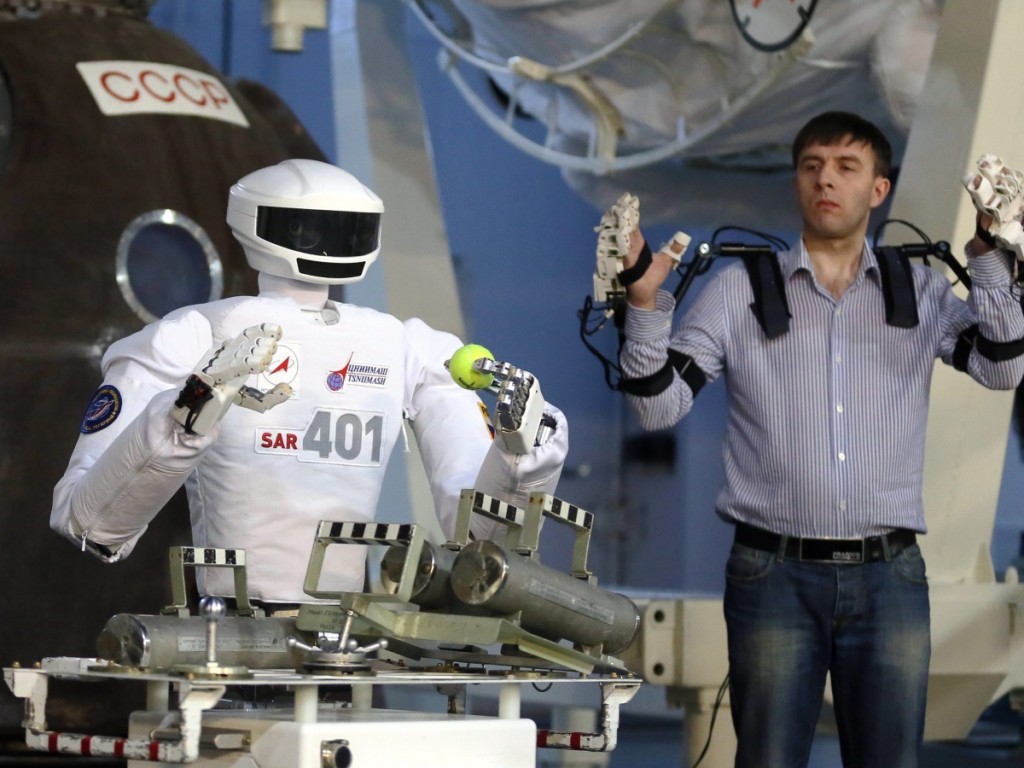
Still, I was hoping some Energia-inspired heavy lifter or even Angara, "preparing the future" with the R-7 only is a bit short :hmm:
BTW, I love the music and the "old school" jet training with full analog panel
---------- Post added 11-28-13 at 04:54 PM ---------- Previous post was 11-27-13 at 10:29 PM ----------
And that's not over ! Fear SAR-401 ! That tough guy is probably going to confront Robonaut at the ISS ! I want to see a robotical-wrestling-match in 0g, that would be fun !! :lol:
http://en.ria.ru/video/20131128/185100173/Robot-Cosmonaut-Shows-Off-Skills-in-Space.htmlA prototype robot called SAR-401 demonstrated its skills at drilling, using pincers and clasping a carabiner during testing in Star City, home of Russia’s cosmonaut training center. Watch this RIA Novosti video to see what else the robot is capable of.
Last edited:
- Joined
- Oct 30, 2009
- Messages
- 14,018
- Reaction score
- 4
- Points
- 0
An URL from "youtu.be" isn't a valid automatically embeddable video. You need a "http://www.youtube.com/watch?v=YDtAX6iIqwE" URL, or otherwise [youtube=Роскосмос]YDtAX6iIqwE[youtube] bbcode.(epic fail at removing the "url" tags so no embedded display ?)
- Joined
- Oct 30, 2009
- Messages
- 14,018
- Reaction score
- 4
- Points
- 0
That's because the parser doesn't like the secure protocol links, either (https).Edit : well done, I don't see what I missed :idk:

And that's because the title isn't treated by the parser as UTF-8 encoded text, but as ISO 8859-1. It's fixable by copying the title from the YouTube page and pasting it in place of the messy symbols in the post.Edit2 : OK, I think it is because the title is in cyrillic, I got messy symbols in the link, exactly РоÑ�коÑ�моÑ, which sounds like a computer insult.
Kazakhstan to end Proton missions in 2025
Kazakhstan to end Proton missions in 2025 : Kazakhstan would gradually reduce Proton carrier rocket launches from Baikonur space port and end them in 2025, an official with the national space agency (Kazcosmos) said Wednesday.
Kazcosmos Deputy Chairman Meirbek Moldabekov said Kazakhstan had signed an agreement with Russia on the reduction.
The Proton family of rockets was developed in the 1960s and first launched in 1965.
The current model, the Proton-M heavy launch vehicle, was designed to deliver satellites and automatic spacecraft to a near-Earth orbit and outer space. It uses toxic heptyl and nitric oxide and is therefore criticized by environmentalists.
The Proton series would eventually be replaced by a new launch vehicle known as the Zenit LV, which was under an upgrade program which would last until 2018, the official said.
But this did not mean the end of Proton launches in 2018, as the Zenit needed to "learn to fly," he said.
According to Moldabekov, Proton is Baikonur space port's "workhorse," and the port will be useless if Proton operations shut down.
Baikonur is the world's first and largest operational space facility. It launched the first manned spacecraft and the first satellites in history.
It now undertakes all of Russia's manned space missions, and is leased to Moscow by the Kazakh government until 2050 for an annual fee of 115 million U.S. dollars.
Source: Xinhua News Agency
Kazakhstan to end Proton missions in 2025 : Kazakhstan would gradually reduce Proton carrier rocket launches from Baikonur space port and end them in 2025, an official with the national space agency (Kazcosmos) said Wednesday.
Kazcosmos Deputy Chairman Meirbek Moldabekov said Kazakhstan had signed an agreement with Russia on the reduction.
The Proton family of rockets was developed in the 1960s and first launched in 1965.
The current model, the Proton-M heavy launch vehicle, was designed to deliver satellites and automatic spacecraft to a near-Earth orbit and outer space. It uses toxic heptyl and nitric oxide and is therefore criticized by environmentalists.
The Proton series would eventually be replaced by a new launch vehicle known as the Zenit LV, which was under an upgrade program which would last until 2018, the official said.
But this did not mean the end of Proton launches in 2018, as the Zenit needed to "learn to fly," he said.
According to Moldabekov, Proton is Baikonur space port's "workhorse," and the port will be useless if Proton operations shut down.
Baikonur is the world's first and largest operational space facility. It launched the first manned spacecraft and the first satellites in history.
It now undertakes all of Russia's manned space missions, and is leased to Moscow by the Kazakh government until 2050 for an annual fee of 115 million U.S. dollars.
Source: Xinhua News Agency

- Joined
- Feb 6, 2008
- Messages
- 38,938
- Reaction score
- 3,937
- Points
- 203
- Location
- Wolfsburg
- Preferred Pronouns
- Sire
An upgraded Zenit to replace Proton... didn't know that they work on improving it, I thought Angara is now the Zenit replacement project, since it uses a lot of its hardware.
I think that the plan is to replace Proton by Zenit at Baikonur (because the Kazakhs are getting fed up will all those chemical spilled on their plains), then use Angara from Plestesk and the yet to be finished "Vostonchy" (sorry, still have trouble with that one) spaceport. The first Angara launch should occur next summer from Plestesk.
Of course I'm a bit sceptical on what will really be done, but that sure would make no sense to build new Angara launchpads at Baikonur, which is supposed to be closed by 2050.
---------- Post added 12-11-13 at 05:55 PM ---------- Previous post was 12-10-13 at 07:04 PM ----------
Vostochny spaceport : "There can be no failures to meet the time constraints"
Russian Deputy Prime Minister Dmitry Rogozin said the construction of the Vostochny spaceport will start running according to schedule by yearend.
The issue was raised by First Deputy Chairman of the Committee on Industry under the State Duma lower house of Russia's parliament Vladimir Gutenev. He drew the attention to the underfunding of the federal space program in the period from 2006 through 2015, which reached 12.5 billion rubles [1].
"Recalculation of the cost of the Vostochny spaceport found that the facility needed an extra 11.1 billion rubles [2]. "Isn't this underfunding threatening the Vostochny construction deadline and implementation of the presidential decree?" Gutenev asked Rogozin at the Government Hour question and answer session.
"We did have problems," Rogozin acknowledged. "We began to fail the deadlines for the construction of the key facilities, such as the launch pad for the Soyuz-2 booster, in August. These works should be completed by the end of 2014, in order to be able to carry out the first launch by 2015. We're now ten days behind schedule, and this lag will be fully eliminated by the New Year; we're monitoring it."
"Vostochny's funding is envisioned in the draft federal budget for 2014. We'll announce these figures at the State Duma next year. Together with Roskosmos, we decided to only allocate the funds necessary for design documents to build the first and second phase," the deputy prime minister went on. "The second phase is the construction of the launch pad for the Angara heavy booster, to be used in a manned flight in 2018."
Rogozin told lawmakers that the leadership of the Roskosmos aerospace company had been fired for failing the Vostochny spaceport construction deadlines.
"The Vostochny spaceport for us is the only guaranteed opportunity for unhindered access to outer space and solution of all civil and defense tasks. There can be no failures to meet the time constraints here," he said.
MOSCOW, December 11. /ITAR-TASS
[1] 381,425,000 USD
[2] 338,705,400 USD
Of course I'm a bit sceptical on what will really be done, but that sure would make no sense to build new Angara launchpads at Baikonur, which is supposed to be closed by 2050.
---------- Post added 12-11-13 at 05:55 PM ---------- Previous post was 12-10-13 at 07:04 PM ----------
Vostochny spaceport : "There can be no failures to meet the time constraints"
Russian Deputy Prime Minister Dmitry Rogozin said the construction of the Vostochny spaceport will start running according to schedule by yearend.
The issue was raised by First Deputy Chairman of the Committee on Industry under the State Duma lower house of Russia's parliament Vladimir Gutenev. He drew the attention to the underfunding of the federal space program in the period from 2006 through 2015, which reached 12.5 billion rubles [1].
"Recalculation of the cost of the Vostochny spaceport found that the facility needed an extra 11.1 billion rubles [2]. "Isn't this underfunding threatening the Vostochny construction deadline and implementation of the presidential decree?" Gutenev asked Rogozin at the Government Hour question and answer session.
"We did have problems," Rogozin acknowledged. "We began to fail the deadlines for the construction of the key facilities, such as the launch pad for the Soyuz-2 booster, in August. These works should be completed by the end of 2014, in order to be able to carry out the first launch by 2015. We're now ten days behind schedule, and this lag will be fully eliminated by the New Year; we're monitoring it."
"Vostochny's funding is envisioned in the draft federal budget for 2014. We'll announce these figures at the State Duma next year. Together with Roskosmos, we decided to only allocate the funds necessary for design documents to build the first and second phase," the deputy prime minister went on. "The second phase is the construction of the launch pad for the Angara heavy booster, to be used in a manned flight in 2018."
Rogozin told lawmakers that the leadership of the Roskosmos aerospace company had been fired for failing the Vostochny spaceport construction deadlines.
"The Vostochny spaceport for us is the only guaranteed opportunity for unhindered access to outer space and solution of all civil and defense tasks. There can be no failures to meet the time constraints here," he said.
MOSCOW, December 11. /ITAR-TASS
[1] 381,425,000 USD
[2] 338,705,400 USD
Last edited:
Similar threads

- Replies
- 4
- Views
- 3K

- Replies
- 5
- Views
- 7K

- Replies
- 12
- Views
- 7K

- Replies
- 5
- Views
- 3K