An SSTO as "God and Robert Heinlein intended".

I calculated the payload even with reentry/landing systems as 4,500 kg while the mass of the Dragon capsule is 4,200 kg.

For Dragon to be useful, it has to carry other stuff- mass, like people or cargo (and propellant). Having effectively just the mass of the capsule means that you have little or nothing left over to allocate to payload.

If you keep the capsule/cargo/crew cabin attached to the vehicle at all times, you can eliminate some things (such as the heatshield, for example), but then you also have to deal with other disadvantages- such as modifying the entire stage for operation for relatively long durations in space, carrying enough propellant for rendezvous/proximity operations, etc...
 
Well, even on a working SSTO I wouldn't like to remove the heatshield from the capsule. You may still need to separate the crew compartment (capsule) from the vehicle in case of an emergency. Reusable SSTO or not, it's kinda full of kaboomish stuff you want to get away from as quickly and painlessly as possible.
 
For Dragon to be useful, it has to carry other stuff- mass, like people or cargo (and propellant). Having effectively just the mass of the capsule means that you have little or nothing left over to allocate to payload.

You may find it interesting to see what payload you get for this SSTO Falcon 9 from Schilling's launch performance calculator if you assume that with altitude compensation you can get the vacuum Isp of the Merlin Vacuum and vacuum thrust of the Merlin 1D.


Bob Clark
 
if you assume that with altitude compensation you can get the vacuum Isp of the Merlin Vacuum and vacuum thrust of the Merlin 1D.

Before assuming this, consider the physical limitations of the hardware you are working with.

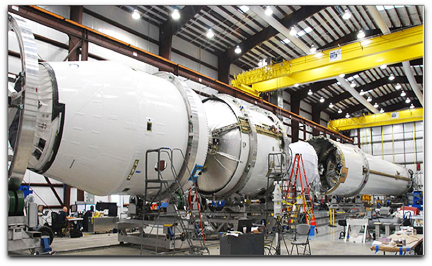
You simply cannot fit more than a single Merlin Vacuum nozzle under Falcon-diameter tankage. See here, the base of the F9 first stage, with Merlin nozzles visible:

falcon9-vehicle-100211-02.jpg


And then here. The MVac nozzle is covered by the white sheet, and is visible between stages one and two (behind the red ladder thing):

Falcon-9-integration-2.jpg


The nozzle extension is so large, that it fills the entire interstage.

Unless you mean taking some sort of Merlin with an MVac expansion ratio and TAN-ing it to get the proper T/W, in which case;

1. You'll have to reinforce the engine/nozzle extension and its thrust structure to withstand the higher thrust.

2. You'll have to find some way to pump the TAN propellants.

3. If the radiatively cooled nozzle extension even works in the atmosphere, you may need to prevent the niobium alloy from oxidising/burning in air.

Perhaps a more realistic option would be to pull four or five engines off of F9, increase the area ratio of the remaining engines, and design them for TAN. Such a vehicle might have comparable liftoff thrust to F9, along with higher ISP in a vacuum, and fewer engines (lower cost, less risk of catastrophic engine failure).
 
Before assuming this, consider the physical limitations of the hardware you are working with.
You simply cannot fit more than a single Merlin Vacuum nozzle under Falcon-diameter tankage. See here, the base of the F9 first stage, with Merlin nozzles visible:
falcon9-vehicle-100211-02.jpg

And then here. The MVac nozzle is covered by the white sheet, and is visible between stages one and two (behind the red ladder thing):
Falcon-9-integration-2.jpg

The nozzle extension is so large, that it fills the entire interstage.
Unless you mean taking some sort of Merlin with an MVac expansion ratio and TAN-ing it to get the proper T/W, in which case;
1. You'll have to reinforce the engine/nozzle extension and its thrust structure to withstand the higher thrust.
2. You'll have to find some way to pump the TAN propellants.
3. If the radiatively cooled nozzle extension even works in the atmosphere, you may need to prevent the niobium alloy from oxidising/burning in air.
Perhaps a more realistic option would be to pull four or five engines off of F9, increase the area ratio of the remaining engines, and design them for TAN. Such a vehicle might have comparable liftoff thrust to F9, along with higher ISP in a vacuum, and fewer engines (lower cost, less risk of catastrophic engine failure).

Another advantage of the aerospike is that you don't need that long, wide, nozzle to get the high vacuum Isp. So it can be useful for upper stages as well for its compact size.
For the TAN an interesting possibility is just using one single nozzle for all the engines. So you would have all the combustion chambers for all the engines exhausting into a single large nozzle. According to Phil Bono, the progenitor of so many SSTO concepts, this would actually increase your Isp:

Chamber/single nozzle.
http://www.astronautix.com/engines/chaozzle.htm

Also, try using your TAN concept for the Falcon 9 engines with a reasonable vacuum thrust and Isp on Schilling's launch performance site. What do you get for the payload of the SSTO?

Bob Clark
 
Also, try using your TAN concept for the Falcon 9 engines with a reasonable vacuum thrust and Isp on Schilling's launch performance site. What do you get for the payload of the SSTO?

I never suggested an SSTO, I suggested a modification to the current TSTO.

Running the numbers through the Schilling launch calculator would be pointless because the numbers would only be a guess.
 
if you assume that...

These four words are really disqualifying you every day. We have enough assumptions already. Where is the evidence? How much specific impulse can "altitude compensation" give you, if you are comparing different technical approaches for altitude compensation? Yes, that means you really have to look at the details and deal with mathematics beyond the rocket equation. Yes, that means you have to calculate more than a single number for every alternative.

I can assume just as well that your rocket designs will just explode when a bag of rice topples in China. It is stupid, absolutely. Ignorant, you name it. But you treat us just the same here every day without noticing it. If you assume that pigs can fly and cows jump over the moon, why do you need rockets at all?

You do bad engineering. The Michael Griffin Medal for the best of the 69% engineering projects that failed can maybe be your goal, but not mine. Your circular self-references are not just annoying for the reader, it also seems to give you a wrong kind of security about your claims. Hey, didn't I already claim so one year ago? Yes, you did. And you did it already by assuming more than you did know.
 
Just saw this discussed on Nasaspaceflight.com

Elon Musk on SpaceX’s Reusable Rocket Plans.
February 7, 2012 6:00 PM
The key, at least for the first stage, is the difference in speed. "It really comes down to what the staging Mach number would be," Musk says, referencing the speed the rocket would be traveling at separation. "For an expendable Falcon 9 rocket, that is around Mach 10. For a reusable Falcon 9, it is around Mach 6, depending on the mission." For the reusable version, the rocket must be traveling at a slower speed at separation because the burn must end early, preserving enough propellant to let the rocket fly back and land vertically. This also makes recovery easier because entry velocities are slower.
However, the slower speed also means that the upper stage of the Falcon rocket must supply more of the velocity needed to get to orbit, and that significantly reduces how much payload the rocket can lift into orbit. "The payload penalty for full and fast reusability versus an expendable version is roughly 40 percent," Musk says. "[But] propellant cost is less than 0.4 percent of the total flight cost. Even taking into account the payload reduction for reusability, the improvement is therefore theoretically over a hundred times."
http://www.popularmechanics.com/sci...musk-on-spacexs-reusable-rocket-plans-6653023

Then for the Falcon 9, the payload would be reduced from 10 mT to 6 mT. If the reduction in payload really is this high, then maybe it would be better to recover the first stage at sea. The loss in payload is coming from the reduction in the speed of staging as well as the need to retain a portion of the fuel for the return to base. Recovering at sea would not have these disadvantages because you could let the first stage make its usual trajectory at returning to the sea but use just small amount of propellant for the final slowdown before the sea impact.
In this article Musk does mention that returning back to the launch point allows the turnaround time at least for the first stage to be just hours. But will we really need that short a turnaround time at this stage of the game? A turnaround time of a few days would seem to be sufficient.
Perhaps the idea that retrieval at sea would be so expensive comes from the experience of the shuttle with the SRB's. But these were quite large and heavy at ca. 90 mT dry compared to that of the Falcon 9 first stage at less than 15 mT. Also, it is well known the labor costs for the shuttle were greatly inflated compared to a privately funded program.
The only additional requirement is that you would need a cover that could be extended to cover the engine section and would be watertight.


Bob Clark
 
Sea-recovery is bound to be more expensive not because history with the shuttle SRBs makes it so, but because corrosive salt-water makes it so. You really want to avoid dunking your stage in seawater if you can, since it means further safety checks and refurbishment, a longer turnaround time/more labour, and thus higher costs.

Also, SpaceX's attempts at reentry and water recovery so far have all failed, presumably because of the reentry dynamics. Perhaps it is not the only reason why SpaceX switched to the boost-back scheme, but it's probably the primary one.

A fully stretched F9 could do 16 tons to LEO. Assuming 60% payload for the reusable version, that's 9.6 tons- still roughly in the F9 ballpark,
 
Sea-recovery is bound to be more expensive not because history with the shuttle SRBs makes it so, but because corrosive salt-water makes it so. You really want to avoid dunking your stage in seawater if you can, since it means further safety checks and refurbishment, a longer turnaround time/more labour, and thus higher costs.
Also, SpaceX's attempts at reentry and water recovery so far have all failed, presumably because of the reentry dynamics. Perhaps it is not the only reason why SpaceX switched to the boost-back scheme, but it's probably the primary one.
A fully stretched F9 could do 16 tons to LEO. Assuming 60% payload for the reusable version, that's 9.6 tons- still roughly in the F9 ballpark,

I would like to see the trades between the cost of towing the stage back to land but keeping close to its original payload and landing back at the launch site but losing 40% of the payload. You would need a deployable cover for the engine section. The outer surface probably could be coated to not undergo too much degradation at only a short time in the water.

It is ironic that the hardest part is recovering the first stage instead of the orbital upper stage. Also interesting is that the payload becomes reduced to about what you can get with an SSTO Falcon 9 first stage using Merlin 1D's with altitude compensation. This would also be cheaper in not having the upper stage and you would not have the problem of returning to the launch base for a lower stage.


Bob Clark
 
I would like to see the trades between the cost of towing the stage back to land but keeping close to its original payload and landing back at the launch site but losing 40% of the payload. You would need a deployable cover for the engine section. The outer surface probably could be coated to not undergo too much degradation at only a short time in the water.

Firstly, who said that the water recovered version would retain anything close to its original payload? It could be much lower, especially if you have to add mass to the first stage for it to withstand reentry, or you need to seperate earlier in order to conserve propellant for a boost-back to slow the stage down to survivable velocities before splashdown.

Secondly, the F9 stages are (or were) marinised, so they have inbuilt corrosion protection (they don't need "special coatings"). A deployable engine cover is another matter. If it keeps water out, it still adds mass, adds something that can fail, has to be integrated into the aerodynamics of the vehicle at launch, etc.

It is just better to avoid dunking your stage in seawater... if you can, that is.

It is ironic that the hardest part is recovering the first stage instead of the orbital upper stage.

Nonsense. The upper stage is flying faster, hence it is more difficult to recover.

Also interesting is that the payload becomes reduced to about what you can get with an SSTO Falcon 9 first stage using Merlin 1D's with altitude compensation. This would also be cheaper in not having the upper stage and you would not have the problem of returning to the launch base for a lower stage.

RGClark's fictional F9 first stage SSTO, with RGClark's fictional altitude-compensating Merlin engines. Both existing as nothing more than mathematical quirks, with no engineering behind them...
 
I see nothing amiss there. Except this:

Musk says he expects "single-digit hours" between landing and next flight, at least for the lower stages.

Musk is nuts. :rofl:
 
I see nothing amiss there. Except this:

Musk is nuts. :rofl:

Actually what he says there makes sense, assuming he does return the first stage to the launch site, based on the experience with the engines on the DC-X:

DC-X News
June 23rd, 1993

Demonstrating fast turnaround between flights is also a major DC-X objective. May 26th's eight-hour fire/defuel/service/refuel/fire cycle time goes a long way toward that goal too.
"We were pleased with the vehicle's performance as well as the ease with which we can turn it around between tests. We're realizing the benefits that come from designing the system to be totally reusable." -- Pete Conrad, DC-X flight manager.​
"The entire DC-X system, including avionics, software, hydraulics, propellant feed systems, engines, and sub-systems met or exceeded our expectations. Through this rigorous series of tests we learned how to efficiently service the vehicle and quickly load and unload propellant. We acquired extensive data showing that the vehicle's operations, support and maintenance features will help us to achieve our goal of aircraft-like operations." -- Paul Klevatt, DC-X program manager.​
http://www.islandone.org/SpaceAccessUpdates/930623-DCXN.html


Bob Clark
 
based on the experience with the engines on the DC-X

It should be noted though that the engines on the DC-X were different engines. The engine cycle for example was different- the more thermally benign expander cycle, rather than gas generator cycle.
 
It should be noted though that the engines on the DC-X were different engines. The engine cycle for example was different- the more thermally benign expander cycle, rather than gas generator cycle.

Yes, and expander cycle engines have a hard-coded thrust limit for every fuel combination, because the turbine for pumping the fuel has to be driven by the evaporation of a propellant component.

You will need many such engines for a given stage thrust - or a new engine. For the DC-I, this was an annular plug nozzle of J-2T heritage. Which didn't exist except on the specifications for the model, all is pretty coarse there.
 
Can't TSTOs come instead?

I assume you mean reusable TSTOs since we already have TSTOs. SpaceX is working on reusable TSTOs. The Air Force is nearly there since they want to make the first stage reusable.

However, as is well known SSTO's have the characteristic that if refueled in LEO then they can fly to the Moon, land, lift off and fly back to Earth on that one single fuel load. This is not true of TSTO's where the upper stage might only get, say, a delta-v of 6,000 m/s.
 So if one did have his own private, SSTO vehicle, then with propellant depots he would also have his own private lunar vehicle.
 See discussion here:

SSTO's would have made possible Arthur C. Clarke's vision of 2001.
http://exoscientist.blogspot.com/2012/05/sstos-would-have-made-possible-arthur-c.html


  Bob Clark
 
LOL, the problem is: Your SSTO is even then the poorer choice. It is made for leaving Earth, not flying in space - many propulsion technologies that are better suited for space don't work for entering LEO from the surface. Why refuel them? Your SSTO can maybe get a DV of 10000 m/s. An electromagnetic thruster with nuclear power supply could be well past 20000 m/s and carry more payload than a similar massed SSTO.

And an SSTO for flying into LEO is a poor choice for landing on the moon, since it has too much stuff not needed for that route. On Mars, it would be less worse, but still less optimal than a dedicated Mars vehicle. Which could be easily SSTO with much simpler technology.
 
Last edited:
Back
Top