Ares I-X Updates

Perhaps this was an accident waiting to happen for 20+ years with the STS boosters, but just never did..

Not so. There have been a few cases of parachute problems with the STS programme. I think it was STS-3 where both SRB's were lost due to ALL the parachutes failing and on a few other missions one parachute has failed leading to some damage when the booster hit the water.

---------- Post added at 15:04 ---------- Previous post was at 15:02 ----------

For example -> http://www.nasaspaceflight.com/2008/02/sts-122-reviewing-atlantis-ifas-parachute-failure-tops-list/
 
This is not the first time foward segments have been damaged. It just that most Shuttle flights don't get this kind of attention. In the past the damage would accur if the chute slapped the booster into a wave. This problem was address by adding a Salt Water Activited Release (SWAR). On water impact the chute is released form the booster and is set free.

In this case two of the chutes didn't fully function. Further investigation will tell but I believe the bigger chutes will need some adjustments in packing. The chute packing is done manually and the chutes have been drop tested many times. This is the first time they have been released from the rocket of course. Also the mains are exposed by the separation of the segements. That too will need to be looked at. This is normal life at the rocket ranch folks. You can label it success or failure as you please.
 
Well, such failures are on the other hand not unexpected, when the tests do not cover the real deployment situation. When the three parachutes should get deployed, the SRB is still tumbling more rapidly, than the parachute test box.

The problem is just...how to test it properly? Simulation does not work, the only way is to launch a rocket...like done. Of course, that the separation system this time was not the same as needed for the Ares I, will make the test a bit useless, since they need to start again with the new interstage then. You can't just extrapolate from Ares I-X to Ares I about the situation at parachute release.
 
All in all, loss of an SRB is in no manner a mission critical failure. With rational approach, NASA can move addressing this parachute problem down the issues list.

Yeah, it is not that painful. But of course, the parachutes should work if they are launched.
 
That 1'st stage doesn't look very re-usable to me ;)

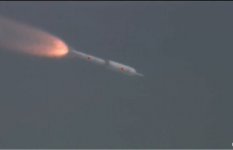
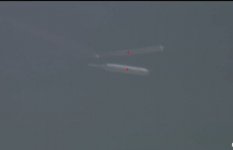
Nasa states that the camera angle makes the two stages look very close. I've made a guess where the center of mass is on each stage.

The first image is at 1:55 when separation occurs.
The second image is at 2:05, and it looks like the 1'st stage hasn't slowed down by much. I can't find the actual launch profile (downrange etc.), but the 1'st stage has to move quite a bit laterally to end up looking that close to the dummy stage.
If I could find more facts (downrange, camera position etc) it could make more sense.
 

Attachments

  • Ares1X_1_55.jpg
    Ares1X_1_55.jpg
    17.4 KB · Views: 32
  • Ares1X_2_05.jpg
    Ares1X_2_05.jpg
    15.2 KB · Views: 36
That 1'st stage doesn't look very re-usable to me ;)

If the parachtues unfold correctly an Ares booster is as reusable as the Shuttle SRB's. If the parachtues don't unfold correctly the booster gets damaged or even lost like the STS-4 SRB's for example, which both were fully lost due to high speed impact.

The Ares I-X booster damage is caused by parachute issues, not by a contact of both stages like some people may specualte.

Nasa states that the camera angle makes the two stages look very close.

Which should be correct. At 02:30 you can see the difference between both stages is anything but close anymore:

http://www.youtube.com/watch?v=g_R5IclogZw&feature=related"]YouTube - Ares 1-X Launch [H

But it's a lot of actually useless guesswork anyway.
 
Last edited:
Yeah, at 2:30 they're pretty far apart, I say that the dent in the SRB came from impact with the USS. However, I ask that, if the US had motors, would it have accelerated away from the SRB before an impact was made? Or, assuming that there was indeed an impact from residual thrust, is there really anything they can do to "kick" the upper stage farther away from the first stage?
 
Yeah, at 2:30 they're pretty far apart, I say that the dent in the SRB came from impact with the USS. However, I ask that, if the US had motors, would it have accelerated away from the SRB before an impact was made? Or, assuming that there was indeed an impact from residual thrust, is there really anything they can do to "kick" the upper stage farther away from the first stage?

From the add-on development front:

The Ares I-X has 8 Booster Deceleration Motors (BDM) which fire at USS separation for slowing the first stage.

ARESIX-FS-SEP-X.png


ARESIX-FS-SEP-Y.png


Three seconds later, the four booster tumble motors (BTM) fire and make the first stage yaw.

ARESIX-FS-BTM-Y.png


Five seconds after the BTM ignition, the distance grows rapidly.

ARESIX-FS-BTM+5-Y.png


You see, the stages are close during the whole sequence, but the distance is constantly growing - the relative speed should be much higher when the USS tumble motors also fire.
 
Last edited:
Yeah, at 2:30 they're pretty far apart, I say that the dent in the SRB came from impact with the USS. However, I ask that, if the US had motors, would it have accelerated away from the SRB before an impact was made? Or, assuming that there was indeed an impact from residual thrust, is there really anything they can do to "kick" the upper stage farther away from the first stage?
The dent did not come from the USS. The dent is located just above the field joint connecting the Aft SRM segment with the Aft Center SRM segment.

I have attached a screenshot of my Ares 1X First Stage with the dented area circled in red.
 

Attachments

  • Ares1X_dent_area.jpg
    Ares1X_dent_area.jpg
    32.5 KB · Views: 44
The damage is a typical buckling because of bending loads. Nothing too special, you can produce the same damage pattern by trying to bend a cola can.
 
If the parachtues unfold correctly an Ares booster is as reusable as the Shuttle SRB's. If the parachtues don't unfold correctly the booster gets damaged or even lost like the STS-4 SRB's for example, which both were fully lost due to high speed impact.

The Ares I-X booster damage is caused by parachute issues, not by a contact of both stages like some people may specualte.

You can see on that video that they didn't collide after separation. That wasn't my point. I just think that re-usable is a buzz-word that is used to score points amongst people that don't understand space craft engineering. :lol:


At 02:30 you can see the difference between both stages is anything but close anymore:

If the stages were in close proximity 30 sec after separation, NASA would be in big trouble!

But it's a lot of actually useless guesswork anyway.

Of course it's guesswork. We don't have all the data yet. Useless? Well, you're entitled to your own opinion.;)

The important part is how 'clean' was the separation. Did the booster deceleration motors manage to overcome the residual thrust? The #1 vessel cam drops out just as the deceleration motors are about to fire. In the HD video Ares1-X goes behind a cloud at the same time. The camera view changes between deceleration motor and tumble motor firing. We don't see clearly how much the 1'st stage slows down before the tumble motors fire in the released footage.
It looks like the upper dummy stage has already started to rotate when the tumble motors fire. A possible cause would be failure of separation bolt(s). Another (more scary) is that the deceleration motors didn't perform well enough to make a clean sep.
The worst case would be if everything worked perfectly, and the upper stage is unstable. The real one will contain liquids instead of concrete and will be even more unstable. Let's hope that NASA doesn't have to add mass to the upper stage too.:lol:

:cheers:
 
There is no evidence of a collision. And I really don't want to jump on a speculation-wagon to be honest. The movement of the upper stage mass-simulator was caused by aerodynamic effects, as mentioned during the post flight conference. The upper stage also couldn't be anything else than unstable because it was an almost uncontrollable piece of metall right after separation.

The upper part of the booster proverbially doesn't show a single scratch i.e. not a single evidence of a collision:

397883main_AIX%20Floating.jpg
 
Last edited:
The upper stage also couldn't be anything else than unstable because it was an almost uncontrollable piece of metall.

Unpowered does NOT mean unstable.

And that photo proves nothing as it's just one side of the booster.
 
Did the booster deceleration motors manage to overcome the residual thrust?

Of course, orbiter is no reference for real life, but since I calculated rather conservative and the thrust profile of the SRBs even after "burn-out" is pretty much correct (based on 3 SRM mission debriefing reports, each report has both SRBs of the Shuttle, so all together the performance data of 6 SRMs, I did the analysis for SSU some time ago), the 8 BDM should be overcoming the thrust.

The vacuum thrust is approximately 50,000 lb(f) at 123 seconds burn time (dropping off approximately proportional to 1/t), the BDMs reach 23,000 lb(f) each, for eight BDM angled at 45° to the Z axis, this makes 130,106.4 lb(f) for the 1.2 seconds burn time.
 
There is no evidence of a collision. And I really don't want to jump on a speculation-wagon to be honest. The movement of the upper stage mass-simulator was caused by aerodynamic effects, as mentioned during the post flight conference. The upper stage also couldn't be anything else than unstable because it was an almost uncontrollable piece of metall right after separation.

The banner at the top doesn't say "Orbiter & space flight sitting-around-waiting-for-NASA-announcements board".:lol:
The real upper stage will be exposed to the same aerodynamic effects. AFAIK it doesn't have active stabilisation during separation until the 2'nd stage ignites. But I might be wrong. You really don't want a wobble at mach 4.5!
You can make a piece if lead aerodynamicly stable. It isn't hard at all.;)

The upper part of the booster proverbially doesn't show a single scratch i.e. not a single evidence of a collision:

Where exactly is the forward skirt in that picture?
 
Where exactly is the forward skirt in that picture?

At the top of it. What is gone is the forward skirt extension, which forms the interface between SRB and frustrum. It should be retrieved as well, it splashes down a few meters away from the SRB.
 
Unpowered does NOT mean unstable.

The USS became an uncontrollable useless piece of metal at separation. It had no working separation system installed, nor did it have a working J-2X engine installed.

And that photo proves nothing as it's just one side of the booster.

People are free to believe that there could be some kind of "secret" on the other side of the booster (while NASA released photos of the lower dented part of the booster). That's just another speculation I don't like to become a part of.
 
And that photo proves nothing as it's just one side of the booster.

The part that would have been damaged isn't even in that picture.:) What you see there is the dummy 5'th segment/instrument bay. The forward skirt (that would be damaged by a collision), was jettisoned at 4.500 feet 29 seconds before splashdown.
But this is besides the point. I'm quite sure (according to the facts and data at this time) that the stages didn't make re-contact after separation. The question is "did they separate cleanly".

... the 8 BDM should be overcoming the thrust.

:rofl:Of course they should. I wouldn't expect NASA to launch it if the math didn't show that it should work. The point of doing tests like this, is to show that it really does work.
 
Back
Top