
Is Plane Drift Normal

HiPotOk1978

ReFuel L.L.C CEO
Addon Developer
Joined
Aug 19, 2008
Messages
373
Reaction score
0
Points
0
Location
Tucson
I had this wonderful idea for my own amusement was to place a space station in the orbital plane of the moon for refueling for missions to the Moon. I figured that if I dock and refuel, I can shorten the trip by burning longer. After I placed a station in LEO, I would do the same in lunar orbit. Well 5 simulated days later, I came to the end of my SSBB excitement and I decided to check the orbit of this station. I was surprised when I brought up MapMFD as to what I saw. I thought if I launched into the plane of the Moon, that my station would say aligned in that plane of the Moon, but because if its altitude, it would just orbit the Earth a lot faster. Can someone explain to me why the attached picture looks the way it does?
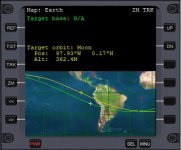
Drift.jpg
 
Is a normal realistic phenomena, the result of non-spherical gravity and three-body problems. The sun for example has still an effect on your orbit.
 
Thanks for the quick reply. Never thought that a mere 5 days that the amount of drift could happen. Now its a matter of saying
"that is damn annoying... Curse you giant flaming ball of gas!" Do you have any suggestions on how to counter those forces and prevent drift like this or keep it to a minimum? I am assuming that this drift is predictable?
 
There is even a document in the base Orbiter install about it:
Orbiter\Doc\Technotes\gravity.pdf

It is what allows sun-synchronous orbits to work.


-----Post Added-----


Do you have any suggestions on how to counter those forces and prevent drift like this or keep it to a minimum? I am assuming that this drift is predictable?
Restrict your moon flights to once every ~two weeks and time them so the intercept occurs when the moon is on the node of the orbit you are launching from. This ensures that your off-plane intercepts are no more delta-v expensive than an in-plane intercept. The IMFD Target Intercept program correctly accounts for nodal regression (if you have that option switched on) to allow you to properly calculate these burns.
 
There is even a document in the base Orbiter install about it:
OrbiterDocTechnotesgravity.pdf

It is what allows sun-synchronous orbits to work.

Restrict your moon flights to once every ~two weeks and time them so the intercept occurs when the moon is on the node of the orbit you are launching from. This ensures that your off-plane intercepts are no more delta-v expensive than an in-plane intercept. The IMFD Target Intercept program correctly accounts for nodal regression (if you have that option switched on) to allow you to properly calculate these burns.

Last time I read the manual, I can honestly say I didn't know jack about orbital mechanics. Gonna go over the manual again cause I am sure at this point I can take a bit more away from it with my experiences.
So just a quick reality check to see if I am understanding what I am attempting to learn... You can place an object in a orbital plane following the ground track across the surface that is your common center body, but as soon as you enter in the N-Body Problem, into your equations your gonna experience what I am experiencing? And to limit the effects, though in the grand scheme of things, orbital altitude has EXTREME low effect?

I guess the next question here goes out to Martins... How accurate are these forces simulated
 
The main cause of orbital precession for LEO orbits is not the N-body problem, it is the Earth's oblateness, the fact that Earth is fatter around the equator than in any other direction. This causes your orbit plane to shift westward for pro-grade orbits and eastward for retrograde orbits.

Jerry Jon Sellers book Introduction to Space has a nice plain English explanation, as well as pictures, and I think Bates, Mueller, and White's book does, too (and it's much cheeper).
 
The main cause of orbital precession for LEO orbits is not the N-body problem, it is the Earth's oblateness, the fact that Earth is fatter around the equator than in any other direction. This causes your orbit plane to shift westward for pro-grade orbits and eastward for retrograde orbits.

Jerry Jon Sellers book Introduction to Space has a nice plain English explanation, as well as pictures, and I think Bates, Mueller, and White's book does, too (and it's much cheeper).

Would raising my altitude assist in preventing further drift?
 
Yes, but you'd have to raise it a whole lot, so far that the earth can be modeled as essentially a point mass. I mean way out there. And once you get up that high, n-body effects become dominant.
 
Yes, but you'd have to raise it a whole lot, so far that the earth can be modeled as essentially a point mass. I mean way out there. And once you get up that high, n-body effects become dominant.

So I basically translate what your telling me, I would have to put the station into an orbit where geostationary satellites live? If so I am basically damned if do and damned if I don't? that sucks... so as I put on my WWND bracelet... I ask... "What Would NASA Do" or would they not even attempt such a project and launch things as needed as they are planning on doing with the Orion project dual launching
 
At Geostationary altitudes you have to deal with both N-body effects and Earth triaxiality, which causes satellites in GEO to drift east or west between the two "valleys" of the Earth's equator.

If you can live with the plane change velocity requirements or restrict your transfers to once every two weeks, you can still put your station in a low-inclination orbit.


-----Post Added-----


ETA: I'm not sure if Orbiter models triaxiality or not.
 
At Geostationary altitudes you have to deal with both N-body effects and Earth triaxiality, which causes satellites in GEO to drift east or west between the two "valleys" of the Earth's equator.

If you can live with the plane change velocity requirements or restrict your transfers to once every two weeks, you can still put your station in a low-inclination orbit.

ETA: I'm not sure if Orbiter models triaxiality or not.

Well from what people are telling me and my own research has shown, I have to live with it or not use the station
 
At Geostationary altitudes you have to deal with both N-body effects and Earth triaxiality, which causes satellites in GEO to drift east or west between the two "valleys" of the Earth's equator.
At 75W and 105E, according to simonpro's advice here:
http://www.orbiter-forum.com/showthread.php?p=65306

That post also provides info on how to calculate the drift. I guess you could make a plugin that would simulate that, if you were so inclined (pun intended ;)).

ETA: I'm not sure if Orbiter models triaxiality or not.
It doesn't. Orbiter only considers gravity perturbations with latitude, not longitude. It is mentioned in the doc I mentioned above. For all orbits except those very close to 0° inclination, the oblateness of the Earth quickly dominates.
 
Back
Top