Question Trip to Venus

greyrogue715

New member
Joined
Apr 12, 2012
Messages
55
Reaction score
0
Points
0
Location
Marshall
Should I be needing a 1200sec burn time to get to Venus on launch window day? I am using IMFD with Autoburn. I have everything programmed in right. I set the launch window day but I am not too sure I am launching at the right time. I launch from the equator when Venus crosses overhead, align with Venus, and then set the Autoburn, but it is giving me a 1200 sec burn time and I am running her dry in an XR-5. Do I have my launch time/orbit eject time screwed up?
 
You're missing something. Remember that Venus is an "inside" planet, like Mercury, but unlike Mars and others.
 
I want a prograde burn but I want to slow down compared to Earth's orbital speed. Would not a prograde burn put me in a higher (solar) orbit once I escape the Earth's gravity thus making me farther from Venus? But a retrograde burn will just deorbit the vessel.

So do I need to first escape Earth's gravity and then fire a solar-orbit retrograde burn to decrease my solar orbit SMa in order to bring me closer to Venus? So does it matter where in my orbit I do the prograde burn. I would think it would not. Someone please help me to understand this. I have a lot of docs on this but none are really clarifying the issue for me. I can use the IMFD pretty well, I think.
 
Last edited:
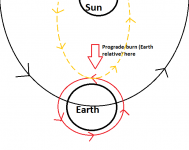
As you see on this crappy Paint-drawing, perform the prograde ejection-burn from e.g. a 0 inclination circular orbit around the Earth on the Earth's sun-lit site (red circle), and therefore rising you ApA, until you have reached the escape-velocity. Then you have at the same time performed a retrograde-brun Sun-relative, and have lowered your PeA around the Sun (golden circle), and have a perfect rendezvous comming up in a few months with Venus or Mercury!:thumbup:
 

Attachments

  • Ejection burn to inner planets.png
    Ejection burn to inner planets.png
    15.4 KB · Views: 62
Last edited:
Escaping Earth's gravity from the daytime side of the planet will automatically put you in a lower solar orbit. I know it's weird, and a bit counter-intuitive, but trust me:) Just do the burn like you would for any other planet, and when you cross out of SOI, your prograde and retrograde directions will swap. This is because you had to raise your Earth orbit to lower your solar orbit. It sound confusing, but that's how in-system trajectories work.

20 minutes does sound a bit lengthy for a Venus burn: A Mercury burn typically takes 10-15 minutes. Are you sure you had the right launch window? Did you align planes first?
 
Thanks for both explanations. I thought it sounded strange regarding raising the Earth orbit to lower the solar orbit, but your posts really helped me on this.

So you approach Venus from a solar retrograde orbit, and I would assume then entering into a retrograde planet orbit. Does this not make for high closing velocities, compared to that of a lunar approach?

I was thinking about what I posted earlier and realized launching with the sun at your back would not be the thing to do. I thought maybe launching while my directional axis was pointed right at the Sun, but was not sure. So high noon it is! Got it.

TMac: yeah, I was aligned to zero with Venus and that was the part of my initial question. I was not sure if I had the right launch window. Not even sure if that would be orbit ejection time or ground launch time. And I know what the launch dates are, but not too sure about the exact timing (of day) for the ejection burn. I would think it would not make too much difference considering the length of the trip.

Thanks a lot guys, I'm learning a lot.
 
You aren't putting yourself into a retrograde solar orbit, merely cancelling out some of Earth's orbital velocity to bring your periapsis lower to meet Venus.
 
So the actual spacecraft motion with regard to the sun is still in a PROGRADE solar orbit. That would put the Earth ejection point at the aphelion of my (solar) orbit I assume?

And also, the point of prograde ejection could also be when the Earth is between the spacecraft and the Sun, right?

And at certain times (last quarter to new Moon), would a lunar slingshot to Venus work if lunar inclination was right?
 
Last edited:
So the actual spacecraft motion with regard to the sun is still in a PROGRADE solar orbit.
Yes.

That would put the Earth ejection point at the aphelion of my (solar) orbit I assume?
No. You're not changing the orbit around the sun that much to see big changes on aphelion/perihelion.

And also, the point of prograde ejection could also be when the Earth is between the spacecraft and the Sun, right?
Yes. You can even fire the engines retrograde respect to the sun orbit, you'll leave the Earth and stay in a sun-prograde-orbit anyway, because you just have enough power to escape Earth, but the speed of Earth around the sun is stlll "impressed upon" your ship.

And at certain times (last quarter to new Moon), would a lunar slingshot to Venus work if lunar inclination was right?
Yes, you can do that with TransX.
 
So the relative velocities between the spacecraft and Earth after ejection must be quite low if I understand you correctly. You have to escape the Earth's gravity at the same time slowing your solar orbit. That is strange indeed. I would think in this case an ejection from the last quarter Moon position, or the 'three-o-clock' position (nose to the sun) would be the most proper time for a prograde ejection. Or how about saying any ejection burn on the side of Earth that is on the side of it's orbital direction ie. the full moon position to the new moon position, is proper prograde burn position. Anything giving you an inward velocity and definitely not an outer one.

[Sorry, I am not sure what the proper terms are for these points in the orbit.]

As a side note, I think the velocity required to enter a retrograde solar orbit must be off the scale, eh? Over 30km/sec?

Further thanks, I certainly love this topic. I feel I am making progress.

---------- Post added at 11:54 AM ---------- Previous post was at 11:12 AM ----------

Well, I just tried another Venus shot and after a 3000sec burn I ended up in an orbit paralleling Earth's orbit with no inward component at all. I guess what I did was just put myself in a slightly higher solar orbit. Having been on and off Orbiter since '06, I have yet to reach an orbit around another planet. I can launch and dock with spacecraft and make a rather ugly trip to the Moon, but I have yet to successfully reach another planet. I am sure every ten year old on Orbiter this side of the Mississippi is successfully bounding around Io and Europa by now.

I guess I do not understand the IMFD as well as I think I do and that is where the problem lies. Not being able to understand pretty much ends your fun on Orbiter. But I must add that I will persist.
 
Last edited:
From your last post it's difficult to help, maybe posting a scenario with your current situation and IMFD plan would be better. Or give us some more details.

I'll just throw some thoughts here.
What goes wrong, precisely? You time warp to the encounter point but Venus is too far away? Or do you look at your orbit in the MFDs and it doesn't look right? Or you don't reach the escape velocity? What the PeA value on the Target intercept program reads? If it's high (megameters M or gigameters G) then you've set a bad IMFD plan.
Also, the date must be set changing both the TEj and TIn (time of ejection and time of the encounter), but you also have to advance the time (with T key) to reach the correct launch window in case you looked for one here. The autoburn should show anyway how many seconds are left for the burn.

The most important thing is that you precisely say what's wrong, so we can guess the cause.
 
Last edited:
Well Ripley, I assumed the launch window lasted somewhere around 12-24 hours, and so the question would be not what time to launch necessarily, but what position along the orbital path, right?

You would have to eject prograde along your orbital path, roughly anywhere past the point of Aries off your 3 o'clock, to it's degree opposite (point of Virgo?), and you would have a handful of times to eject (once per orbit) as the duration of the launch window passes, correct?

I hope I am explaining what I am asking clearly enough. I have been thinking a lot about this lately so that's good imo.

Goth, I will run the scenario again today/tonight and give you the requested figures. You are probably right re. incorrect IMFD settings. The main problem is, as you said, missing the planet by distances in the M range and then making incorrect mid course corrections perhaps. I seem to do no better when heading outward to Mars. I can make the Moon usually, just using the old Transfer MFD. No luck with TransX. I tend to like IMFD more but I am still quite new to it.

Thanks again.

- and now I am all of a sudden thinking more and wondering if the point of Aries is correct. When you have the Earth between you and the Sun aligned (midnight) and you are prograde, is the point of Aries at your three o'clock all year or does it change in this case, keeping the Earth between you and the sun that is. In three months, will Capricorn (or Cancer? not sure) be at your three o'clock? Sorry about the flood of questions, as well.

 
Last edited:
so the question would be not what time to launch necessarily, but what position along the orbital path, right?
AND
and you would have a handful of times to eject (once per orbit) as the duration of the launch window passes, correct?
Exactly, but that is managed by the autoburn autopilot of the IMFD. So if the IMFD points the nose of your ship in the wrong direction it's because the plan is not accurate, so you only have to care about that.

The main problem is, as you said, missing the planet by distances in the M range
When do you realize this? When approaching Venus or immediately when you're still at Earth looking at the IMFD? If it's the former, then you're making bad midcourse corrections (typical error is not setting the source as "x", namely your ship).
If it's the second thing (the IMFD PeA shows something like 200M) it means that you have not a close approach, and so you have to keep changing the TEj and the TIn until you find a right trajectory.
It's weird that you don't manage to reach a close approach (a low PeA) since you are in a nice launch window. When I don't manage to find a decent approach with IMFD it's generally because I'm not in a good launch window and so I have to use TransX which almost never fail even when you have a bad launch window. But there may be some IMFD experts that can tell you what other reasons could be the cause of not getting a low PeA.
 
Here's my MFD procedure. It is from a tutorial that I am not sure who wrote it. I use IMFD 5.5

EJECTION:

LEFT MFD
Course >Target Intercept> Tgt=Venus

RIGHT MFD
Op Mode Share with '0' left MFD
Orbit Eject >Course>Proj=Self

LEFT MFD
Tgt Int >decrease Tin to minimize burn time in Orbit Eject

(Not sure, but I have been setting ejection time here. The tutorial doesn't clarify about this. I wait until I am at the noon position on the daylight side or slightly before and set the ejection time for about 450 seconds.

RIGHT MFD
Orbit Eject MOD>TEj to get blue line over green dotted line.

Set Autoburn

(Also, the MFD don't seem to be syncing up with each other. I notice contradictory burn times on the tgt int screen L mfd and the orbit eject page R mfd. I manually type in ejection time on the R MFD and hit enter when it matches the LEFT MFD.)

MID COURSE CORRECTION
LEFT MFD
TGT INT >Source enter 'X' for vessel

RIGHT MFD
MAP >Ref=SUN, Tgt=VENUS, Cnt=Sun, Sel >Dsp >PG >Soi >Int >Plan >PG .Sel to get PeRef Venus
Read PeT and Warp 1000X wait until 1/2 initial PeT and WARP 1X

LEFT MFD
AUTOBURN

It is at this point that I realize something is wrong. I haven't made it as far as planet approach yet. I got the PeA down to 200km last attempt setting the IMFD, but still missed by quite a ways upon actual attempt. I am going to try it again here shortly.

EDIT - I just tried again and I can't remember how I got the PeA down. Everything I try and it won't change. How is the PeA adjusted? I will search.

Thanks again.
 
Last edited:
Autoburn must be clicked on the Orbit eject program (right MFD).
Just in case.

Tgt Int >decrease Tin to minimize burn time in Orbit Eject
Decreasing TIn the burn time increase, because if you want to arrive soon, you will need more speed.
TIn small => more speed required => more elliptic orbit => longer burn time
TIn big => less speed required => more circular orbit => less burn time => generally less fine approach;
As I said, the key is watching the PeA value.
 
Thanks Goth. I can't get the PeA down any less than about 600M. It flips immediately to -600M range. I also noticed I was getting a "no burn vector' message on the burn screen. I'm trying now to get a screenshot for you.

---------- Post added at 07:09 AM ---------- Previous post was at 06:54 AM ----------

A million questions...

Does the Left MFD have to also be set to shared with the right. I set the right for left, but do they both have to be set? And should the Tin be in the 22M range, because that is what I am getting. I tried once again and it gave me a Tej that occurred on the sunset side of the planet and it launched me out past the orbit of Mars.
 
Does the Left MFD have to also be set to shared with the right. I set the right for left, but do they both have to be set?
No. Generally nothing bad happens if you set both, but the correct procedure is to set only one of them. Anyway, when in the orbit eject program, selecting Course, the graph actually appears, you know you did it right. Otherwise a yellow error message appears.

And should the Tin be in the 22M range, because that is what I am getting.
Yes, sounds fine.

Instead of screenshots/scenarios, just tell us your scenario MJD date, so we can try the plan.
 
MJD 56578.3588

I start at sunrise using the Oct. 13 2013 window.

---------- Post added at 08:00 AM ---------- Previous post was at 07:26 AM ----------

It keeps pointing me straight at the Earth and burning me straight into it. I also am getting a 1300sec burn time again. I wish this could be more difficult.

---------- Post added at 08:03 AM ---------- Previous post was at 08:00 AM ----------

And do I just ignore Ejection time on the left MFD? It shows zero.
 
Back
Top