Just a thought:
The current Ares design has an 'issue' or 'feature' in that it has a wide second stage perched on a tall skinny first stage, so without active control, the rocket aerodynamics are such that it really would rather fly tail-first. The analogy is trying to balance a broomstick in your hand - it can be done if you are constantly correcting, but the system is negatively stable in that orientation without those corrections.
What prompted me to think of this is the recent report on the Columbia crew survival, and the fact that the body flaps went to a free flight condition that caused the orbiter to pitch up when hydraulics failed, overloading the airframe. Had the flap remained in position during the hydraulic failure, the catastrophe (at worst) might have been delayed, and at best, may have permitted extended flight to a point where a survivable bailout might have been possible, depending on whether the left wing held on while maintaining the nominal re-entry AOA (a big if).
I am wondering about failure modes in the Ares 1, and it occurs to me if there is some guidance problem or mechanical failure that precludes control inputs, you then have a bunch of astronauts in a tumbling rocket, and I don't think the escape tower is really going to be much help in this situation unless luck is on their side.
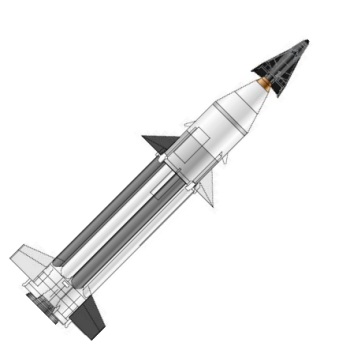
So, in the interests of dumb and easy redundancy, why can't some good old fashioned tail fins be put on the first stage of the Ares 1? Yes, it is some additional weight, but wouldn't it take some of the effort out of the active control system? They would just need to be big enough to ensure that the ship doesn't flip tail first during a first stage guidance failure to ensure safe separation with the escape tower?
P.S. Or is their enough lead shot in the nosecone to prevent this tail-first issue?
The current Ares design has an 'issue' or 'feature' in that it has a wide second stage perched on a tall skinny first stage, so without active control, the rocket aerodynamics are such that it really would rather fly tail-first. The analogy is trying to balance a broomstick in your hand - it can be done if you are constantly correcting, but the system is negatively stable in that orientation without those corrections.
What prompted me to think of this is the recent report on the Columbia crew survival, and the fact that the body flaps went to a free flight condition that caused the orbiter to pitch up when hydraulics failed, overloading the airframe. Had the flap remained in position during the hydraulic failure, the catastrophe (at worst) might have been delayed, and at best, may have permitted extended flight to a point where a survivable bailout might have been possible, depending on whether the left wing held on while maintaining the nominal re-entry AOA (a big if).
I am wondering about failure modes in the Ares 1, and it occurs to me if there is some guidance problem or mechanical failure that precludes control inputs, you then have a bunch of astronauts in a tumbling rocket, and I don't think the escape tower is really going to be much help in this situation unless luck is on their side.
So, in the interests of dumb and easy redundancy, why can't some good old fashioned tail fins be put on the first stage of the Ares 1? Yes, it is some additional weight, but wouldn't it take some of the effort out of the active control system? They would just need to be big enough to ensure that the ship doesn't flip tail first during a first stage guidance failure to ensure safe separation with the escape tower?
P.S. Or is their enough lead shot in the nosecone to prevent this tail-first issue?