SRB Question

TMac3000

Evil Republican
Joined
Nov 16, 2008
Messages
2,773
Reaction score
0
Points
36
Location
Flying an air liner to the moon
I didn't want to hijack ryan's thread, but I have a idea to kick around.

Might it be possible to use SRBs as boosters for future manned spacecraft? Maybe even interplanetary launches?
 
Might it be possible to use SRBs as boosters for future manned spacecraft? Maybe even interplanetary launches?

See Ares I.

It is possible, but I don't recommend it. Fixing the combustion instabilities of solid rocket boosters so that you can launch humans on them and get them to orbit in one piece, is not easy.
 
It's a good idea if you're using them as strap-ons, a la STS, Atlas V and Ares V, though. Smooths out the rough ride a bit.
 
At least the Apollo astronauts knew if something was wrong with the engines they could shut them down, but the Constellation astronauts cant shut down the Ares becuase it uses solid fuel and once you light them, theres no stopping the.
Maybe if an Ares flight is aborted the main rocket smashes into the VAB, i want to destroy that building during a flight ;)
 
You can "shut down" a solid rocket booster as well, it's just messy. It involves opening up the casing and letting it burn itself out sideways. Most solid rockets are not designed to do this, and of course it would be a violent event in any case, but if the idea is to cut thrust and acceleration just enough to make a clean getaway with the LES, than it enters the realm of the possible (but difficult).
 
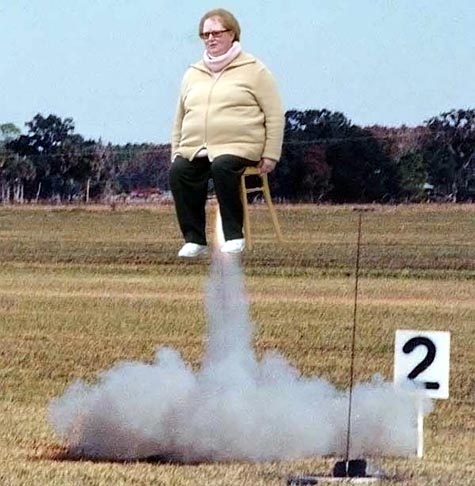
How about this idea to strap yourself? Rocket chair...:lol::rofl:
Sorry, I couldn't resist to joke about it...:P:lol:

3272415099_8c1a207dc7_o.jpg
 
At least the Apollo astronauts knew if something was wrong with the engines they could shut them down.

What do you think, that a good old astronaut has an ultra-sensitive butt to notice a failing turbo-pump blade by the vibrations? The first spacecraft to have the option to manually shutdown the main engines, was the space shuttle and that feature is not used when something is wrong with the engines, but when something is wrong with the guidance.

On Apollo, the Astronauts only had two options: Fire escape rockets or hope for the engine management to report a failure. At that time, engine management was not really sensitive, it required really strong pressure fluctuations in the engines to cause a shutdown.
 
What about Saturn Vs or Titans? They are liquid fueled, aren't they? But I guess you would have to install manual pumping systems, and God only knows the difficulty or cost. But if it's doable at all, a pair of Saturns would way more powerful than SRBs:speakcool:
 
What about Saturn Vs or Titans? They are liquid fueled, aren't they? But I guess you would have to install manual pumping systems, and God only knows the difficulty or cost. But if it's doable at all, a pair of Saturns would way more powerful than SRBs:speakcool:

AFAIK the Saturn V rocket is touching the limits of the stress and strain of the metals it's using, I don't know if we can ever built another version of Saturn V with Carbon nanotube, but if the material is changed, it might be able to be stacked or joined, but for nowadays material, if you put more weight on it than the ones used on Apollo programs, the rocket itself will crumble because of the sheer weight. but IMHO even if we can stack or join two or three Saturns, the sheer lift and power might render it uncontrollable.
 
Back
Top