Launch News SpaceX Falcon 9 launch with Jason-3, January 17, 2016

Even if the booster could hover, any LAMPS guy will tell you the sea state would make recovery a tricky business.

From a flight deck of a Perry Class frigate in rough seas, the helicopter looks as if it's being tossed around the sky. The rational part of me knew that the helo was pretty steady, I was the one violently moving side to side, up and down. If it was bad enough we'd use the RAST and pull the helo down.

One night the boat raised up high enough I got hit in the shoulder by the landing gear. Scary stuff.

I don't think what they are doing is impossible, just damb difficult. I would have aborted the attempt if it were me after looking at the sea conditions. But, it wasn't me and it ain't my money. I will however give them kudos for hitting the target, not an easy task either.
 
Well, I know some people are going to spin this negatively for SpaceX, but objectively, they are trashing first stages in the ocean anyway, so might as well give it a try despite the marginal conditions. Let's not forget this was a NASA payload too, so there's a PR issue here as well not to delay the launch for first stage recovery efforts.
 
I'm thinking the concept of a solid landing at sea is somewhat going in the wrong direction. Why not thrust it to a ~stationary vertical velocity and let it fall into the sea, with a big inflatable collar in lie of the landing legs.

Downside ... engines submerged in sea-water (including hot engine bells, etc). Upside ... you will recover the booster most times, as it'll be floating in a very stable position (CoG underwater for ballast, etc).
 
Jason-3 separation!
 
At least, you need to make everything a lot more sturdy than for landing on land. Carrier aircraft and naval helicopters are also build with a lot more structure and heavier landing gear to survive what is called a "controlled crash".
 
At least, you need to make everything a lot more sturdy than for landing on land. Carrier aircraft and naval helicopters are also build with a lot more structure and heavier landing gear to survive what is called a "controlled crash".
Yes. My suspicion right now is that the landing legs doesn't even have any form of shock absorption. They engineered it entirely for land landings.
 
Stronger landing gear with shock absorption capability would be a lot heavier. Although likely lighter than extra fuel needed for full boostback burn to landing pad at launch site. If another few drone ship landings fail then it is possible Space X may design new landing gear that can tolerate more abuse or some kind of semi submersible landing platform that is less affected by waves.
 
If it was NASA, they would have built a gyro-stabilized landing platform that is perfectly still even during an ideal storm.

However, it would have cost 20 billion dollars up front and required a billion dollars of maintenance after every landing, thus removing any gains from saved stages.
Also, any failed landing, and you'd have to build a new one.
 
Yes. My suspicion right now is that the landing legs doesn't even have any form of shock absorption. They engineered it entirely for land landings.

They look like they have some shock absorption in the structure itself by being flexible enough. But that is not enough if you are also getting the impact on a single leg.
 
Well... if you can't have the shock absorption on the rocket, why can't you have it on the barge itself?

An adjustable platform, with hydraulic actuators, to keep a landing platform level and absorb a landing, while the barge can move a little more freely with the swells underneath it.
 
Hardware failure again.

Elon Mush on Twitter:

Definitely harder to land on a ship. Similar to an aircraft carrier vs land: much smaller target area, that's also translating & rotating.

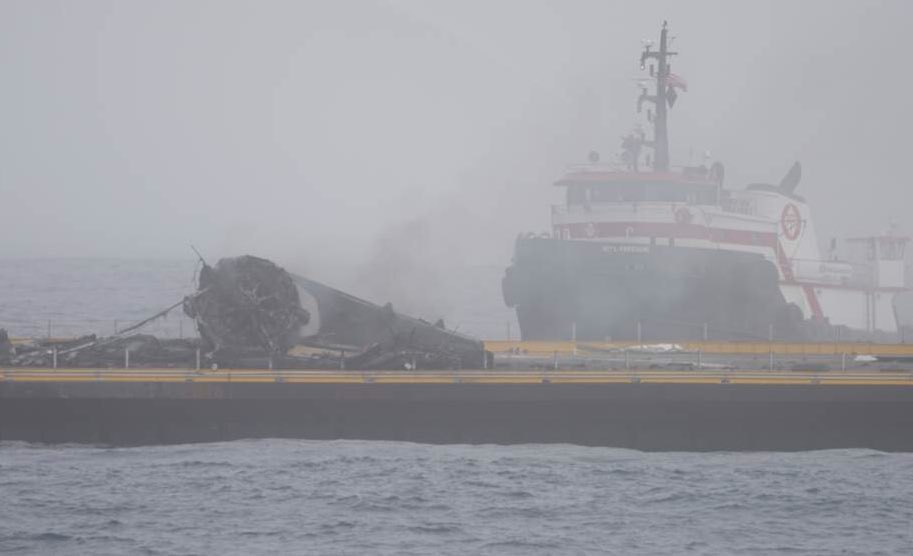
However, that was not what prevented it being good. Touchdown speed was ok, but a leg lockout didn't latch, so it tipped over after landing.


I still think the live feed was delayed and cut. I don't buy the loss of signal.

---------- Post added at 22:29 ---------- Previous post was at 21:36 ----------

SpaceX tweeted:

After further data review, stage landed softly but leg 3 didn't lockout. Was within 1.3 meters of droneship center


---------- Post added at 22:41 ---------- Previous post was at 22:29 ----------

The wreck:

https://twitter.com/elonmusk/status/688837706005131264
 
Well, the pieces are bigger...

CY8-PdyU0AABqaa.jpg
 
Those legs don't inspire confidence in me. They just seem too rickety. It's too bad that they couldn't just use fixed legs on the ends of fins or something.
 
In case we ever forgot: spaceflight is hard!

My go-to line when discussing setbacks and failures with those who don't usually follow spaceflight. Usually followed by "If it was easy, we'd be on Mars."
 
If it was NASA, they would have built a gyro-stabilized landing platform that is perfectly still even during an ideal storm.

However, it would have cost 20 billion dollars up front and required a billion dollars of maintenance after every landing, thus removing any gains from saved stages.
Also, any failed landing, and you'd have to build a new one.

What they would need is a dynamically positioned barge larger than the wavelength of those big swells i.e. a semi-submerged drill rig. You're looking at about $1 billion in round numbers for these rigs, less a small fraction for the stuff needed for drilling. And you still need to get the rocket to shore. This won't help the economics of reusability all that much.
 
Guidance was fine. Engine was fine. A leg didn't lock and it lead to the rocket tipping over.

I'm not really sure what you guys are debating here.
 
Guidance was fine. Engine was fine. A leg didn't lock and it lead to the rocket tipping over.

I'm not really sure what you guys are debating here.

We're not debating, we're discussing. Join in if you'd like.

For what it's worth, I'm not convinced that the landing would've been successful even if the leg had locked properly. Barge landings have proven to be very difficult.
 
Back
Top