Space Shuttle Columbia - What could they have done?

Ok, I'll go along with the camera angle thing -- as the camera has a really long lens and is at an angle. And we've got complex airflow around the shuttle, with all sorts of velocities and what not in a state of flux. ok.

But I hear that if a crew is doomed, Nasa will not alert that crew. Seems humane enough to me! This is a recent policy, it wasn't in place with the likes of the early mercury program or apollo 13.. This is something new in today's politically correct safety mongering society.
 
Isn't that number consisting mostly of DoD personnel?

Its a statistic of all intelligence agencies in the USA and includes all people...so yes, likely mostly DoD people. But it is pretty funny to see something being labeled top secret and still a large number of people can read it. 0.3% of the Citizens of the USA.
 
That's the wonders of bureaucracy, i'm not really surprised.
 
Ok, I'll go along with the camera angle thing -- as the camera has a really long lens and is at an angle. And we've got complex airflow around the shuttle, with all sorts of velocities and what not in a state of flux. ok.

But I hear that if a crew is doomed, Nasa will not alert that crew. Seems humane enough to me! This is a recent policy, it wasn't in place with the likes of the early mercury program or apollo 13.. This is something new in today's politically correct safety mongering society.
The crew were told of the debris strike: http://www.nasa.gov/pdf/45253main_email_foam_strike.pdf
 
One problem was that a lot of people at NASA believed that the RCC would stand up to an impact. Most of the discussion during the flight was about tile damage under the wing and on the landing gear door.
 
No. even with skip entries you still have to dissipate a lot of heat - more so at the end than with a gliding entry.

There is no magic trick for getting STS-107 home after damage of that magnitude
 
Could skipping the atmosphere several times perform enough braking?

No, you would actually get higher temperatures, because you then enter at a steeper angle eventually. Only the total energy during the heating phases would be less, but damage would still happen.
 
... And anyone who reads Aviation Leak.

:rofl:

Regarding clearance levels...
I held a TS several times. My clearance would move up or down depending on what my job was at the time. And no matter what my clearance level was, there was always a "need-to-know", which is determined by the person having the information, not the person requesting the information.
For instance, my boss and I both held a TS. My task was to break-down and clean an infra-red jammer. I had to ask my boss to leave the room and lock the door behind him, which he did (and I verified). He was cleared to know the basic priciples of operation, but not the inner workings. He had no "need-to-know" to operate the equipment, but I had to in order to fix the equipment.

Is it seriously NASA's current policy to keep the crew unaware of a denger level of this magnetude? I would hope not...
 
:rofl:
Is it seriously NASA's current policy to keep the crew unaware of a denger level of this magnetude? I would hope not...

Sure - it is even common everywhere I know. If you can't do anything once you know the danger, you can live better by not knowing it.

Happened also for some Apollo missions, like Apollo 12, where the possible damage to the parachute mortars was kept secret to the crew.
 
Both Challenger and Columbia were preventable in my opinion, sts 107 to a lesser extent. The manufacturers of the SRB's warned NASA not to launch Challenger on the cold winter day that it was. I suppose an exploratory/reparative spacewalk would have been possible on sts-107.
 
Both Challenger and Columbia were preventable in my opinion, sts 107 to a lesser extent. The manufacturers of the SRB's warned NASA not to launch Challenger on the cold winter day that it was. I suppose an exploratory/reparative spacewalk would have been possible on sts-107.

Morton Thiokol gave a GO to launch in a teleconfernece with NASA mangement. Admitedly, that was over the heads of the engineers and espeically one in particular, Roger Boisjoly.

Probably the worst thing that was said was just prior to the teleconference was "Put your managers hat on and not your engineers hat". This lead to the unanimous go decision from Morton Thiokol.
 
I suppose an exploratory/reparative spacewalk would have been possible on sts-107.

I don't think so, that repair would have been much different to fixing a flat tire.

The blunder of NASA was either not fixing the debris impacts or installing impact detectors into the RCC panels, when the problem was known. The impact prediction software of NASA didn't even include the RCC panels by design.
 
was this the first time the RCC panels were hit? I would, at first look, think that any debris from the tank would be 'swept' under the shuttle due to speed and slipstream. There wouldn't be enough time for the debris to travel away from the tank and make it 'out to' the aerosurfaces.. But what do I know!?!?

Anyways, the shuttle project is winding down and we won't have to worry about that anymore.
 
was this the first time the RCC panels were hit?

Again, I urge you to read the reports.

I would, at first look, think that any debris from the tank would be 'swept' under the shuttle due to speed and slipstream. There wouldn't be enough time for the debris to travel away from the tank and make it 'out to' the aerosurfaces.. But what do I know!?!?

Well, you did have some sort of conspiracy theory earlier in this thread. Seriously, spend some time reading the CAIB report, at least volume I.

Anyways, the shuttle project is winding down and we won't have to worry about that anymore.

Anything that can be learnt from the shuttle should be to make the next vehicle better, to make the one after that better. Everything that's learnt from both STS-51-L and STS-107 as well as other space accidents all contribute to making the next vehicle and the next accident more survivable.
 
Last edited:
There wouldn't be enough time for the debris to travel away from the tank and make it 'out to' the aerosurfaces.. But what do I know!?!?
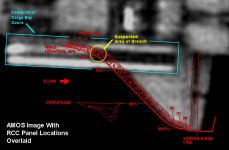
It didn't hit any aerosurface. It hit the leading edge of the left wing. The RCC panels are the gray section of the wings and the nose. Black/white areas are either tile or thermal blankets. Most probable area of impact was RCC panel 7L. This panel is at the very beginning of the joggle section of the wing.

I have attached a chart of the left WLE to this post.
 

Attachments

  • amos_overlay1.jpg
    amos_overlay1.jpg
    96.1 KB · Views: 23
Unfortunately not. No way to get under the orbiter and nothing to hold onto even if they could get there.

Let say it a bit more careful: Nothing to get there without causing likely more damage to the orbiter, than already is there.

There seems to be really a way that includes disassembling the ladder between mid deck and flight deck and wrap it into cloth, so you can climb from the payload bay past the body flap. But compared to that, climbing the [ame="http://en.wikipedia.org/wiki/Eiger"]Eiger[/ame] North face is easy.
 
I remember seeing some film of the launch showing the foam fall off and shatter like an exploding bomb when it hit the wing. If that couldn't pass the point that something went wrong, I guess nothing could.
 
Back
Top