Small Orbital Craft

attachment.php


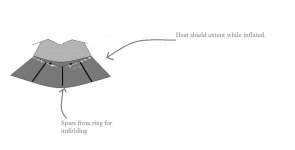
I meant that I thought an inflatable heat shield would burn up; I didn't have much time to post. Or maybe we could use the service module on a tether as a parachute?? I wouldn't know. Anyhow, at about 1 kilo per second, the drogue chutes would open, followed by the pilot for the main and the main chute at a low enough speed.
 

Attachments

  • SOC Heat Shield.jpg
    SOC Heat Shield.jpg
    27.6 KB · Views: 167
Allright, I'm gonna try modeling some of this stuff roughly, just to see how it goes.

However, modeling is all I'm good for. If anyone who isn't mighty busy with their own large projects wishes to help with this in some way, do let me know.
 
Here's a simple, one-man, SSTO-launched capsule. I just love this addon, it's simple (if a tad bit unrealistic) to get to orbit, uses it's escape tower for RCS (the tower isn't jetissoned until reentry), and has a deployable, inflatable heatshield and a parachute. No EVA or docking capability though.

[ame=http://www.orbithangar.com/searchid.php?ID=2304]Airman by Auditek747[/ame]
 
I've seen that before. It is a really good add-on. The problem is that it isn't realistic. Hmm. A docking port would look good on the nose.


-----Posted Added-----


Well, Cobalt started up this thread, and I thought I might adress the issues here:

The size might be an issue, but there really isn't that much to cram in there. The hardest part would be adding a long term life support. My idea calls for only up to maybe a week in orbit to dock up with the ISS and hook up the oxygen hose, which I think I left out in the drawings I made. I have some sketches in a notebook, I might scan and put them up.

There really isn't much of a docking port. It's more like Gemini's, only used for connecting and not much else.

And for the parachutes, I agree that could be a pretty big problem. Considering the parachute housing is in the nose, which opens up... It could be hard to keep the nose from just coming off. The heat shield would probably end up being jetissoned after the major heating is gone. Lighten the load a bit? Anyhow, if that problem isn't solved, we'll have to tell the pilot that he'll be hanging upside-down when the parachutes open XD.

Have we solved the reentry problem yet? For some reason, I think that an inflatable heat shield would be burned away. But even though the heat shield is so small, there isn't much mass to be decelerated. Is it actually a problem?
 
Inaflateable heat shield technology is still in its infancy, but it's widely believed to be feasible. There were plans to use it for personal rescue schemes back in the 60s. Do a search on OH for sputnik's Douglas Paracone.


-----Posted Added-----


Also, IIRC a Russian spacecraft has experimented with an inflatable heat shield, with only partial success.
 
So it works a little. That's good! Maybe use a heat shield that could take the major deceleration and burn up eventually and use the ship's heat shield for the rest?
 
Well, Cobalt started up this thread, and I thought I might adress the issues here:

So, how are both threads supposed to be related? These ideas inspired some wild new thoughts in me. I'll share them here:

I guess your mission is to bring a single person to a space station, and bring him/her back to earth safely, with a minimum of equipment.

You can, as usual, split up the development into developing an orbital vehicle, and a suitable launcher. Let's start with the orbital vehicle.

First of all, it has to be able to survive the launch. Secondly, it has to be able to bring your astronaut to the space station (possibly re-using the last stage of the launcher; you can call it a SM if you wish). Third: your astronaut has to survive in space, which means life support. Fourth: the astronaut should be able to enter and leave the space station. And last but not least, you need to be able to de-orbit, re-entry, and land safely.

The smallest space craft I can think of is an MMU. Its main problems are probably the low amount of life support supplies, and the fact that it's incapable of de-orbit and re-entry. So I guess the backpack needs to be a bit larger, and you need some aerodynamic protection during re-entry (capsule design would work I guess).

My suggestion, described inside-out:

  • The astronaut. Probably the only re-usable part.
  • The spacesuit. Small enough to be carried into an airlock. Contains most life support equipment, and small amounts of life support supplies. Similar to spacesuits on ISS, but can be connected to the capsule for extra life support supplies and electronics links. Also contains a parachute (I hope it fits somewhere), so that it can do a parachute landing.
  • The capsule. Can be connected somehow to the space station to prevent it drifting away. Contains some electronics, e.g. the displays, and everything needed during re-entry. Main purpose is to survive re-entry. Opens a big hatch in space to allow the astronaut to leave and enter the space station. After re-entry, it releases the astronaut to let the astronaut make a parachute landing. Contains a normal ablative heat shield, or any other type if that turns out to be lighter. Contains additional life support supplies.
  • The service module. Contains everything needed during approach of the station and de-orbit, but not during re-entry. I'm thinking about a de-orbit engine and its fuel, and maybe some electronics. Maybe also RCS, if that makes the RCS in the capsule smaller / lighter. Might also act as orbital insertion stage after the launch, if that turns out to be efficient.
  • The launcher. Contains an escape tower for emergencies.
This thing won't be comfortable. One thing I still don't know is whether the capsule should be pressurized. If it isn't, the astronaut should be able to use the electronics with his/her gloves on. Alternatively, maybe you could place a kind of fish bowl with integrated keyboard in place of one of the gloves. The gloves / bowl should be easy to detach, to allow safe parachute handling.

If the whole parachute + spare parachute system doesn't fit in the space suit, it should be placed in the capsule. As I don't intend the capsule to make a smooth landing, the parachute set should be attached to the space suit before landing. As the astronaut doesn't have enough space to manoeuvre around, it should already be in the right place, and there should be some easy kind of mechanical connection. Maybe something like clamps, or a safety-belt-kind of construction, to be fastened before the hatch closes (when the astronaut can still move his/her arms).

 
Last edited:
So, how are both threads supposed to be related?

Well, they're both about the small orbital craft. Right?

I guess your mission is to bring a single person to a space station, and bring him/her back to earth safely, with a minimum of equipment.
Correct.

First of all, it has to be able to survive the launch. Secondly, it has to be able to bring your astronaut to the space station (possibly re-using the last stage of the launcher; you can call it a SM if you wish). Third: your astronaut has to survive in space, which means life support. Fourth: the astronaut should be able to enter and leave the space station. And last but not least, you need to be able to de-orbit, re-entry, and land safely.
Can already do.
My suggestion, described inside-out:

  • The astronaut. Probably the only re-usable part.
  • The spacesuit. Small enough to be carried into an airlock. Contains most life support equipment, and small amounts of life support supplies. Similar to spacesuits on ISS, but can be connected to the capsule for extra life support supplies and electronics links. Also contains a parachute (I hope it fits somewhere), so that it can do a parachute landing.
  • The capsule. Can be connected somehow to the space station to prevent it drifting away. Contains some electronics, e.g. the displays, and everything needed during re-entry. Main purpose is to survive re-entry. Opens a big hatch in space to allow the astronaut to leave and enter the space station. After re-entry, it releases the astronaut to let the astronaut make a parachute landing. Contains a normal ablative heat shield, or any other type if that turns out to be lighter. Contains additional life support supplies.
  • The service module. Contains everything needed during approach of the station and de-orbit, but not during re-entry. I'm thinking about a de-orbit engine and its fuel, and maybe some electronics. Maybe also RCS, if that makes the RCS in the capsule smaller / lighter. Might also act as orbital insertion stage after the launch, if that turns out to be efficient.
  • The launcher. Contains an escape tower for emergencies.

Today's space suit designs are extremely bulky and unwieldy. A much better design would be a tight rubber suit that pushes in on the body to simulate air pressure. This suit would not have to be pressurized, except for the helmet.

The capsule can dock. See drawing:
http://orbiter-forum.com/attachment.php?attachmentid=945&stc=1&d=1217995850

Drawing explains all. There is no escape tower, though: the reentry retros are used instead. Rocket is solid-fueled two stage, extremely simple.

If the whole parachute + spare parachute system doesn't fit in the space suit, it should be placed in the capsule. As I don't intend the capsule to make a smooth landing, the parachute set should be attached to the space suit before landing.

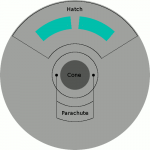
This is a big problem, discussed in the first page of this thread and I think a bit in the other thread as well. I thought that the parachute might be able to fit in the nosecone of the craft. The only problem is that the nosecone opens (see drawing; not like the DG's nose!) for docking, and I'm not sure the latches holding the cone closed will hold out or not.

Anything else?
 
Just had a sudden idea about docking to s station. Instead of using some fancy complicated clamp, why not use a small clamp designed to attach to one of the Station's grapple points? Then you save some space beause I don't think the RMS end effector clamp is that big.
 
Well, they're both about the small orbital craft. Right?

OK, but do they serve a different purpose, or can one of them be closed? My guess is that the other thread will be more about the actual add-on development, and this one about the idea behind it.

Today's space suit designs are extremely bulky and unwieldy. A much better design would be a tight rubber suit that pushes in on the body to simulate air pressure. This suit would not have to be pressurized, except for the helmet.

I was a bit skeptic about this one, but Wikipedia isn't completely negative; only this:
Wikipedia said:
Unfortunately, a number of problems also turned up, primarily related to the problem of keeping the suit in strong mechanical contact at every point on the body. Concavities or small folds in the fabric could lead to fluid pooling in the gaps, and the crotch area proved extremely difficult to tailor successfully. To fill out these areas, small pads of polyurethane foam were inserted into concavities and were successful in most problem areas. The suits also had to be tailored to each individual, although the same was true of the earlier Apollo suits. The largest difficulty was donning and removing the suit. In order to effectively provide the minimum pressure of 4.3 psi necessary for human physiology, the suit must be extremely tight-fitting, making donning and doffing a highly strenuous task.
It's not completely current-tech though.

The only problem with doing an EVA mission immediately after arrival in orbit is that vomiting in a spacesuit can be fatal.
And the same will be true for an astronaut entering orbit in a spacesuit. If the capsule isn't pressurized, the helmet can not be opened. How much weight would be added to the capsule by making it pressurized? I guess the skin already needs to be strong enough for aerodynamic forces during re-entry, and needs some kind of heat management for its in-vacuum phase. Anyway, pressurizing the thing is probably easier than making advanced vomit-removal equipment.

There is no escape tower, though: the reentry retros are used instead. Rocket is solid-fueled two stage, extremely simple.

I guess an escape rocket needs to have a very high thrust, to accelerate the capsule away from the rocket even when the rocket itself is still accelerating.For de-orbit, high-ISP is preferred, which gives you different kinds of rocket. But if you want to cut down the number of parts, I guess you can simply make the service module engine very strong and inefficient. That's the one you want to use for de-orbit, right?

Zatnikitelman said:
why not use a small clamp designed to attach to one of the Station's grapple points?
How strong are those grapple points? I guess that especially the torques can be a problem when the astronaut enters/leaves the capsule. Maybe use a flexible connection that absorbs strong fluctuations?

I thought that the parachute might be able to fit in the nosecone of the craft. The only problem is that the nosecone opens (see drawing; not like the DG's nose!) for docking, and I'm not sure the latches holding the cone closed will hold out or not.

I also made a drawing (see below): maybe the parachute can be stored in a way asymmetrical to the cone.
On the other hand: if the astronaut will wear a rubber pressure suit, my option will become even more attractive: let the astronaut wear the parachute, instead of attaching it to the capsule. The capsule won't be re-usable anyway, and this avoids having complicated landing equipment. Just let the capsule crash, and let the astronaut sky-dive to the ground from, say, 4 km altitude.
 

Attachments

  • parachute.png
    parachute.png
    5.9 KB · Views: 11
The capsule could be left to its certain doom on the ground. It could save a bit of weight to have the pilot jump out, but what about that paracute? I've heard in the other thread I think that the parachute could fit in a slightly oversized pants pocket. Sonds pretty flimsy to me. But then, the MER parachuts fit in a can 10cm across, right?

The capsule parachute has no problem with being located asymmetrically.

I'm pretty sure a grapple point will be pretty strong. The torque also shouldn't be a problem. Wasn't the Hubble serviced on the end of the space shuttle arm?

There was another idea also in the other thread, I believe. Having the spacecraft remain grappled to the arm would render the arm unusable, because it's already got something. So, someone proposed attaching the spacecraft to an attachment point somewhere where oxygen, nitrogen, electricity, and other stuff could be transferred. But the entire point is to have docking with direct crew transfer. See the other thread to get some more ideas. So far, docking with an adapter module (possibly inflatable) seems the most promising. Otherwise, we'll have to go with the attachment point. The craft is far too small for a typical dock.
 
Back
Top