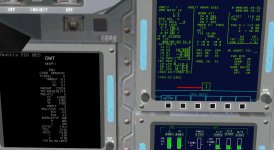
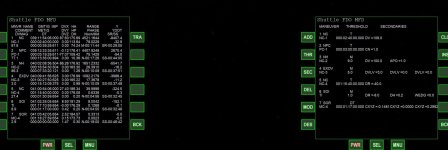
Shuttle FDO MFD

Potentially silly question: when the first maneuver is deleted, should the secondaries of the next maneuver always be deleted? Could this be automated?

 
Potentially silly question: when the first maneuver is deleted, should the secondaries of the next maneuver always be deleted? Could this be automated?
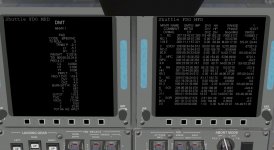
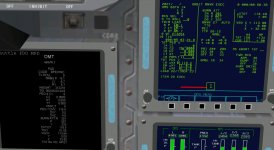
It probably could be automated, but if you forget to delete it then the MFD will give an error that tells you exactly what went wrong, at least in the case of the three iterator types (NC, NH and NPC with their constraints). Then you just need to find the constraint that causes an issue and delete it with the help of the DES button. Should be easy enough.
 
About STS-114 I have a couple of questions
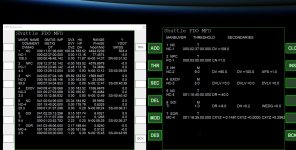
NC-1: after launching the scenario I calculate, transfer and load the burn data but I am confused about which TIG I should use for the burn since the Man Eval Table TIG differs from the Detailed Maneuver Table (screenshot below)
0002.jpg


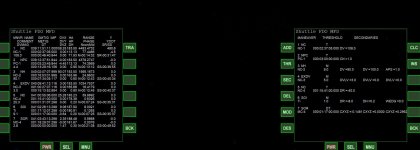
also the target orbit calculated by FDO is 162x127 NM while SSU , once the data are fed into OPS202 gives me a different orbit (150x134 NM)
0004.jpg
I tried using the Man Eval Table TIG for the SSU burn but the orbit still won't match..


I am sure it'd me doing something wrong, I just don't know what it is..


Last thing: I guess speeding the sim time messes up all the data
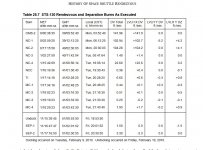
After time accel up to x1000 I did recalculate the data with FDO MFD and the results are quite different. it shows now a lower DVtot (115.4 fps) and the TIG has moved 3 minutes later
0006.jpg


Is it due to non spherical gravity sources enabled or is it FDO MFD that doesn't like time warp or maybe both things together?
 
About STS-114 I have a couple of questions
NC-1: after launching the scenario I calculate, transfer and load the burn data but I am confused about which TIG I should use for the burn since the Man Eval Table TIG differs from the Detailed Maneuver Table (screenshot below)

Yep, they differ because of an option on the transfer page. OPT vs. IMP. With the OPT option the TIG is moved back by the burntime divided by 2. The reason for this is that the previous pages (constraints and evaluation table) calculate the burn as if it happens instantly, so it doesn't take into account which thruster is used for the burned. That is done with the OPT option and then displayed on the Detailed Maneuver Table. So you should always use the TIG and DV vector from the DMT for the OPS 202 inputs. That makes sure that the trajectory after the burn is as desired.

also the target orbit calculated by FDO is 162x127 NM while SSU , once the data are fed into OPS202 gives me a different orbit (150x134 NM)

I tried using the Man Eval Table TIG for the SSU burn but the orbit still won't match..

I am sure it'd me doing something wrong, I just don't know what it is..

I'll have a look, but it's probably that the FDO MFD doesn't calculate those quite right as finite burns. Shuttle computer gives the better predictions. The calculation of those parameters isn't connected to the calculation of the burn itself, so the TIG and DV should still give very accurate results.

Last thing: I guess speeding the sim time messes up all the data
After time accel up to x1000 I did recalculate the data with FDO MFD and the results are quite different. it shows now a lower DVtot (115.4 fps) and the TIG has moved 3 minutes later

Is it due to non spherical gravity sources enabled or is it FDO MFD that doesn't like time warp or maybe both things together?

Definitely make sure that the gravity setting you have enabled in Orbiter matches the one in the OMP Executive Menu. Orbiter supports both and the MFDs should support both, but they need to match. I haven't ever tried 1000x in SSU. One thing that it could be is that Orbiter stops doing the nonspherical gravity calculations at a certain timestep length, but I believe that only happens at even larger time accelerations than 1000x.
 
Hey Indy, I am setting up STS 130 ( quite nice with all the documentation about it in the History of rendees vous book)

How long does it take you to iterate the solution? It always shows Iterating... for a long time for me.

Where did you find all the timeline for burn concerning sts 126 ?
 
Last edited:
Hey Indy, I am setting up STS 130 ( quite nice with all the documentation about it in the History of rendees vous book)

How long does it take you to iterate the solution? It always shows Iterating... for a long time for me.

Instantly for spherical gravity, one or two seconds for nonspherical gravity in my experience. So you are definitely getting some bug, normally it would show an error message for too many iterations. What you can do is press CLC again, that stops the iteration.

Maybe you can provide the scenario and the save file from the MFD, then I can check what goes wrong. And I already have another release almost ready for later today that will fix some more issues.
 
Yep, it is on my side.
Even to calculate STS 114, it never stops to iterate.

I am sending you the files, thanks :)

Yep, it is on my side.
Even to calculate STS 114, it never stops to iterate.

Here the scenario and mission file for SSU :

Launch 8 feb 2010 at 09:14 ( MJD 55235,3848 // 2010:039:09:14:06)
ISS orbit of 188 x 183, Phase angle of 90 ° for a FD 3 Rendez vous ( 88 ° in the forecasted Nasa Flight plan, 92 in real after OMS 2)

I use CMG add on with Default ISS

View attachment STS 130.zip


And there Initial draft of STS 130 FDO

View attachment STS-130.txt


I Messed up with Spherical and non
Indeed, in spherical it is quite quick to show " too many iterations"
I will need to refine the plan :)
 
Last edited:
Hmm, I think the issue is the burn after the NPC maneuver. The only constraint for its TIG is to happen 5.0 revolutions after the previous (NPC) maneuver, but the NPC TIG can change and is not set at or close to apogee/perigee. So that will make the following burns not happen at apogee or perigee as well. I actually had this set up differently in a previous version of the MFD, where the NPC TIG gets ignored, so that all the non-NPC burns are still happening on one maneuver line, so either perigee or apogee. The examples in the FDO handbook had me confused about this, but it seems like the example maneuver plans are missing some more constraints to properly work.

So what you probably should do is to have an additional secondary constraint on the NC-3 burn. It should happen at apogee, so add the secondary constraint "APO 1.0" to it, so that it is set at the next apogee. If that makes it one revolution too late just decrease the threshold value of it from 5.0 to 4.0 or so.

Also, you gave me a launch scenario, but I assume you were only using the MFD on orbit, right? It can't simulate an ascent, so it will only work after MECO. On the launchpad it would be no wonder if the iteration doesn't work. :lol:

EDIT: Launched your scenario and had the same result as you. It's better when I remove the NPC burn from the plan, but it gives weird results then. Finding the issue will take a bit longer than I hoped, but there should be an update in the next few days.
 
Last edited:
Also, you gave me a launch scenario, but I assume you were only using the MFD on orbit, right? It can't simulate an ascent, so it will only work after MECO. On the launchpad it would be no wonder if the iteration doesn't work

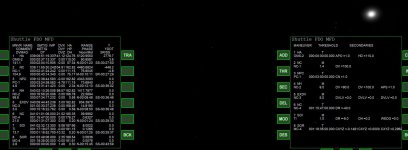
That might be the solution, I was trying to iterate on ground :cheers:

Thanks for testing, it was a rough draft of the flight plan.
I will work on that now.
Good Idea for the APO.

The APS secondary constraint will try to match both line of apsides?

Where do you find data on STS mission like the one we have on STS 130 in the rendez vous history book ?

---------- Post added at 10:09 PM ---------- Previous post was at 09:47 PM ----------

To force it on a Perigee, is it PEO=1.0 ?
 
Alright, With fine tunning, it works better :)
So far, it gives me a rendez vous time as close as 2 mn compared to the real mission.

Really powerful tool, and so many way to shape our rendez vous.
Awesome work


Screenshot_10.jpg

FDO.jpg


Could explain me how to use DES button to erase a secondary constraint ?
 
The APS secondary constraint will try to match both line of apsides?

Nope, it constraints the maneuver to happen at the next (or 5th or 10th or whatever) apsis, so either apoapsis or periapsis.

Where do you find data on STS mission like the one we have on STS 130 in the rendez vous history book ?

Not in that format unfortunately, but I found the mission reports for all Shuttle missions on L2. A lot of them seem to be out there publically though, not sure if all. And I just took the time of ignitions for all the OMS and RCS burns and derived from that e.g. how many orbits there were between two burns. Takes some trial and error to get it right, but it works. If you don't have the mission reports then I'm sure you can still find the TIGs of all the burns somewhere online, at least for the last few years of Shuttle missions.

To force it on a Perigee, is it PEO=1.0 ?

It's PER, not PEO.

Alright, With fine tunning, it works better :)
So far, it gives me a rendez vous time as close as 2 mn compared to the real mission.

Really powerful tool, and so many way to shape our rendez vous.
Awesome work


View attachment 16408

View attachment 16409

Some notes on this. I wouldn't fix the TIG for MC4, at least not this early on. That can cause a bunch of issues. It should be a DT from TI to MC4 of 000:01:16:54, that's the usual value. The last TIG that should be fixed is NC-4 or, if it exists in the plan, a NH burn that happens 0.5 revs before NC-4. That's all you need to move the terminal phase of the rendezvous around to achieve the right lighting conditions. EDIT: Ah, and that's why the earlier versions of the plan probably didn't work, because you had set e.g. the NPC maneuver to happen at 1 second of mission elaspsed time and not one second after the previous maneuver. There probably should be an error if it finds the TIG of a maneuver to happen before the previous maneuver.

Then, only a 4.45 ft/s plane change burn? That is very nice. Are you using spherical or nonspherical gravity? Did you use a TLE for the ISS or did you modify its orbit? And did you launch on time or changed that?

And lastly, I am confused about the rendezvous profile in general and how it can work. NC-2 is supposed to be a NH type maneuver, but it happens at apogee. So it can't really control the delta height. Well, it might be able to if the orbits are very elliptical and just changing the phasing would have an effect on the DH. I know the evaluation table in the History of Shuttle rendezvous document says that NC-1 is a NC maneuver and NC-2 is a NH maneuver, but in the relative motion plot it seems more like it's the other way around. Very weird.
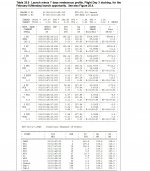
Could explain me how to use DES button to erase a secondary constraint ?

Ah yeah, I forgot to make that self descriptive. I'll add that to the input box. The format is: "Maneuver Secondary". So to delete the 4th secondary constraint of the 2nd maneuver in the table you need to input "2 4".
 
Last edited:
it constraints the maneuver to happen at the next (or 5th or 10th or whatever) apsis, so either apoapsis or periapsis.

Ok, good :)
I finally found the 3 rd part of FDO Handbook on L2.
Really interesting.
So much people and Docs around Nasa Programms, quite fascinating.


the NPC maneuver to happen at 1 second of mission elaspsed time and not one second after the previous maneuver.

Yep, I put a T instead of DT in Threshold.


Then, only a 4.45 ft/s plane change burn? That is very nice. Are you using spherical or nonspherical gravity? Did you use a TLE for the ISS or did you modify its orbit? And did you launch on time or changed that?


Spherical, I will try with non though and nodal precession, more fun and realistic :)

I created a flight plan to fit the ISS state vector at time of launch ( Sma and Ecc, and Mean Longitude to have the correct phasing)

I launched 300 sec before the DN. I found that in Orbiter and with SSU, it is the sweet spot.
It gave me Rinc of 0.01 ° ( never above 0.05°)

I guess with nodal precession, it is better to have a more eastward LAN to catch up ISS LAN later and decrease the NPC at PC burn.


And lastly, I am confused about the rendezvous profile in general and how it can work. NC-2 is supposed to be a NH type maneuver, but it happens at apogee. So it can't really control the delta height. Well, it might be able to if the orbits are very elliptical and just changing the phasing would have an effect on the DH. I know the evaluation table in the History of Shuttle rendezvous document says that NC-1 is a NC maneuver and NC-2 is a NH maneuver, but in the relative motion plot it seems more like it's the other way around. Very weird.

Yes, I do agree. It is surprising compared to what we are used to ( like your STS 114), whom I more familiar with.

I think in their philosophy, it is depicted as NH because it is the last burn ( except the EXDV which is more an over phasing protection burn than a proper phasing burn) before the final NC burn to set up SOI/R.

But with that Rendez vous profile, NH burn happens indeed quite early on.


Screenshot_10.jpg


Ah yeah, I forgot to make that self descriptive. I'll add that to the input box. The format is: "Maneuver Secondary". So to delete the 4th secondary constraint of the 2nd maneuver in the table you need to input "2 4".

Great, thanks :thumbup:
 

Attachments

  • Screenshot_11.jpg
    Screenshot_11.jpg
    139.7 KB · Views: 160
That would be awsome to have the plot motion, I am really fascinating by those plot.
I love the one with Y on abcissa and Z on ordinate :)


EDIT: I tried the scenario with non spherical and nodal prec.
It is Ok ish excpet for the NPC :)
Really need to launch on an east ward Lan or In plane plus something
Need to quantify that now

Screenshot_12.jpg


Just to make sure, the NPC with a 0 WEDG constraint at Ti will planify a burn to null the delta Y at Ti ?
 
Last edited:
I tried the scenario with non spherical and nodal prec.
It is Ok ish excpet for the NPC :)
Really need to launch on an east ward Lan or In plane plus something
Need to quantify that now

For me it worked out great when I used an ISS state vector from TLE and hoping that the Shuttle launch time is at the in-plane time. If that is the case then the trajectories should be very close to reality and thus give small NPC burns.

I think there actually should be 9.5 orbits between NC-1 and NC-2, not 9.0. And I tried making NC-1 the NH burn and NC-2 the NC burn. The problem with such an early NH type burn is that it has a big influence on the phasing, so it shifts the time at which the DH constraint is applied (the TI manevuer). And that causes it to iterate very badly. The orbits are elliptical and the line of apsides aren't aligned yet.

I wonder if the fix for that is the lighting constraint "NITI = -28" that the basic, TIG-less rendezvous plans seem to have. That basically keeps the TIG for the constrained maneuver fixed, because the lighting is based on the target orbit, not the Shuttle one. I think I'll implement those lighting constraints and will see, if that improves the behavior of the early NH burns. Of course after the initial plan is working, more TIGs are fixed and varied to get the lighting and TI DVZ even more right. And the NH iteration probably prefers fixed TIGs.

Just to make sure, the NPC with a 0 WEDG constraint at Ti will planify a burn to null the delta Y at Ti ?

Yes, it will try to make the orbital planes of both vehicles the same at the time of the TI maneuver.
 
I used an ISS state vector from TLE

What is TLE ?
With trial and error, I think around 0.15 ° of diff between Lan after MECO gives great results for that type of Rendez Vous.
Almost there for the full mission :)


I think I'll implement those lighting constraints and will see, if that improves the behavior of the early NH burns. Of course after the initial plan is working, more TIGs are fixed and varied to get the lighting and TI DVZ even more right. And the NH iteration probably prefers fixed TIGs.


Very nice. There are indeed a lot of Lighting Constraint in the book
 
Thanks GLS.
:thumbup:


Alright, I think I finished with STS 130 with spherical Gravity

Screenshot_14.jpg


I am working on non spherical now.
A bit more tricky, a difference of 0.12 ° in Lan after Meco seems to work well, with a NPC of 15 fps max
 
New release: https://github.com/indy91/Shuttle-FDO-MFD/releases/tag/0.1.4-alpha

Mostly bug fixes and smaller changes. I also added all the secondary lighting constraints. These act like TIG modifiers, so from the threshold time they will find the next occurance of the desired lighting condition. These new constraints are:

LITI/NITO: Time from sunrise
LITM: Time from noon
LITO/NITI: Time from sunset
NITM: Time from midnight

So for example the secondary constraint "NITI = -36" will place the maneuver at 36 minutes before sunset. The FDO handbook doesn't say what the difference between e.g. LITO and NITI is. Maybe it's just a different name for the same thing.
 
Back
Top