Idea Second Orbiter window

4throck

Enthusiast !
Joined
Jun 19, 2008
Messages
3,502
Reaction score
1,012
Points
153
Location
Lisbon
Website
orbiterspaceport.blogspot.com
For dual screen setups, the ability to have a second Orbiter window would simplify things.

The second window only needs to show the external view (VC would be a bonus, but not crucial) with the possibility of choosing a viewing angle.
That way, you could use your secondary monitor as a side window, for example.
There's no need for interaction with the second view.

I know that Camera MFD worked kind of like this, but it's too slow with the standard client under full screen view and incompatible with the new ones.
 
I know about that, and tried it.
It's too complicated, because you need to have 2x the disk space to run 2 Orbiter installs, uses 2x the memory, etc.
And to run 3 or 4 monitors... you would need that many installs.

The best example of my request is what MS Flightsim does.
Someting like this:
xOEw7.jpg


Camera MFD does this, but it's only fast enough for small windows. If I extend the MFD to cover the full screen, my FPS drops to 1!
 
Last edited:
I know about that, and tried it.
It's too complicated, because you need to have 2x the disk space to run 2 Orbiter installs, uses 2x the memory, etc.

Actually, you can run multiple Orbiter instances from a single install. Source: I developed the add-on in question this way :D

About memory, well... Orbiter is 32-bit, so limited to 4GB -- given that my machine has 16GB of RAM I could run 4 orbiters in parallel easily :D
 
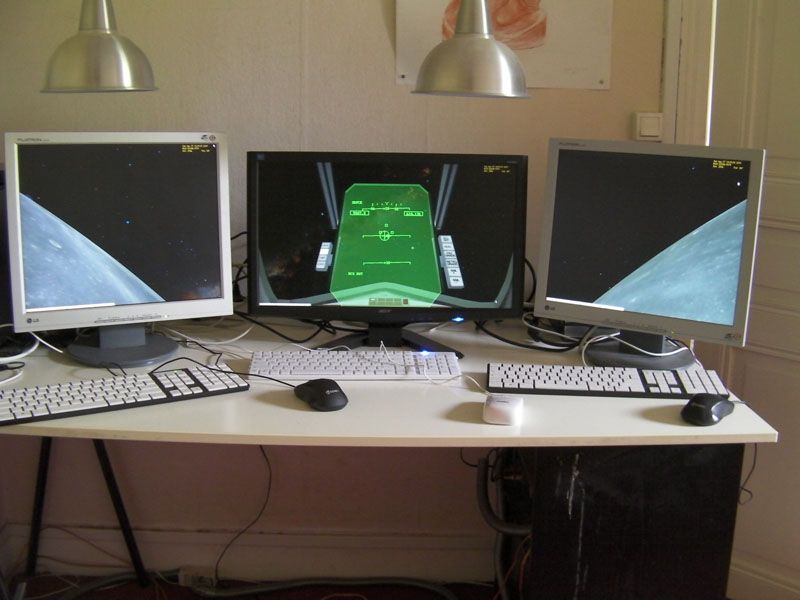
Mmh... my 2 cents :

SANY0042_zps230644b5.jpg


3 computers were needed for this, but it is doable with only 1 also, with Kamaz's add-on.
 
Ok, got that working on my machine and it's doable. Usage is not as straight forward or stable as I'd like, but it works. :thumbup:

The fact that you are running a second instance of Orbiter doesn't bog down my PC. Actually the second one loads faster than the first. Perhaps they are sharing resources?
 
The second instance loads faster because at that point the Orbiter files used on startup are already cached in memory via Windows' disk cache, so it doesn't have to wait for disk I/O like the first instance did. :tiphat:
 
Back
Top