Science Rapid Interstellar spaceflight, exploration and,colonization thread

How much energy do you want to use for accelerating the muons fast enough that they keep on existing for more than ten minutes?

The half-life of a Muon at rest is just 2.2 µs - for having 50% of the muons left after one second, you need already a Lorentz factor of 500,000 - which corresponds to [math](1-2.5 \cdot 10^{11}) c[/math]

I don't know how much closer to c you want to get, but that is already so close that my pocket calculator returns 1 for the ratio between velocity and speed of light.
 
Last edited:
And what if the muons decay while you are accelerating them?

How do you suggest the creation of muons aboard the ship?
 
How much energy do you want to use for accelerating the muons fast enough that they keep on existing for more than ten minutes?

IDK the energy comes from a reactor in the middle of the ship... The muons will be harvested/created... And will only be use to start and boost the fusion...
 
Last edited:
"A reactor"?

How massive will this reactor be? Will it be fission or fusion? How will you deal with the fuel supply and shielding and waste heat requirements? How efficient will it be?
 
IDK the energy comes from a reactor in the middle of the ship... The muons will be harvested/created... And will only be use to start and boost the fusion...

How?

Have you ever even slightly wasted a thought on what in Goddards name you are babbling here?
 
"A reactor"?

How massive will this reactor be? Will it be fission or fusion? How will you deal with the fuel supply and shielding and waste heat requirements? How efficient will it be?

It's a fission reactor high generation... The exact type and process I havnt worked out yet... But when the fusion engine is started the excess heat will be used to drive a turbine and thus possibly creating more muons in the generator...
 
It's a fission reactor high generation... The exact type and process I havnt worked out yet... But when the fusion engine is started the excess heat will be used to drive a turbine and thus possibly creating more muons in the generator...

TANSTAAFL! :facepalm:
 
TANSTAAFL! :facepalm:

Well i have to admit we need to be giving suggestion instead of having me babbling like a complete idiot...
 
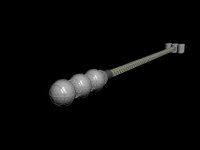
My most recent model...
 

Attachments

  • voy2P.jpg
    voy2P.jpg
    3.6 KB · Views: 21
I have a problem how would one store positrons for antimatter-catalysed fusion and how does it work. Does positrons have a special interaction with helium 3/ duterium that anti atoms dont...
 
Has anyone heard of the Sanger ablative concept yet... For my crewed ship I would like to use a large disk 1/2km wide with lithium-duteride covering... When a beam of positrons come out of small holes of the disk it curves into the ablate and reacts causing thrust... Is this a logical scheme or just total monkey garbage?
 
When a beam of positrons come out of small holes of the disk it curves into the ablate and reacts causing thrust... Is this a logical scheme or just total monkey garbage?

well, it would certainly produce thrust... but I somehow doubt that it would be enough to be of much effect. What you have here is just a rocket with solid propellant and, as I would assume, one hell of a lousy ISP (unless that ablation is more along the lines of a rather huge explosion, but we have Orion for that...) combined with low thrust. It couldn't get much worse...
 
well, it would certainly produce thrust... but I somehow doubt that it would be enough to be of much effect. What you have here is just a rocket with solid propellant and, as I would assume, one hell of a lousy ISP (unless that ablation is more along the lines of a rather huge explosion, but we have Orion for that...) combined with low thrust. It couldn't get much worse...

http://www.niac.usra.edu/files/library/meetings/fellows/mar06/1147Smith.pdf
They talk about sanger concept for a mission to mars...
 
Well, it is more or less what I thought it to be... bombard an ablative reflector with positrons to produce gamma rays, which will in turn be reflected away and drive the ship forwards. Kind of a "continuous orion", but I cannot really imagine it to produce much thrust, but ISP should be ok (I didn't realize that the result of the ablation would be gamma rays), but they didn't provide any numbers in that article... no estimates on thrust whatsoever.

But it's a literal equivalent of shooting your own spacecraft continuosly with gamma rays. Not much wilder than orion, where you're nuking it I guess, but it still doesn't sound too comfortable...
 
How do you reflect the gamma rays? :blink:

One idea of mine, is to eject specially designed pellets of dense material (lead, tungsten, depleted uranium) into a reaction chamber and strike them with a beam of antimatter; the antimatter anihillates with a small amount of the pellet, releasing gamma rays and pions; these turn the pellet into high-temperature expanding plasma, which radiates photons at a lower wavelength, which are reflected by a highly efficient mirror.

The rapidly expanding plasma (remains of the pellet) have to be deflected magnetically, so they don't damage the mirror and other supporting infrastructure; the velocity of these particles will be relatively low, but redirecting them also adds extra thrust.

The two main problems with this concept that my uneducated mind can work out, are antimatter-exhaust energy efficiency, and the reflector. Here the "exhaust" has to directly interact with the spacecraft, and a highly reflective mirror will be needed to reflect the energy without destroying the ship (it needn't be a totally reflective mirror, just a very efficient one). Following that are other niggly problems such antimatter beam collimation and pellet mass.

An advantage is that you could hybridise the system to create an antimatter catalysed fusion rocket, for lower specific impulse manuvering.

The advantage of an antimatter engine (or an antimatter beam core drive, at least) is that the waste photons are gamma rays, and gamma rays tend to go through stuff. Make your spacecraft transparent to gamma rays (make it out of light materials, such as beryllium) and a large proportion of the waste energy can simply escape into space. Of course you will still have some heating, as well as transmutation and embrittlement issues, there is no free lunch in spaceflight.

If you place your actual anihllation/fusion/Big Bad Radiation Source area far ahead of the ship on a cable (Valkyrie), you can potentially even house your propellant stores far away from the radiation-intensive zone, and then severely dumb-down your engine technology to make it withstand high radiation and temperature. You'll still need to do something... odd... with magnets in the drive system, because superconducting magnets need to be kept cold, or at least cool, even if we have a superconductor that has a transition temperature at 200 degrees C, the engine could be many times hotter, which would necessitate some sort of seperation from other components as well as a seperate cooling system.

When reading about black hole propelled spacecraft, I read something about an "electron gas mirror" being used to reflect gamma rays for propulsion. Black holes (and their problems) aside, what is an "electron gas mirror", and how could it be used to reflect gamma rays? Could it be used practically?
 
Well I have no intention of reflecting gamma rays but the energy produce from the anihilation of positrons with electrons could produce energy to power fusion of boron hydride... And the charged particles that are release from the fusion could be accelerated using superconducting magnets...

On the other hand the craft could be a traditional fusion drive with positrons as a catalyst... The fuel will either be helium-3 or dueterium(though I do have doubts of duterium)... And the fuel will be stored in 5 fuel tanks 15m in diameter... The positron will be stored in a cyclotron type of device because I thought pennings are to hard to control...
 
How do you reflect the gamma rays? :blink:

Not as shown in the drawings. Sänger didn't draw concrete reflectors but only symbolic ones, you can only reflect them with really small angles of incidence.

The reflector/nozzle for such a engine would have to be HUGE. Really huge.

---------- Post added at 08:47 PM ---------- Previous post was at 08:46 PM ----------

Well I have no intention of reflecting gamma rays but the energy produce from the anihilation of positrons with electrons could produce energy to power fusion of boron hydride...

again: The energy by this reaction is in the form of gamma rays. You either need a good gamma ray absorber or a good gamma ray reflector.
 
I'd imagine any sort of gigantic positron trap, on that scale, would be absolutely (prohibitively) massive.

As I can understand it, suspending frozen antihydrogen is relatively easy ( "easy" is a very, very vague term here when we're discussing somehow levitating hundreds to thousands of tons of instant-gamma-ray-death), but decelerating antihydrogen after creating it in a particle accelerator is pretty difficult, and putting it together into atoms is difficult... and slowing down those atoms into a state which is storable is difficult...

Though I would say that once you solve all those "minor" problems, antihydrogen is probably a far better storage medium, than positrons on their own.

What you basically want to do is antimatter catalysed fusion. That's nice, but it'll also have a lower exhaust velocity. A lower exhaust velocity means you can't accelerate to the same velocity with the same amount of propellant, or you'd need a much larger amount of propellant to accelerate to the same velocity.

Why 5 tanks 15 meters in diameter? Did you do any calculations based on output, efficiency, reaction mass, propellant density, and ullage volume?

Why don't you want to reflect gamma rays? If you could (somehow, only Probe knows), you could make an engine with pretty impressive performance. It's the how, not the why, that's the problem.

EDIT:

The reflector/nozzle for such a engine would have to be HUGE. Really huge.

Sanger's concept, or my stitched-together-from-bad-knowledge concept?

I'm pretty sure that my mirror would have to be large, even with a reflector that has a very high albedo; if it needs a prohibitative size (something like 20 kilometers, maybe), then it's pretty much back to using Unobtanium... :rolleyes:

I'm trying to wrap my head around nozzle geometry based on gamma-ray grazer mirrors... :blink:
 
Last edited:
And yes I have no calculations as I am horrible at physics... I still do not know how much fuel is needed for anything... Nor how much this thing will weigh payload and fuel together...

Help!!!
 
Back
Top