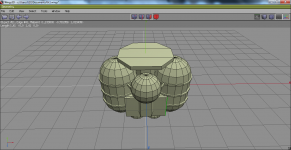
Request Planetary lander? What to land on Mars in?

Some fresher pubs are available from NTRS once the shutdown has ended:

Parametric Mass Modeling for Mars Entry, Descent and Landing System Analysis Study
Jamshid A. Samareh and D. R. Komar.

http://hdl.handle.net/2060/20110005491
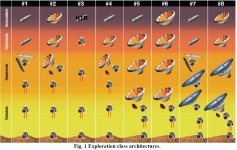
 

Attachments

  • mars_arch.jpg
    mars_arch.jpg
    85 KB · Views: 48
Well, the landing engines are still missing, but that could be fixed. The landing engines could be made modular, so we could use bigger/smaller engine packs for different planets.
Except that where do you realistically put landing engines on such a rig?
Are the three RCS-like cones on the sides it?

What could maybe be helpful would be the capability to reenter and land towards a beacon signal, if the lander should be anything sophisticated.
I'm yet to succeed in making an autopilot that could do that efficiently.

There are some inconsistencies in the design, the MAV in the MDV drawing has just one engine, this here uses 4 Delta II second stage engines.
What are they attached to? They appear to float on the tanks.

I found a lander here but it is still in beta:

Leo300 - Beta 1
Spacecraft3 Add-on, does not count.
 
Except that where do you realistically put landing engines on such a rig?
Are the three RCS-like cones on the sides it?

Yes.

I'm yet to succeed in making an autopilot that could do that efficiently.

Well, it is less a coding issue than a strategy issue. If the parachutes drop the MDV close enough to the target, it is just as simple as Galilean gravity model with Newtonian physics.

What are they attached to? They appear to float on the tanks.

Its just a Phase A study, there are no detailed engineering solutions yet, like telling how the structure connecting a thruster to the main structure looks like.

Which means: Artistic freedom for us.
 

So, they look about like that?
mdv-110413.jpg


Well, it is less a coding issue than a strategy issue. If the parachutes drop the MDV close enough to the target, it is just as simple as Galilean gravity model with Newtonian physics.
Sure, you need to guide it from orbit through air to the point. Not exactly easy.

Which means: Artistic freedom for us.
Then, what should a parachute look like?
Wishbone's paper make some nice pictures, but how such a parachute work?

We have 4 canisters on the craft, supposedly holding parachutes, so this design does not fit, no?

Lately, who's going to make it all?
I don't suppose meshes of the quality and colouration i've shown would be nice enough.

My current idea is a dial-a-lander concept, where you could put together a lander by given parameters. I can do the code, but unless you want to stick with the meshes above, someone's got to make the models.
 
Artlav, I tried your AddonMaker yesterday to sketch up a concept of Mars Transfer Vehicle from DRA 5.0, it is the way to go for me, being too dense to use Blender or Anim8or. With a bit of further customization, the whole Mars project can be attempted.

Re: chutes. See here: http://www.mrc.uidaho.edu/~atkinson...7 - Space parachute system design Lingard.pdf

Re: atmospheric guidance. Agree, the algorithm ain't easy to code, but I'll look at NTRS for clues.
 
Last edited:
Artlav, I tried your AddonMaker yesterday to sketch up a concept of Mars Transfer Vehicle
You may want to get a recent version, that old one was very primitive:
http://orbides.1gb.ru/orbf/meshmake-110414.zip
Includes a shipyard and a texture function viewer.
This version have full set of primitives and control functions.
All the blocks are now in blocks dir.

MDV sketch i shown is defined in blocks/mdv.txt

It's a nice parametric mesh, but i still want to know if they look good enough for anything.

The link is 404, btw.
 
Link fixed, and thank you for the meshmaker, the command-line viewer means I'll be able to edit and compile and view almost on the fly!
 
Link fixed, and thank you for the meshmaker, the command-line viewer means I'll be able to edit and compile and view almost on the fly!
Don't get used to it, it's a very dynamically evolving thing. Next version can easily turn incompatible with the current.
 
A while ago, I started this on Gmax but never finished it. I had big plans with virtual cockpits and stuff, but my lack of texturing skills killed it. It's based on classic MEM-Apollo style lander and Stephen Baxter's Voyage novel:

5619239675_3ed39f87e9_b_d.jpg


5619217343_6658bf29f5_b_d.jpg


177086124_5ecab2ef88_z_d.jpg
 
Last edited:
The Pegasus Ares will actually work in O2010-P1 if you install [ame="http://www.orbithangar.com/searchid.php?ID=3816"]this[/ame] over it. I just tried it now and it worked. It even makes it look better :)!
 
I just tried it now and it worked.
Not exactly. Moving the camera around often causes black screen of nothing.
Not a critical bug, but annoying.
Also the Orbiter's new camera handling is annoying... Shouldn't have missed that back in 2010.
 

My attempt at a lander...
 

Attachments

  • MFSTP.png
    MFSTP.png
    129.2 KB · Views: 10

Another video less boring...
i like the part when the first commercial hab arrives...
 
You could try the MEM, shaped after 1960s NASA concepts.
Download from http://home.arcor.de/francisdrakex/download/MEM-0b.zip

It is a forward-looking lander with chutes and retro rockets.
Once the atmospheric entry starts, the sequence runs automatically
until low above the surface to choose your landing spot in a final hover.

picture.php

Just managed to deorbit + land from 250 km orbit and return to 160 *160 km Martian orbit. (+ some fuel spare for randevous, not sure if enough) I probably could go even higher, but my bad ascent wasted more fuel than I expected. Truly, it is as the readme file states
This is a *very* early version
The RCS thrusters on the ascent stage and then the jettisoned crew module are not fully finished.
But I gotta admit, it works (2010P1) :thumbup:
 
Last edited:
For those not so much into reading the readme-file ("MEM.txt") ;)
The 'J' key separates the descend stage and creates the ascend stage as a new, tail-sitting vessel in the same location. Normally you do this when preparing for launch, but it should also work during flight in case the landing has to be aborted.

The ascent module is indeed unfinished and pretty tight on fuel. Getting into a 160 x 160 km orbit is a pretty good achievment!
 
Re: RCS - huge problem there, prograde etc. autopilots waste main engine (?) fuel constantly.

Re: ascent - no probs, one solution that worked for me was to approximate a two burn ascent by throttling the engine down to 10% after reaching necessary ApA and until circularization.
 
Back
Top