The good:
SEP-021. Tuesday, May 21, 2024. 02:30 UTC.
SDO-201
'Enterprise' has spent four years and 48 days in administrative and operational limbo pursuant to its previous involvement in the SEP-010/SEP-010b debacle of 2020. After
Constitution's own four-year-long heavy check at Edwards Air Force Base in California, and serving its own downtime at Cape Canaveral's OPF-4 for additional tests, checks, retrofitting, and general engineering overthinking,
Enterprise was finally cleared for a two to three day short mission designed to validate the orbiter's abilities to reach low Earth orbit plus a transfer orbit into GEO and return safely to Earth.
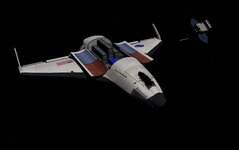
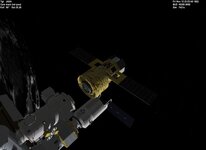
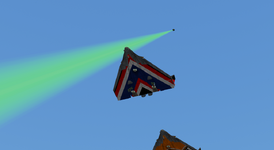
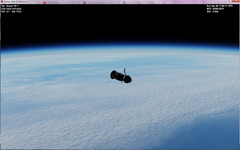
The thinking and operational hope is that at least one Shuttle-Derived Orbiter will be available to begin to retrieve satellites in their 'graveyard' orbits in order to prevent (or mitigate) the possibility of a kessler event while the other(s) tend to the International Lunar Outpost, the International Space Station, or on-orbit operations as demanded. Here, the Big 'E' is demonstrating its ability to do just that. From the perspective of a remotely operated drone, both
Enterprise and the Solar Dynamics Observatory are captured, with the SDO quite ironically occluding
Enterprise's flight deck.
Now, the bad:
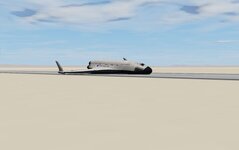 Enterprise
 returned successfully to Edwards on Wednesday, May 22, 2024 at MET 02:02:05:05, but not without incident: low-level windshear was reportedly experienced on final approach resulting in a MLG collapse upon touchdown. Landing rollout resulted in a painful deceleration and minor injuries to the crew.
Enterprise will be out on maintenance for no earlier than the rest of the fiscal year while damage to the hafnium diboride thermal protection system, and the underlying frame rails and stringers are assessed and repaired as necessary.
Crew Notes / Findings / Lessons learned on this flight:
- Per the SEP-010 mission in 2018, it has been proven that Constitution (and by extension, Enterprise) has circumlunar capabilities. In other words, both orbiters can get us to the moon and back given enough fuel.
- The fuel load for this mission was significantly less than what was taken up on SEP-010 and SEP-010b; obviously this was not a circumlunar mission profile.
- Given the above, and the fuel state at the end of the mission, the fuel load here was very close to margins and, in fact, overran the safety fuel budget. The crew DID have enough reaction mass to achieve GTO/GEO and return, but with a minimum of fuel to align planes and deorbit.
- We have proven that we have the basic capability to achieve a pinpoint GEO. More reaction mass will be required to realize the possibility of working effectively in such an environment, such as being able to successfully and consistently intercept and deorbit decommissioned satellites.
After-incident initial report:
- A mishap nearly destroyed the orbiter upon landing, which occurred less than two seconds before contact with the runway. The last recorded Z- acceleration was 16 feet per second which was thought to be well within impact margins.
- Upon initial inspection of the vehicle and further review of camera footage taken from Enterprise's landing, it was discovered:
- The main landing gear assembly folded visibly aftward upon initial impact.
- The MLG door assemblies were sheared off by contact with the runway surface. Both main landing gear trunnions, drag links, and actuating cylinders were torn free, and the MLG assemblies themselves were both crushed and torn apart by the orbiter acting upon them against the runway surface at 200+ knots.
- Surprisingly enough, none of the tires (filled with between 250 PSI and 350 PSI of nitrogen) were damaged enough in the incident to the point of rupture or overall destruction. Post-crash explosion hazards were discounted at the time and the tires were deflated without incident prior to removal from the site.
- A hydraulic leak was initiated by the forcible liberation of both main landing gear assemblies. Due to the nature of the high-temperature phospate ester (Skydrol) hydraulic fluid in use, a post-impact fire did not result.






![2024-03-17 14_25_21-OpenOrbiter [D3D9Client].jpg](https://cdn.orbiter-forum.com/data/attachments/37/37378-a773efd208f1b88ce2bf006918144bca.jpg?hash=p3Pv0gjxuI "2024-03-17 14_25_21-OpenOrbiter [D3D9Client].jpg")


 Korolev's GR-1 (GRAU index: 8K713, NATO code name: SS-X-10 Scrag) fractional orbital bombardment system (FOBS)