
That was my first impression when I first started this work: "hey, a typo... oh wait"Didn’t realize that it was correct in British English. So, just ignore me.

ORBITER-FORUM will be temporarily closed at 2026-07-23 18:00 UTC while we complete some OF maintenance tasks. The amount of downtime is expected to take up to one hour, but probably less.
That was my first impression when I first started this work: "hey, a typo... oh wait"Didn’t realize that it was correct in British English. So, just ignore me.

Ctrl+2 and you can pick the number you want.Excuse me if this is the wrong place, but what about adding the 2x, 4x time acceleration into the game (maybe assigning a separate key for this)?

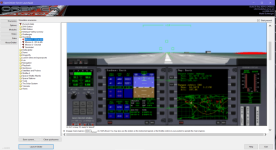
Checking and updating the scenario descriptions is also on my documentation "to do" list... but I haven't gotten there yet.Maybe some pictures from old Orbiter versions must be deleted?:
View attachment 41084
That's Orbiter 2024 RC2.

Years ago I did a quickstart-guide for TransX. Maybe this is helpful, see attached.I'm currently (re)learning how to use the TransX MFD,
Thanks! That doc is part of the sources in Orbiter, and I've already included that info.Years ago I did a quickstart-guide for TransX. Maybe this is helpful, see attached.

const double MAIN_PGIMBAL_RANGE = tan (5.0*RAD);
const double MAIN_YGIMBAL_RANGE = 1.0/7.7;
// main engine pitch and yaw gimbal range (tan)

// ....

void GimbalControl::SetMainPGimbal (int which, double lvl)
{
    VECTOR3 dir;
    DG()->GetMainThrusterDir (which, dir);
    dir /= dir.z;
    mpgimbal[which] = dir.y = MAIN_PGIMBAL_RANGE*lvl;
    DG()->SetMainThrusterDir (which, unit(dir));
}

// --------------------------------------------------------------

void GimbalControl::SetMainYGimbal (int which, double lvl)
{
    VECTOR3 dir;
    DG()->GetMainThrusterDir (which, dir);
    dir /= dir.z;
    mygimbal[which] = dir.x = MAIN_YGIMBAL_RANGE*lvl;
    DG()->SetMainThrusterDir (which, unit(dir));
}
I should have been able to figure this out, but my head is just too fried with documentation...
What is the yaw gimbal range of the DG: 7.4º or 7.7º?
C++:const double MAIN_PGIMBAL_RANGE = tan (5.0*RAD); const double MAIN_YGIMBAL_RANGE = 1.0/7.7; // main engine pitch and yaw gimbal range (tan) // .... void GimbalControl::SetMainPGimbal (int which, double lvl) { VECTOR3 dir; DG()->GetMainThrusterDir (which, dir); dir /= dir.z; mpgimbal[which] = dir.y = MAIN_PGIMBAL_RANGE*lvl; DG()->SetMainThrusterDir (which, unit(dir)); } // -------------------------------------------------------------- void GimbalControl::SetMainYGimbal (int which, double lvl) { VECTOR3 dir; DG()->GetMainThrusterDir (which, dir); dir /= dir.z; mygimbal[which] = dir.x = MAIN_YGIMBAL_RANGE*lvl; DG()->SetMainThrusterDir (which, unit(dir)); }
It seems a bit too optimized... maybe a comment would help... anyway, it is clarified, thanks!atan(1/7.7) = 7.4°
Why is the code like that? no idea haha, but it's a bit confusing...

Well, proof reading (doing that during lunch, and I'm only up to the DG section of Orbiter User Manual), or a more accurate Voyager-2 TransX plan, only until Saturn (let the user then apply the acquired knowledge to get to Uranus and Neptune). There are a bunch of (old) scenarios for that trip, but they start in 1976 and not 77...Anything I can help with on documentation?
I'm sorry, but this needs to be a little better.
Well, proof reading
um what!? wow. Yeah that would need to be fixed.but they start in 1976 and not 77...
I cannot speak to that, I presume the @Gondos and @Kozak would be the best to provide input for Lua documentation. the chm format is proprietary and microsoft; I see no reason to continue with it for new documentation.Also, there is the question of the Lua and scripting MFDs sections, and how much is in these docs (User Manual and Developer Manual) vs the .chm files.
I think trying the Voyager-2 trajectory in TransX exposes a big weakness in it: not taking into account the mass of the planets, which when going near Jupiter really messes up the precision of the plan. I can put some offsets (leaving Earth aiming to encounter Jupiter ~7 days after the historical date) to end up in the correct place at the correct time and fly-by all the moons as Voyager-2 did (after some more brute-force corrections during the approach), but this makes it impossible to perform informed course corrections, as there is no "clear" target to aim.
Even forgetting about the historical part, and just flying by the planets, aiming to Saturn from Jupiter requires several corrections as the vessel approaches Jupiter and the pulling begins, so I'm not sure of the value of this simplified Grand Tour version. I'll probably try it until the weekend, and then we'll see.
That said, it is a great tool, and I particularly like the Slingshot view, which illustrates very well the orientation of a flyby.


