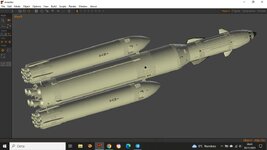
Project Nova HLV

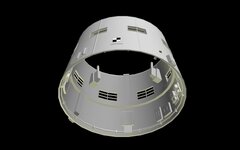
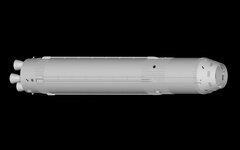
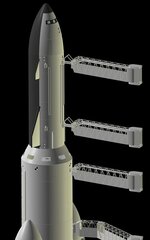
Redesigned interstage for the manned spacecraft. Now includes all the stuff previously in the core stage "instrument ring", and connects more smoothly with the spacecraft. A purely aesthetic modification. Please note the "pushers" on top

2.jpg
1.jpg
 
A name change?

In 2023, Stoke Space announced their reusable rocket, called "Nova". I have chosen to ignore it until now, but some thought on a name change is in order.

An alternative name I was considering from the beginning of the project was "Hercules". This comes from the classic sci-fi movie "Meteor" with Sean Connery, where the "Hercules" are a rocket system with a nuclear warhead, used to deflect an incoming asteroid. The USSR also has a similar system in the movie, called "Peter the Great".

In your opinion, should I change the name or just ignore Stoke Space Nova?
 
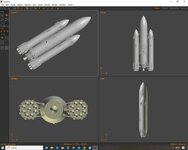
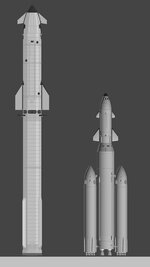
Another concept I was playing with is this "stubby" one, made with a shortened XCS core stage with a single engine instead of four, and the boosters directly attached to the fairings, which become structural. Energia-M vibes. The expected payload is about 47 tons in LEO. For BLEO applications, a HES-2 upper stage inside the fairings (shared with the single-stick Nova-I), but in this case the rocket would probably have to liftoff partially unloaded.
Image1.jpg
 
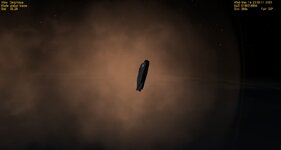
I'm returning to the project after the summer break. In these days, validation of the reentry profile of the Argo crew vehicle, using the Delphinus spacecraft from my FOI comrade Vittorio as a stand-in.

Image1.jpg
 
I discussed for a while with Grok :LOL: the weight per square meter the TPS should have in a BLEO-optimized configuration, considering shield ablation in the worst-case scenario and reusability in a nominal reentry. Starting from Starship's values and doing some calculations using the Stefan-Boltzmann law and other lucubrations, I arrived at around 31-32 kg/m2 starting from a baseline of about 12 (for LEO). Grok came to the following conclusions: 12.5 kg/m2 for LEO and 28 for BLEO. Not sure how reliable the calculations are, but not bad.
 
Thoughts about the lunar scenario. I could pursue a multi-mode approach.

Mode 1 is the direct mission: a dual launch of the partially reusable Nova V rocket, the first with the lander (Auriga), the second with the crewed spacecraft (Argo). Dual TLI and rendezvous in LLO. This is more or less the same scenario envisioned by the Chinese; the unfinished lunar exploration scenario of the Forum Orbiter Italia was also envisioned in the same way. This method is faster, but at the cost of two XCS core stages and one HES-4 upper stage expended for every landing.

Mode 2 envisions a special Nova V which features a new reusable vehicle (an uncrewed spaceplane) built around its XCS core stage. This particular version of Nova V thus becomes totally reusable. This spaceplane (XCS-R) is responsible for refueling the Argo exploration vehicle in LEO, which can now be launched atop a small Nova I. The advantage of having a much larger tanker, coupled with a much smaller crewed vehicle than Starship and intended only for crew (rather than crew plus cargo) is that, from my calculations, the number of LEO refueling missions is reduced from twelve/sixteen (Artemis) to just two.

The Auriga lunar lander can still be launched with a standard Nova V like in the Mode 1 scenario. The rocket would place the lander in TLI instead to LLO; the Auriga lander would be only partially fueled, with only the fuel needed to perform LLO insertion on its own; HES-4 upper stage of the rocket, equipped for long-term space operations, would then swing-by around the Moon, returning to Earth and using its remaining fuel to place itself in LEO once again, where it will be refueled by three reusable Nova V launches. HES-4 then will depart once again to the Moon, placing itself in LLO. The fuel aboard will be enough to refuel the lander multiple times, allowing for extended operations. The process will need a total of seven launches (up to sixteen if we want to rotate crews between landings) and will allow for three/four landings, all at the cost of a single expended XCS stage; all the other hardware would be reused multiple times.

I've performed the basic math, and it holds up; if I can, I will provide some kind of infographic to better explain my ideas.
 
Yuk! Turns out that I was wrong about the HES-4 stage: the fuel available once in LLO (after the first refuel in LEO) would be enough only for a single refuel of the Auriga lander. This imply that the HES-4 must travel from Moon to Earth and back for every additional landing. The refuel of the stage in LEO would require thee/four XCS-R tanker spaceplanes, depending on how much their payload will be (my current estimate is about 60 tons, and that would make three launches just enough to refuel the HES-4 stage). The advantage remains though, because we recover and/or reuse all the hardware; even if the HES-4 could be used only for two landings, this will save a lot of stuff (two core stages and another HES-4 upper stage). If we assume that the HES-4 can be used to refuel the lunar lander for, let's say, three landings, this means that the stage must remain in space, fully usable, for at least five/six months, accounting for a realistic launch schedule of the tanker spaceplanes and a comfortable duration of the lunar excursions. The IVF tecnhology, of ULA heritage (that is notionally implemented here) and ZBO (zero-boil-off), comes in handy in order to guarantee such a long service span.
 
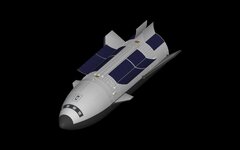
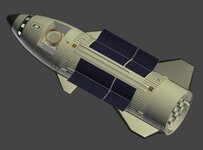
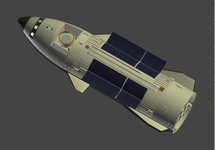
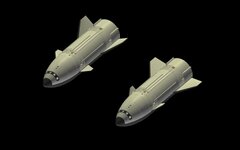
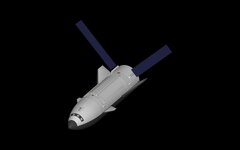
Solar panel solutions for the Argo vehicle. The first hypothesis involves a dorsal, V-shaped installation with extendable panels, but may interfere with docking maneuvers with the lander, since the docking port is also dorsal (between the cockpit and the propellant tanks). The second, more compact solution involves installing panels directly on the hull, part fixed, part deployable. The radiators are located on the unexposed side of the movable parts. I let the AI calculate the required panel and radiator surface area and adjusted the design accordingly.
1.jpg

2.jpg
 
Well, I let the AI (Grok) to refine its calculations with some new input, and seems that, after all, the body in stainless steel of my spacecraft helps a lot with heat management (apparently like in Starship), thanks to the high emissivity of steel, a factor I had forgotten. Seems that dedicated radiators are not necessary, simplifying my design (but they will be necessary for the lander, which is in aluminum for lightness). Also, according to Grok, it looks like the vehicle could be stripped of some panels, thanks to the help of the IVF modules (ULA heritage) I've installed internally. The resulting modified design looks like this (cargo bay opened with docking port exposed).

IMG_20251020_095019.jpg

This leaves me with some free space in the aft skirt, which could be exploited adding some other stuff. Speaking of which, I'm looking for info on Orion's high gain antennas for deep space communications, which appear to be phased arrays instead of classic dishes. This would further simplify my design.
 
Now some analysis of the theoretical CoG and CoP the reentry. That canard configuration looks cool but feels that renders the vehicle unbalanced. Could be necessary to swap the surfaces, placing the larger ones at center and the smaller at the tail. Stay tuned
 
Revised fins after a more accurate calculation of the CoG and CoP during atmospheric descent, with the help of Grok AI. The aft fins are showed with some deflection. Also, I've placed phased array communication antennas on the hull - two on the forward skirt, two on the aft skirt.

image.png
 
Revised fins after a more accurate calculation of the CoG and CoP during atmospheric descent, with the help of Grok AI. The aft fins are showed with some deflection. Also, I've placed phased array communication antennas on the hull - two on the forward skirt, two on the aft skirt.

View attachment 45406
The elegance and level of detail of this rocket are amazing.
:cheers::hailprobe:
 
Back
Top