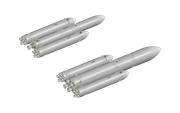
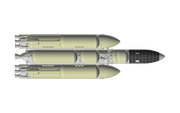
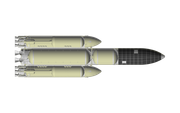
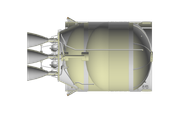
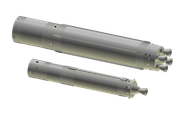
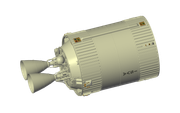
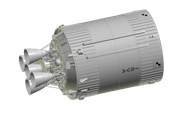
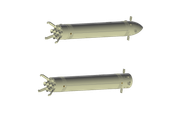
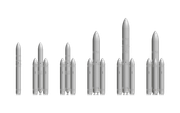
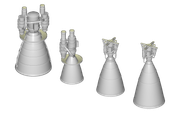
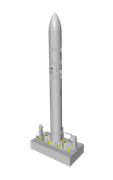
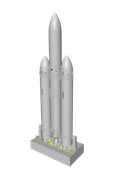
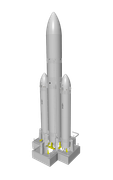
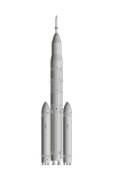
I've attempted to model these rockets at the best of my knowledge in the field. I learned a lot - as always, in the midst of such a complicated journey, you discover that your previous knowledge was incomplete at best.
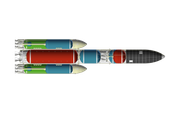
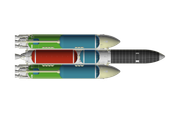
There are five, possibly six versions of the family: Nova I, II, III, IV, V, VI.
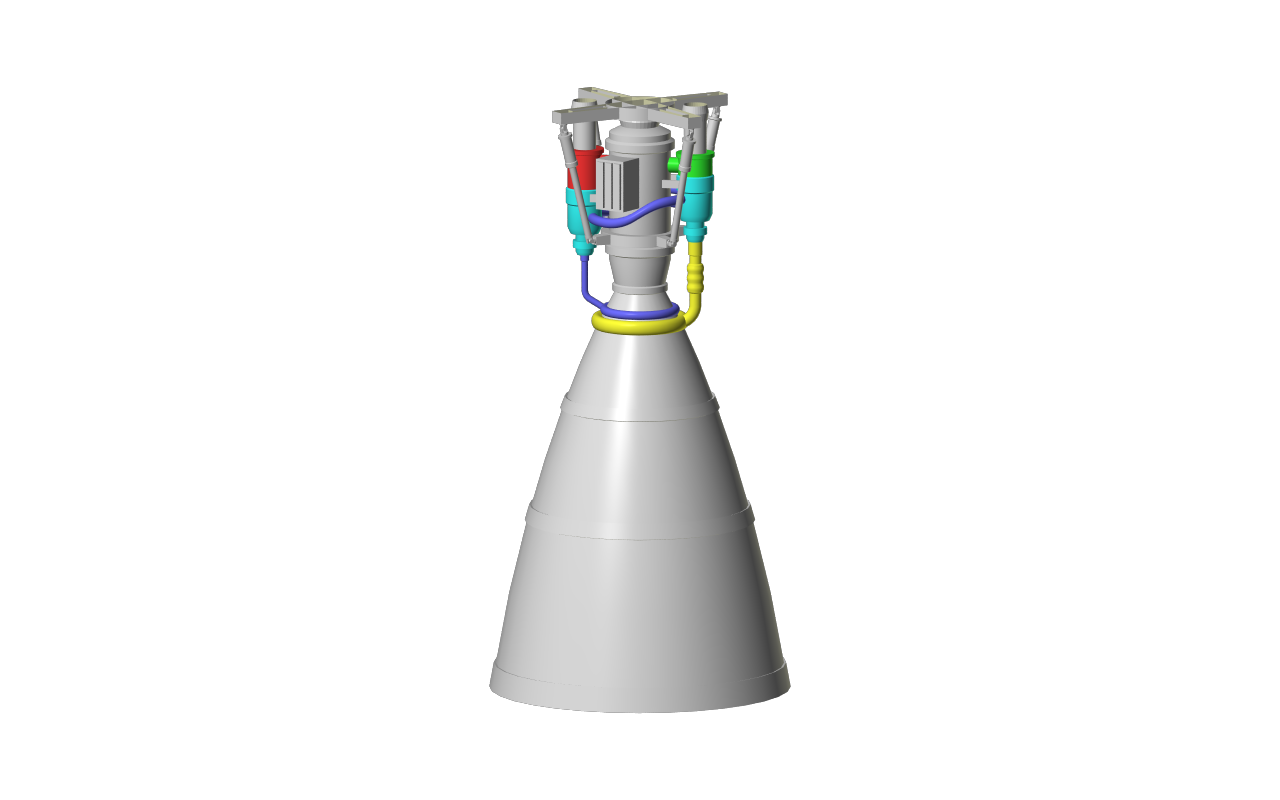
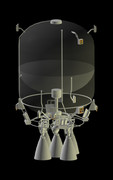
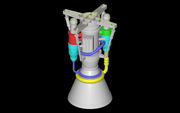
All the versions are based on a so-called Modular Common Stage (MCS), metholox, reusable (Falcon 9 style). Unlike Falcon 9, the stage is based on stainless steel, in order to allow a higher reentry speed and avoid the need of a reentry burn. The empty weight is estimated accordingly. The stage has four retractable landing legs between the engines. The mesh also features a header tank, four grid fins for attitude control, repressurization bottles, RCS groups, also for attitude control and ullage. The stage has five engines, common bulkhead and a 5.8 meters diameter. The engine, named Neptune A, is something between the Raptor 2 and the BE-4. From the former it inherites the full-flow staged architecture; from the latter it reprises the larger, cheaper, less compact configuration.
I'm not a programmer and the fellow programmers on Forum Orbiter Italia are long gone, so I must rely on Multistage 2015, thus the recovery is not simulated; instead, i've tried to model, in the spreadsheet I use for the performance calculation, the fuel consumption for RTLS (the only recovery style contemplated here).
All the versions except Nova I also features a cryogenic core stage, aluminium built, expressely designed to be disposable, in two versions, one also of 5.8 meters and the other 8.41 meters. They have the same engine, a slightly scaled down version of the RS-25 named Jupiter A, conceived from the beginning to be expendable, thus arguably cheaper. The small core, named LWCS (LightWeight Core Stage) has one of them, the large XCS (eXploration Core Stage) four. Nova II and III uses the small one; Nova IV, V and VI the large one.
Finally, we have two different upper stages for BLEO operations: HES-2 (5.8 meters) and HES-5 (8.41 meters). They are designed around the same engine (2 of them in the former, 5 in the latter), named Selene C, an expanded bleed hydrolox engine designed to be a good compromise between thrust and ISP.
"C" because it is the third incarnation of such an engine (my ideas varied a lot) and "selene" because the main goal is the Moon. A Selene D version, closed expander with larger expansion ratio, higher ISP and lower thrust, is envisioned for a manned lunar lander.
The acronym "HES" stands for "High Energy Stage" and is inherited from the old HES stages of the Jarvis rocket family on Forum Orbiter Italia.
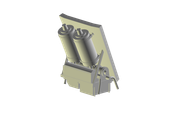
The goal for the HES stages is to be reusable in the sense that they could remain active in space for extended times, refilled and reused in different missions. To do so, they are both equipped with IVF stations (Integrated Vehichle Fluids) similar to ULA's, in order to assure power, pressurization, ullage, attitude for such extended operations.
While Nova I and II are designed for cheap, routine LEO operations and Nova III for GTO/GEO works and interplanetary robotic exploration, Nova IV and VI are conceived for heavy duties, still in LEO, and Nova V is tailored for manned Moon exploration with a lander of appropriate size. Estimated performances (RTLS configuration for the first stages/boosters) are as follows:
Nova I
LEO 16300 kg
GTO 4400 kg
GEO 900 kg
LTO 3300 kg
LLO 1500 kg
Nova II
LEO 39200 kg
Nova III
GTO 25600 kg
GEO 15000 kg
LTO 22300 kg
LLO 16800 kg
Nova IV
LEO 92500 kg
Nova V
GTO 63100 kg
GEO 38000 kg
LTO 55300 kg
LLO 42200 kg
Nova VI
LEO 127200 kg



 orbiteritalia.forumotion.com