News NASA's Future: The News and Updates Thread

Well I guess I am not to take the stance that NASA is just full of idiots that know nothing about their craft, worry about the wrong things, blow everything out of proportion and should best leave such things in the hands of casual observers.
 
regarding microbes:

Yes, what is harsh for one organism is comfortable for another. I feel comfortable at sea level, but if you pull deep ocean fish out of the water, their eyes pop out and swim bladders explode grotesquely out of their mouths, not to mention they can't breath or swim out of water, and I can't breath water but if i could would probably get hypothermia at the bottom of the ocean. i doubt your average martian microbe would last 5 minutes if released. who knows, maybe the atmosphere would be poisonous to them, or they can't handle the Ph of rainwater, salinity of the ocean or what have you

P.S. I would like to see penguins overrunning major ports all over the world
 
Last edited:
The article is a few months old, but still interesting.

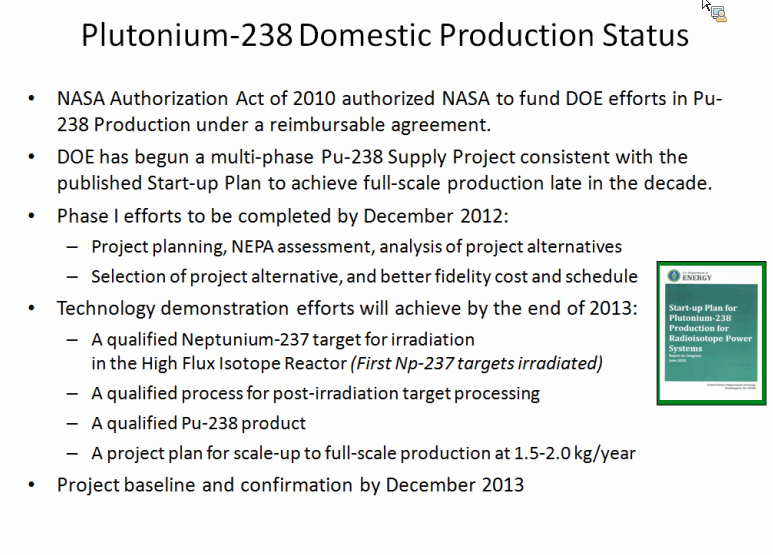
More Plutonium:
20120924_jim-green-caps-2012-p238-slide_f840.png


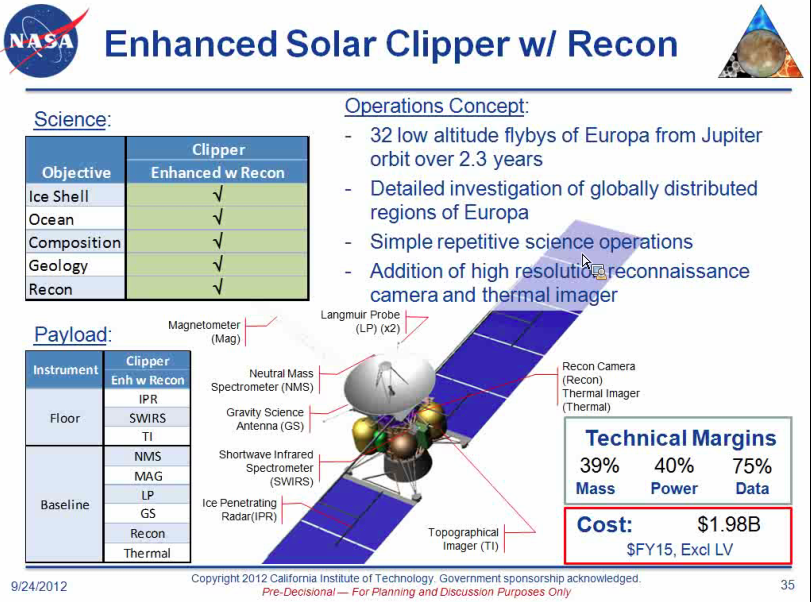
Possible JEO replacement?
20120924_europa-clipper-solar-caps-2012_f840.png


Source: http://www.planetary.org/blogs/casey-dreier/20120924-a-new-direction-for-mars.html
 
One must not automatically assume that all actions of professionals are professional, because in reality this is not always the case. If any group are to make a claim of importance, no matter how notable their stature, they have to back it up. And unless you look at the logic of this sort of planetary protection as over-precaution, the claim of danger to Earth from Martian microbes basically mandates the bad science of a poor horror film over the reality of biology.
 
Tiny warning: You don't need to be professional, to act unprofessional.

Yes, the SLS sample return mission concept is only one possibility, but the possibility that will get political backing since it is really the best way to waste taxes for looking good. Politics work that way. Hey, our shiny expensive job programme called SLS has a purpose.

But: If somebody could pull off the sample return mission with smaller launchers and smarter mission concepts, saving money and avoiding the large project malus that NASA will face, the SLS solution would look really stupid. Why should we pay billions for something, that can be done for only millions?

I don't want to go so far that NASA is made of idiots. NASA has many talented engineers, skilled people. But most important decisions are made by well-defined idiots. Not idiots in the sense of "I just call them idiots because I don't understand their decisions" (Things you don't understand are called art anyway.) But idiots who have no clue about the topic that they have to decide on. They are not required to have it. They are politicians. The engineers spend 40 hours every week with their work, the decision makers spent maybe 40 minutes in that week with the program. They don't care about engineering problems, because they don't even understand why it is so hard to build a rocket. All they are interested in: How much does it cost and where will this money be spent?

And now you wonder why the SLS is not dead yet? Why engineers have to design it? Why engineers are tasked with finding a purpose for the SLS instead of solving the more important problems in the US space program?

Have a little more respect for those, who are not participating in this mad house as outside observers, but who are forced to be inside it. How are not crazy yet, but have the standard of normality defined by insanes.
 
[ame="http://www.youtube.com/watch?v=B90LklmG-1I"]J-2X Powerpack Completes Testing - YouTube[/ame]
 
I just reported on the concept for an Europa mission, and now I found a pretty recent article on it.
SPACE.com: "NASA Eyes Mission to Jupiter Moon Europa"
europa-color.jpg

...
But NASA is also thinking about ways to investigate the possible habitability of Europa, Jupiter's fourth-largest moon. One concept that may be gaining traction is a so-called "clipper" probe that would make multiple flybys of the moon, studying its icy shell and suspected subsurface ocean as it zooms past.
[...]
Here is the Clipper concept, again:
20120924_europa-clipper-solar-caps-2012_f840.png

And the study, again: http://www.lpi.usra.edu/pss/oct2012/presentations/5_Senske_Europa.pdf
And an interview regarding the mission (again): Europa Clipper on Vimeo
The nominal launch date is in 2020 where the transit to Jupiter will take under six years. However, there are launch opportunities available every year.

Out of any possible near-future robotic missions, this one excites me the most.
 
NASA administrator Charles Bolden told the NRC committee on human spaceflight that an asteroid mission didn't necessarily have to be a far trip:

Bolden: Don't Have to Travel Far to Asteroid to Meet President's Goal.
Marcia S. Smith
Posted: 19-Dect-2012
http://www.spacepolicyonline.com/ne...ravel-far-to-asteroid-to-meet-presidents-goal

Perhaps he was referring to the Planetary Resources, Inc. proposal to bring a small asteroid to lunar orbit. But another possibility is a mission to near Earth asteroids that can be accomplished in about a month round trip travel time. See the table of NEO's here:

Near-Earth Object Human Space Flight Accessible Targets Study (NHATS).
http://neo.jpl.nasa.gov/cgi-bin/nhats

Select max delta-v <= 12 km/s, visit time => 8 days, unlimited visual magnitude, the H parameter, and unlimited orbital uncertainty, the OCC parameter. Then there are several asteroids at 26, 34, and 42 day travel times, including stay times at or above 8 days. If you subtract off that stay time to make it only a day or so then the round trip travel time will be in the range of a month or so.

This could serve as an intermediate step for BEO missions between the Apollo missions at max. 12 days and a Mars mission at 6 months one-way travel time.


Bob Clark
 
Last edited:
The Planetary Society Blog: Sequestration Averted for Now:
{...}

This means that NASA will not suffer a $1.4 billion cut today, $100 million of which would have come from the Planetary Sciences division, which already faces a cut in the proposed 2013 budget.

Again, this law only delays implementation of sequestration until March 1st, so expect a repeat of this drama in the coming months. Only if Congress can agree on a separate package of cuts totaling $1.2 trillion over the next decade will sequestration be rendered null.

{...}
 
Member Pipcard on this forum mentioned a proposal to the use the shuttle ET's as space stations on this thread, "Secret plan to privatize shuttle; now, to a next-generation shuttle"

This is interesting because they would have two and a half times the habitable volume of the ISS. And if the SLS really will have a 95+ mT payload capacity to orbit, the ET could be launched to LEO on a single launch with extra payload available for converting the ET into a habitable living space.
I tried to get it also to the Earth-Moon Lagrange points for the space stations NASA is considering but it is a bit too heavy while using propellant left over from the flight to LEO, instead of getting extra payload. However, I think it can be made to work if the shuttle ET was converted to common bulkhead design, to save weight.
Note that the ET's could also serve as quite large propellant depots at either location.

A recent report suggests using the hydrogen tank of an upper stage for the SLS as a space station:

Skylab II: A NASA 'Back to the Future' Concept to Open Up Space Exploration
By Mark Whittington | Yahoo! Contributor Network – Fri, Dec 21, 2012
http://news.yahoo.com/skylab-ii-nasa-back-future-concept-open-space-170200842.html

Better though would be to use the much larger ET tank for the purpose.


Bob Clark
 
"All about Lori Garver."(*)

Critical Decisions Loom For U.S. Space Program.
By Frank Morring, Jr.
Source: Aviation Week & Space Technology
December 31, 2012
...the agency comes up for reauthorization again in the new Congress that convenes in January, and there are hints in the ongoing power struggle between Administrator Charlie Bolden and his deputy, Lori Garver, that the White House may try another push to end government development of the SLS in favor of commercial crew funding. Bolden is seen as a backer of the traditional approach, and there have been fairly transparent press leaks from within the agency that the White House—or at least Garver—wants to get rid of him. Watch the budget request for the outcome on that one too.
http://www.aviationweek.com/Article...AW_12_31_2012_p24-531578.xml&loginAction=true

That was the most interesting part of the article to me. The rest I already knew. But I was surprised by the suggestion that Garver wants Bolden out. Looks like she's angling for his job.

Bob Clark

(*)For those not familiar with the film reference in my post subject line see:
All about Eve.
 
Back
Top