• ORBITER-FORUM will be temporarily closed at 2026-07-23 18:00 UTC while we complete some OF maintenance tasks. The amount of downtime is expected to take up to one hour, but probably less.

Updates NASA New Horizons Mission Updates

January 4, 2018
Spend Next New Year's Eve with New Horizons

The New Year's celebration to usher in 2019 will include an event like no other – more than four billion miles from Earth.
In just under a year – shortly after midnight Eastern Time on Jan. 1, 2019 – NASA's New Horizons spacecraft will buzz by the most primitive and most distant object ever explored. New Horizons' encounter with Kuiper Belt object 2014 MU69, which orbits a billion miles beyond Pluto, will offer the first close-up up look at such a pristine building block of the solar system – and will be performed in a region of deep space that was practically unknown just a generation ago.

http://pluto.jhuapl.edu/News-Center/News-Article.php?page=20180104
 
History made!

New Horizons Captures Record-Breaking Images in the Kuiper Belt

kbo_2102hz84_and_kbo_2102he85.jpg


With its Long Range Reconnaissance Imager (LORRI), New Horizons has observed several Kuiper Belt objects (KBOs) and dwarf planets at unique phase angles, as well as Centaurs at extremely high phase angles to search for forward-scattering rings or dust. These December 2017 false-color images of KBOs 2012 HZ84 (left) and 2012 HE85 are, for now, the farthest from Earth ever captured by a spacecraft. They're also the closest-ever images of Kuiper Belt objects.

Credits: NASA/JHUAPL/SwRI

NASA’s New Horizons spacecraft recently turned its telescopic camera toward a field of stars, snapped an image – and made history.

The routine calibration frame of the “Wishing Well” galactic open star cluster, made by the Long Range Reconnaissance Imager (LORRI) on Dec. 5, was taken when New Horizons was 3.79 billion miles (6.12 billion kilometers, or 40.9 astronomical units) from Earth – making it, for a time, the farthest image ever made from Earth.

New Horizons was even farther from home than NASA’s Voyager 1 when it captured the famous “Pale Blue Dot” image of Earth. That picture was part of a composite of 60 images looking back at the solar system, on Feb. 14, 1990, when Voyager was 3.75 billion miles (6.06 billion kilometers, or about 40.5 astronomical units [AU]) from Earth. Voyager 1’s cameras were turned off shortly after that portrait, leaving its distance record unchallenged for more than 27 years.

LORRI broke its own record just two hours later with images of Kuiper Belt objects 2012 HZ84 and 2012 HE85 – further demonstrating how nothing stands still when you’re covering more than 700,000 miles (1.1 million kilometers) of space each day.
 
http://pluto.jhuapl.edu/News-Center/PI-Perspectives.php?page=piPerspective_02_28_2018

February 28, 2018
The PI's Perspective: Why Didn't Voyager Explore the Kuiper Belt?

NASA's venerable Voyager 1 and 2 spacecraft made landmark explorations of the giant planets from 1979 to 1989. New Horizons is the next deep-space probe after the Voyagers, accomplishing the first exploration of Pluto and the Kuiper Belt beyond—our solar system's third zone. Credit: NASA.

New Horizons is in good health and cruising closer each day to our next encounter, an end-of-the-year flyby of the Kuiper Belt object (KBO) 2014 MU69 (or "MU69" for short). Currently, the spacecraft is hibernating while the mission team plans the MU69 flyby. During hibernation, three of the instruments on New Horizons—SWAP, PEPSSI and SDC—collect data every day on the charged particle, ionized plasma and dust environment in the Kuiper Belt at a solar distance of 41-42 astronomical units (AU), where our spacecraft is traveling. (1 AU is the distance from the Earth to the Sun, about 93 million miles or 140 million kilometers; for comparison, Pluto is about 34 AU from the Sun, so we're about 750 million miles farther out than Pluto now.)
 
Interesting thing about that article is that it doesn't mention the Voyagers' propulsion systems. I don't even know if they have functioning propulsion systems anymore, and had they known early enough, would they have been able to budget any propellant for side missions like New Horizons has. Great article!
 
Yes, we need more wieldys.

N.
 
I don't know. Isn't it a bit close to the plane of the Solar System to be called "Ultima Thule".
 
April 11, 2018
Pluto's Largest Moon Gets Its First Official Feature Names
Legendary explorers and visionaries, real and fictitious, are among those immortalized in the first set of official surface-feature names for Pluto's largest moon, Charon.
The International Astronomical Union (IAU), the internationally recognized authority for naming celestial bodies and their surface features, recently approved a dozen names proposed by NASA's New Horizons mission team, which led the first reconnaissance of Pluto and its moons (by the New Horizons spacecraft) in 2015. The New Horizons science team had been using some of the chosen names informally to describe the many valleys, crevices and craters discovered during that first close-up look at Charon's surface.

http://pluto.jhuapl.edu/News-Center/News-Article.php?page=20180411
 
BBC: Methane ice dunes found on Pluto


Scientists say they have found evidence of dunes of frozen methane on Pluto.

The research, which is published in the journal Science, suggests that the distant world is more dynamic than previously thought.

Pluto's atmosphere was believed to be too thin to create the features familiar in deserts on Earth.

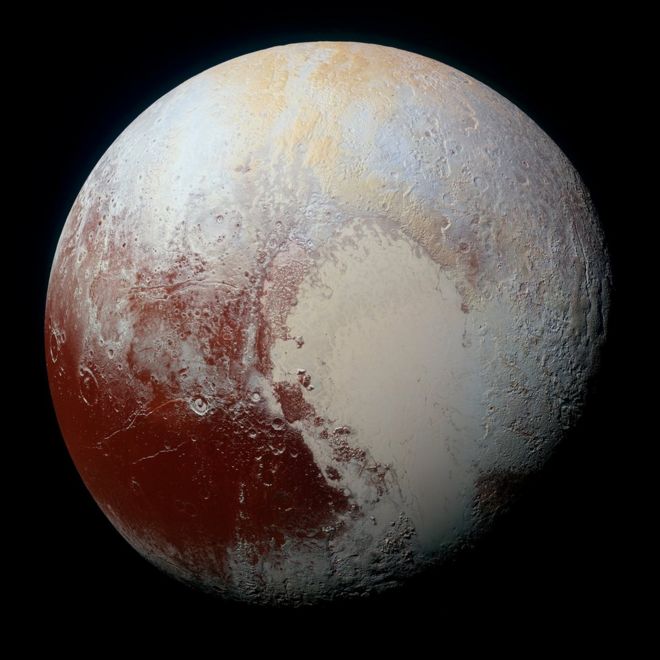
The findings come from analysis of the startling images sent back by Nasa's New Horizons mission, which flew close to Pluto in July 2015.

_101830883_f54f60cc-a294-47c8-8214-ce7063f83463.jpg

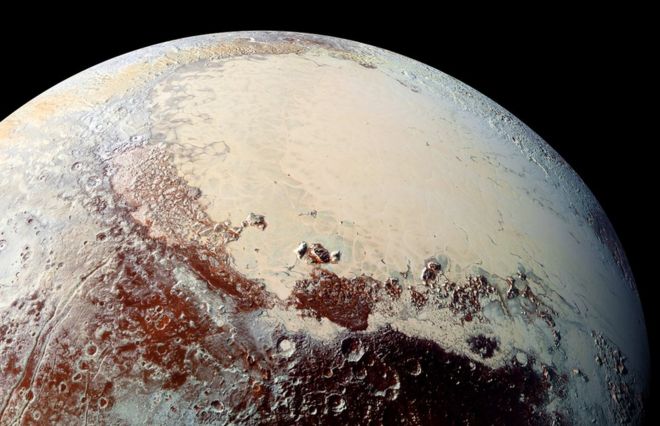
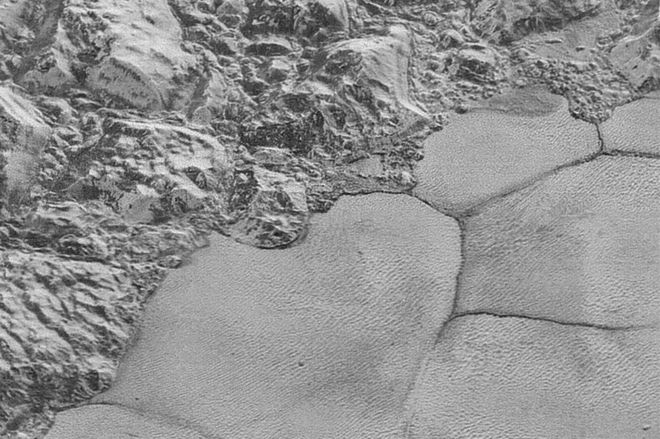
In their study, the researchers explain how they studied pictures of a plain known as Sputnik Planitia, parts of which are covered with what look like fields of dunes.

They are lying close to a range of mountains of water ice 5km high.

The scientists conclude that the dunes are 0.4-1km apart and that they are made up of particles of methane ice between 200-300 micrometers in diameter - roughly the size of grains of sand.

_101830882_mediaitem101830881.jpg

Dunes can be seen in the bottom half of this picture of Pluto's Sputnik Planitia region
Credits: NASA / JHUAPL / SWRI

The paper's lead author is Dr Matt Telfer, a physical geographer at the University of Plymouth. He told BBC News: "We can't see individual grains but what we are able to identify dunes, and characterise their basic physical parameters, and the density of the atmosphere that they've been formed under.

"And we can measure some basic things like how far apart they are spaced, and have an estimate at least of the wind speeds that are forming them.

"We can feed all that back into a physical model and from that deduce what the size of the grains must be."

To be able to form, dunes need an atmosphere dense enough to make wind transport possible, a supply of dry particles, and a mechanism that lifts particles off the ground.

At first sight, none of those conditions seem to be met on Pluto.

But Dr Telfer and his colleagues calculate that the dunes may be in one of the windiest areas of the Pluto with wind speeds reaching up to 10m/sec - enough to keep particles moving.

_101830889_mediaitem101830888.jpg

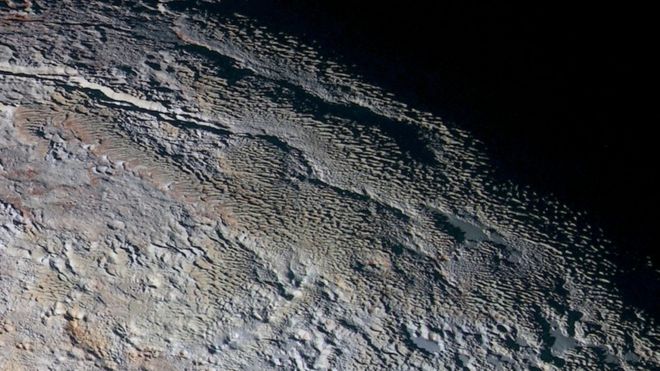
Pluto's strange "snakeskin terrain" may represent not dunes, but blades of ice
Credits: NASA / JHUAPL / SWRI

The wind is generated as air flows downhill from the neighbouring mountains and also as frozen material sublimates - or turns directly into gas.

They believe that the dunes are composed of grains of methane, and maybe of nitrogen as well, and that a "reservoir" of methane may exist in the snowpack of the mountains.

As for the process of "lofting" the grains off the ground, the paper suggests that the driver could be a slight warming from the distant Sun, raising the temperature above the frost point of nitrogen: -230C.

With that warming of the ice below the surface, methane crystals should enable nitrogen ice to sublimate - and that would allow the methane crystals to be wafted into the atmosphere.

Dr Telfer says the analysis provides a new insight to Pluto and also changes our view of it.

"It's really exciting just to be able to look at this world and recognise that it's not just a frozen icy blob in the outer reaches of the Solar System but really we're seeing a dynamic world still changing, still forming today," he said.

_101830885_mediaitem101830884.jpg

That sentiment is echoed in an article accompanying the Science paper by Prof Alexander Hayes, an astronomer at Cornell University in Ithaca, US.

He quotes the late Sir Patrick Moore, the famous BBC Sky at Night presenter, describing Pluto in 1955 as "…plunged in everlasting dusk, silent, barren, and touched with the chill of death…" and says that that perspective has to shift.

Prof Hayes says we now know Pluto to be "a geologically diverse and dynamic world driven by internal heat, extreme seasons and sublimating ices".

He adds that it's not the frontier of the Solar System as Patrick Moore suggested, but the "gateway" to the unexplored realm of the Kuiper Belt.

And it may be that dunes themselves are emerging as a fascinating new feature of space exploration.

Pluto now joins Earth, Mars, Venus, Saturn's moon Titan and even the comet 67P - which a European Space Agency (Esa) mission landed on - as homes to dunes.

 
Back
Top