Moscoviense - Russian outpost on the Moon

OHM Moscoviense - Russian outpost on the Moon 240613

LadyCroussette

Quebec City's Resident Base Builder
Addon Developer
Donator
Joined
Jan 26, 2013
Messages
346
Reaction score
1,155
Points
108
Location
Quebec City
Preferred Pronouns
She/Her
LordCroussette submitted a new addon:

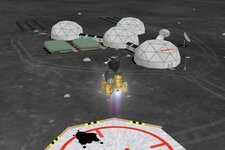
Moscoviense - Russian outpost on the Moon - Another fictional lunar base!

Moscoviense is a Russian lunar outpost located on the far side of the Moon in the Mare Moscoviense, its namesake.

IMPORTANT: The flattening of the base is handled by the D3D9's flat (.flt) system. If it does not work for you, ensure you have the most recent version of the client, and check in the "Visual Effects" tab in the launcher that 'Surface elevation, using' is checked and set on 'linar...

Read more about this addon...
 
Next destination: a Chinese base at the South Pole. 😛
 
The next one I'm making will be an American base. It will have some similarities with Sword Edge (sharing of technologies and all that). I have no idea what to name it, though. Nor where it will be located. But, I do have a layout for it!

I will keep the Chinese base idea in mind though. A south pole base could be interesting. (Though I will need to find some sort of design language that's different from the other bases so it look unique).
 
Russia and China just signed an agreement to build a joint (nuclear) base on the moon so I guess they'll be sharing tech (although I think the Chinese are technologically ahead).
Funny how a few years ago 2001 seemed like a parallel universe fantasy and today it seems quite viable:confused:

On the American base if your going by names there is an Einstein crater and a Von Braun crater, the "best" American (german) names in science/space flight history (although the Einstein crater looks a little bumpy).
 
Last edited:

Attachments

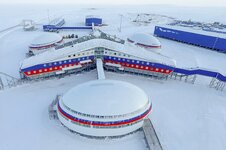
  • Arkticheskiy_trilistnik_(2017)_02.jpg
    Arkticheskiy_trilistnik_(2017)_02.jpg
    106.1 KB · Views: 16
The Chinese station might be called Yuegong (月宫), or Lunar Palace (月 yue - moon, lunar; 宫 gong - palace), in a similar fashion as their already existing orbital station Tiangong (天宫, meaning "Palace in the Sky" - where the character "tian" (天) means "sky" or "heaven").
 
The Chinese station might be called Yuegong (月宫), or Lunar Palace (月 yue - moon, lunar; 宫 gong - palace), in a similar fashion as their already existing orbital station Tiangong (天宫, meaning "Palace in the Sky" - where the character "tian" (天) means "sky" or "heaven").
That's a pretty good name idea. I'll use it when I make the base. It won't be tomorrow, though, since I spend the last three days making three bases, and I want a small break before making the next one. x)

Also, where to put it on the south pole? I need a place that can be turned flat without looking out of place (so no elevated plateau between hills and mountains and such).
 
Shackleton crater is somewhat traditional for south-pole moon bases.
With terrain that look like that, I'm not quite sure it's feasible. My DG keep bouncing on the surface.
1718399177648.png
Also, why does it feel like I'm in Tears of the Kingdom's Depths?
1718399314639.png
EDIT: I tried turning the terrain flat, and now the game freeze on loading. I don't think Orbiter knows what to do when you edit the terrain so close to the poles.
 
Last edited:
Maybe the topography requires some rework.... looks like the elevation data of the different swaths are offsets.

In reality, it looks like this:

 
The next one I'm making will be an American base. It will have some similarities with Sword Edge (sharing of technologies and all that). I have no idea what to name it, though.
Eagle's Landing.

Make sure it has a Burger King to make it authentic.
 
Russia and China just signed an agreement to build a joint (nuclear) base on the moon.
What could be added to make a Russian / Chinese station look different, is adding a nuclear reactor area, a bit remote from the main base.
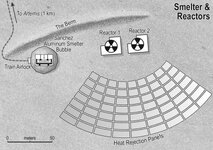
Andy Weir considered this for his Artemis Moon Base, and it looked like this:

Artemis base smelter and reactor.jpg
 
What could be added to make a Russian / Chinese station look different, is adding a nuclear reactor area, a bit remote from the main base.
Andy Weir considered this for his Artemis Moon Base, and it looked like this:

View attachment 38829
Very interesting. I might do something like that.
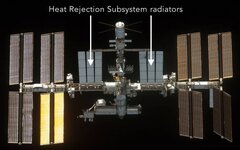
I'm curious though, what are heat rejection panels (I mean, I can somewhat guess from the name itself) and, more importantly, what does it look like?
 
@LordCroussette : excellent development line, all these bases, keep going please!!
May I suggest:
  • Pad numbers should be reversed, as the intuitive spacecraft pointing should be "to" the taxiway, not "from" it, for a commuter to pick up the visitors from the docking port (or they should walk to the base?!).
  • no windows (or Cupola like on ISS) in the bases, is this only acceptable ?!? :)
 
I'm curious though, what are heat rejection panels?
Heat_Rejection_System_radiators.jpg

For any thermodynamic process, a hot and a cold side is needed.
The hot side is provided by the heat of the nuclear decay in the reactor. This will heat up a fluid (liquid or gas) or a heat conductor. On the boundary between hot and cold side, electrical energy can be generated, either by direct conversion in a thermocouple or by machines like a turbine or a stirling motor.

On the cold side, the excess heat needs to be removed. In space this is typically done with radiators, as shown on the ISS above. They have a dull, non-reflective surface. They can appear grey or even white in the visible spectrum (like the radiators of your home heating) but are black bodies at their working temperature.

To avoid unwanted heating by the sun, they are often arranged edge-on to the sun.

Unfortunately radiation power increases with the 4th power of the black bodies temperature. Low temperatures (like a few hundred °C) require big surfaces. Whatever you think would be a good size for a radiator, it probably needs to be 16 times as big.😲
 
View attachment 38833

For any thermodynamic process, a hot and a cold side is needed.
The hot side is provided by the heat of the nuclear decay in the reactor. This will heat up a fluid (liquid or gas) or a heat conductor. On the boundary between hot and cold side, electrical energy can be generated, either by direct conversion in a thermocouple or by machines like a turbine or a stirling motor.

On the cold side, the excess heat needs to be removed. In space this is typically done with radiators, as shown on the ISS above. They have a dull, non-reflective surface. They can appear grey or even white in the visible spectrum (like the radiators of your home heating) but are black bodies at their working temperature.

To avoid unwanted heating by the sun, they are often arranged edge-on to the sun.

Unfortunately radiation power increases with the 4th power of the black bodies temperature. Low temperatures (like a few hundred °C) require big surfaces. Whatever you think would be a good size for a radiator, it probably needs to be 16 times as big.😲
So like the radiators on the ISS. Got it. I thought they were two different things for a moment.

I didn't know how they worked, though. Nor that they are arranged edge-on to the sun. That's good to know! Knowing myself, I would put them face toward the sun like the solar panels x)

I'll also keep the size in mind. There gonna be big, big radiators on this base.
 
Back
Top