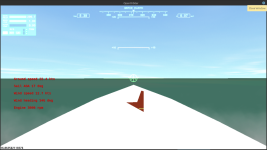
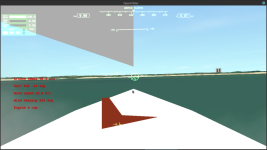
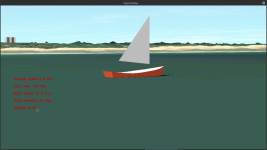
The effects of the hull are only approximated with the touchdown point buoyancy model. It gets the gross buoyant force about right and provides plausible pitching and righting moments, but the magnitudes and locations of those moments aren't perfectly accurate. If anything, this model likely yields hull performance that is more stable than the actual hull. It behaves very much like a boat, and it is computationally very cheap and robust, but to get it to act like a particular hull will require some artistic tweaking.The hull shape should also be important, since it defines the countering rightening moment. Essentially how much bouyancy on one side of the ship increases by increasing list.
I was hoping that directly integrating the hydrostatic pressure on the hull mesh would be feasible as that would allow this sort of geometric fidelity, but I fear that it is simply too numerically unstable for general use, as well as being rather computationally intensive.