Missions to the Sun: NASA's Solar Probe Plus and ESA's Solar Orbiter

I'm surprised they didn't cut down the length of the fairing some. It'd save, what, a few hundred pounds, probably, but that'd be a little extra kick.


Maybe there is simply no shorter fairing available right now and developing a special shorter one would be expensive. After all, such a fairing is a complex design, despite its superficially easy job.


After all, it looks like its just two "rings" less possible, before the end of the payload envelope arrives at the top of the probe. Just look at the product card for reference there.


https://www.ulalaunch.com/docs/default-source/rockets/av_div_product_card.pdf
 
Less than 20 hours!

parker-orbit_0.gif


At 3:33 a.m. EDT on Aug. 11, while most of the U.S. is asleep, NASA’s Kennedy Space Center in Florida will be abuzz with excitement. At that moment, NASA’s Parker Solar Probe, the agency’s historic mission to touch the Sun, will have its first opportunity to lift off.

Stay awake, Americans! :lol:


Live stream will be available on NASA TV (Starts at 3 a.m. EDT).

 
Last edited:
T-4 and holding, pending new launch time.
 
T-4 and holding, pending new launch time.
It got scrubbed as they didn't have enough time remaining in the launch window to complete the recycle, analyze the issue and set up for a new attempt and go again as they picked up the count with 10 minutes remaining in the window. Right now they're working a 24hr turnaround but that is dependent on clearing the GHe regulator issue that cut off the count at T-1:55.
 
Its gone!

Spectacular pics of the exhausts

N.
 
Booster separation.

N.
 
2nd stage ignition and fairing sep clean

N.
 
MECO and into coast phase. NASA seems happy.

N.
 
Well, that was a bit scary... S/C separation has been confirmed.
 
Hooray! Congrats to ULA & NASA. Smooth sail heading to Venus!

YouTube videos are coming... The telemetry keeps dropping out for the 3rd stage. Huh. Northrop Grumman products... :lol:


The probe is set to become the fastest-moving manmade object in history. Its data promises to crack longstanding mysteries about the Sun's behaviour.
It is the first space craft to be named after a living person - astrophysicist Eugene Parker, 91, who first described solar wind in 1958.
"Wow, here we go! We're in for some learning over the next several years," he said as he watched the lift-off.

Nice attitude at 91!

https://www.bbc.co.uk/news/science-environment-45160722
 
It's been talked about for years, that they should launch it at night.. And they did!
 
Clearly a sign of a well-planned mission. They covered every possible detail. :lol:
 
ust weeks after making the closest ever flyby of the Sun, Nasa's Parker Solar Probe is sending back its data.
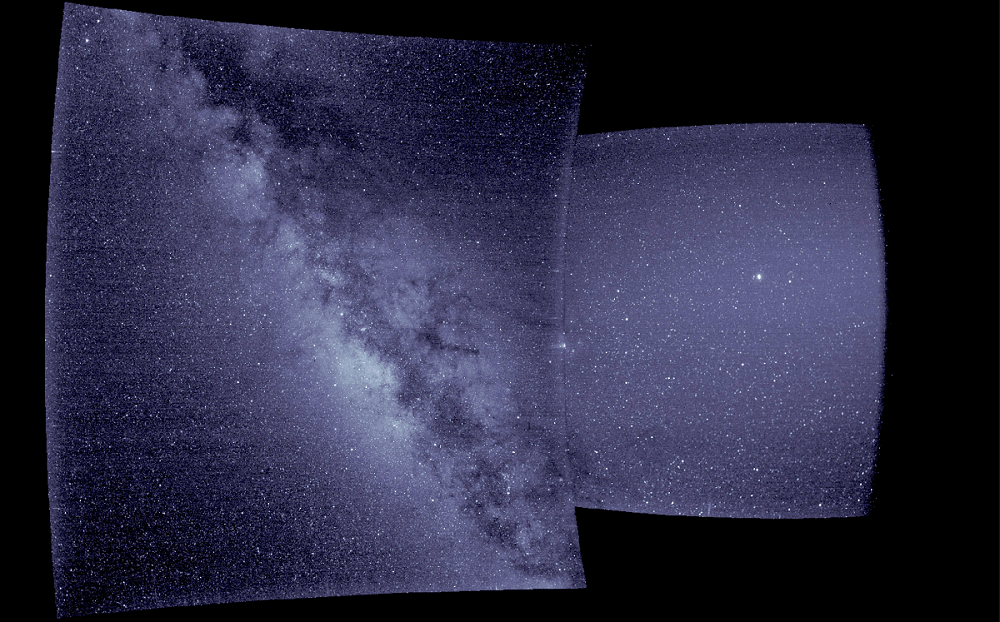
Included in the observations is this remarkable image of the energetic gas, or plasma, flowing out from the star.
The bright dot is actually far-distant Jupiter. The black dots are repeats that occur simply because of the way the picture is constructed.
Parker's WISPR instrument acquired the vista just 27.2 million km from the surface of the Sun on 8 November.
The imager was looking out sideways from behind the probe's thick heat shield.

https://www.bbc.co.uk/news/science-environment-46547588
 
ust weeks after making the closest ever flyby of the Sun, Nasa's Parker Solar Probe is sending back its data.
Included in the observations is this remarkable image of the energetic gas, or plasma, flowing out from the star.
The bright dot is actually far-distant Jupiter. The black dots are repeats that occur simply because of the way the picture is constructed.
Parker's WISPR instrument acquired the vista just 27.2 million km from the surface of the Sun on 8 November.
The imager was looking out sideways from behind the probe's thick heat shield.

https://www.bbc.co.uk/news/science-environment-46547588
 
Back
Top