Flight Question Launching the Ares rocket

richfororbit

Active member
Joined
Jul 8, 2013
Messages
686
Reaction score
52
Points
43
Location
Greater London
Hello,

I would like to know how to get the Ares rocket into orbit. This is obviously from Mr Drake's files.

There is a manual launch scenerio which doesn't allow other addons placed in how ever to get this rocket into a circular orbit how would I do this? How much tilt is necessary when a I get to a certain altitude?
 
There is a manual launch scenerio which doesn't allow other addons placed in

I can't quite make out what your problem is here; though taking a guess at it I'd wager your having a problem adding a payload?

Til you elaborate about that, I'll try my hand at your guidance problem. There's two ways I can think of to go about this:

1)Learn how to put a rocket in the desired orbit by flying it "seat of your pants"-style. This is usually fun, and once you get good at it you can often do better than than a autopilot would. It does depend on you having a bit of knowledge, skill, and of course willingness to learn the ropes.

2)Borrow information from various sources. Let's say you don't want to play intrepid rocket jockey, and just want a simple pitch program to follow. Multistage-based rockets also want a pitch program to follow, and thankfully there is guidance files for them, which you can use for yourself.
Download this Ares addon([ame="http://www.orbithangar.com/searchid.php?ID=4584"]link[/ame]) and after extracting navigate to Cofig\Multistage\ then inside there's a file called "AresV_Guidance.txt". Thank the people who did made this autopilot file, then open it.(The people in particular you should thank are PhantomCruiser, Cymrych, and Columbia42, :hail: them.) Anyway, look for lines like this:

Code:
70=pitch(41,33,10)
80=pitch(33,33,10)
90=pitch(33,33,10)
100=pitch(33,33,10)

You might be asking what the lines mean. From the Multistage manual:

Each line as the following format:

<mission elapsed time>=<command>(param1,param2,...)

..........

pitch(starting_pitch,final_pitch,pitch_time)
This will control the pitch program. The launcher is pitched from the “starting_pitch” to the “final_pitch” in a time duration set by “pitch_time” Note that the pitch segments should join gently to gether(that isthe final_pitch of the previous segment should be the starting_pitch of the next segment)

So "70=pitch(41,33,10)" means "70 seconds of mission elapsed time=41 degrees for starting_pitch,33 degrees for final_pitch, in 10 seconds of pitch_time".

BTW, I've haven't flown a rocket using a multistage guidance file, but if a algorithm can fly by numbers a human ought to be able to. Let me know how this method works out for you.:cheers:
 
Thanks for the insight...

The rocket isn't the problem getting it into orbit is so I can create an orbit around once and then again for the MPCV to be released from the booster, also I can't add a module into the scenario file, I do so and it doesn't load in the select ships. It would seem it is a scenario just for an ISS trip.
 
Module as in "Lunar Module"? a.k.a. LM?
You are right in thinking that scenario with the Aries 1 is just for launching to the ISS, but it isn't too complicated to add more with notepad.
 
Thanks for the insight...

The rocket isn't the problem getting it into orbit is so I can create an orbit around once and then again for the MPCV to be released from the booster,

Your welcome. I've had two thoughts in the mean time that might help you out as far as getting into orbit goes..

1) I wasn't thinking hard enough and directed you to a Ares V autopilot, which isn't made for the Ares I I now realize your using. [ame="http://www.orbithangar.com/searchid.php?ID=2770"]Simcosmos made this multistage-based Ares I[/ame], which has a guidance file that'll probably work better than the Ares V one. Look for it in Config\CEV-Orion, named "AresI_CEV-Orion_ISS.txt". There also a "AresI_CEV-Orion_Moon.txt", which you could try out as well. The Moon guidance file aims you for a LEO rendezvous with a Ares V launched lunar lander+EDS; though you'll have to supply the lander, EDS and a proper launch window to make it all work:P. Should aim you for a lower apogee than the ISS one. Don't forget to :hail: simcosmos for the guidance file.
2) The Ares I was designed to leave the Orion at almost orbital velocity; Orion being intended to detach from the Ares 2nd stage and then boost itself into orbit. This was to insure that second stage stays suborbital and reenters(at least to my understanding). The upshot of all this is that you can't put a Orion in orbit by the work of the Ares I alone, you gotta fire the Orion's engines to round out the suborbital lob the Ares leaves you on.

These two things should help you out getting the Orion into orbit.


also I can't add a module into the scenario file, I do so and it doesn't load in the select ships. It would seem it is a scenario just for an ISS trip.

From what I can tell, I don't believe francisdrake actually meant for anything to be a payload of his included Ares I besides his Orion. It doesn't matter much if francisdrake did code in the option of using his Ares I to launch other payloads, as Ares I had to be redesigned and tweaked up til cancellation just to be able to loft Orion by itself, never mind anything else.

Also, kinda repeating what I said earlier, Ares I was meant to deliver the Orion plus a crew to LEO, either to rendezvous with the ISS or a lunar-bound LM+EDS.
 
Hi, it is as orbitingpluto says. The Ares I launcher was not designed to lift anything other than the Orion capsule into orbit. And the CEV's engine is needed to lift the orbit periapsis out of the atmosphere.

For reaching orbit manually I use the 20-30-40 rule:

Slightly tip over (pull) when altitude is above 1 km.
At 20 km altitude tip over to 40°.
At 30 km altitude tip over to 30°.
At 40 km altitude tip over to 20°.
Hold a pitch of 12-15° above horizontal until engine cut-off.
 
Mr Drake I'll try that.

I can't add a module into the scenario via notepad. Oh well. I just wanted to launch this rocket, I had tried the shuttle and didn't do well with that last month. But I got bored of it.

Thanks.

I have reached orbit Mr Drake.

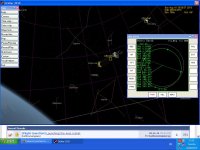
Here is a snap of it. I guess using the state vector I can place something via the addon menu like a container for docking. I haven't a chance in reaching that station.:rofl:
 

Attachments

  • AresLaunch.JPG
    AresLaunch.JPG
    116.7 KB · Views: 24
Last edited:
While not entirely off the rails, your orbiting still needs some work. Your trajectory intersects the Earths surface for one thing. Best to start again from the ground, this time monitoring your PeA along with your pitch. PeA stands for Periapsis Altitude, or just tells you where the lowest point of your orbit is in relation to the Earth's surface. In your screenshot, your PeA is about one million km under the Earth's surface. When you start off next time at the lauchpad, notice how your PeA is at the Earth's center. You raise your PeA with horizontal velocity, and you really only hit velocities high enough in the last 3-4 minutes of ascent to really start moving your PeA away from Earth's center, so don't be too worried about it's slow start. Once your PeA reads about 200km or higher you can safely say your in orbit, since it's high enough for drag to take more than a few days to alter your orbit too much.
 
Check my Constellation Orion CEV add-on, that set up the Ares I rocket as velcro.
Not 100% accurate, but the best way to lift whatever cargo you want. The velcro autopilot just "works". You can of course see how that goes and create your guidance based on it.
 
While not entirely off the rails, your orbiting still needs some work. Your trajectory intersects the Earths surface for one thing. Best to start again from the ground, this time monitoring your PeA along with your pitch. PeA stands for Periapsis Altitude, or just tells you where the lowest point of your orbit is in relation to the Earth's surface. In your screenshot, your PeA is about one million km under the Earth's surface. When you start off next time at the lauchpad, notice how your PeA is at the Earth's center. You raise your PeA with horizontal velocity, and you really only hit velocities high enough in the last 3-4 minutes of ascent to really start moving your PeA away from Earth's center, so don't be too worried about it's slow start. Once your PeA reads about 200km or higher you can safely say your in orbit, since it's high enough for drag to take more than a few days to alter your orbit too much.

I made it and did the engine burns, and everything turned out okay. Went quite high 600KM on one side of the planet, and then did the retro and now at a quite a low altitude. Oh I was wrong about the module not working, unfortunately it is useless for docking due to the problems it has so using the MPCV is the only option which I can't even do that, so I'll use leonardo module undocking from it, add the module and then dock that and then dance around it in the MPCV for docking, now I enjoy that always so long as I do everything with patience that is the key to learning Orbiter in any aspect. I had to restart the pc for the file to work.:huh:

Just for reference does the docking occur auto even when I disable the docking MFD. Because I really like to do that manually?

I did better than the shuttle launch where I remained two days in orbit just doing OMS burns. But that was the first and only time I got it wrong but right, or vice versa.

As for PEA that just escapes me, my only focus is altitude when I get into orbit, I viewed the Velocity travelling at 7,000+ KM as well as making sure I expand my orbit.
 
As for PEA that just escapes me, my only focus is altitude when I get into orbit, I viewed the Velocity travelling at 7,000+ KM as well as making sure I expand my orbit.

I'd suggest taking a break from piloting and spend some time getting familiar with the theory and maths behind orbital mechanics. I wouldn't say you have to actually focus on the math, as various built-in or addon MFDs can do most of the math for you, but knowing terms like PeA and knowing how to use them is pretty important for things like going to the Moon or rendezvousing with the ISS or other orbiting things.

Don't feel bad- orbital mechanics isn't easy to understand, nor is it intuitive. At some point we've all had to study a bit.:)
 
Think of it like this...
ApA is the highest point of your orbit
PeA is the lowest point of your orbit (if PeA is below the radius of the body you are orbiting=bad
Ecc is how far off you are from your orbit being circular

Terminology is everything... If we don't understand what you are asking, it'll be difficult for us to help you out.
 
Hmm.

I guess my reason for launching into orbit was just to make it a little like the Apollo 9 mission. It is getting the hang of the module, doing the thruster firing similar to that mission that is my primary interest than wanting to go anywhere in particular. I can launch, do short distance docking or a bit longer with no catch up and then return back to the ocean.

But using the module seems most appropriate in linear thruster firing of up docking section and undocking away. Do that for several minutes or so.

Beats me how Russel Schweickart and his commander did all those turn arounds or up and downs several miles away. Having watched two or three films on that mission, and then the live one, I only finally gathered they did a several mile linear movement away for a number of hours.:blink: Walter Cronkite, huh.
 
It not why you orbit, but what your not getting about orbiting is what I'm worried about.

See, you PeA tells you what is the altitude of the lowest point of the circle/oval that defines your orbit. For the screenshot you posted, your orbit's lowest point is below the surface of the Earth. In that screenshot you posted, you were traveling at a velocity of 7,200 meters per second in a trajectory pointed at the Earth's surface, and you didn't understand or realize that was happening.

The physics of objects zipping around at thousands of meters per second doesn't come naturally to anyone. The terminology is new, it isn't intuitive, and there's some mathematics involved. Blunting your enthusiasm or making you feel dumb isn't my point- I would think that there isn't a person besides those with degrees physics that hasn't need to study to get into orbit.

You ought to sit down and read through Go Play in Space, as well as look through some of the tutorials on this page as well- Orbiter's own manual is also a source of information as well, located in the "Docs" folder in your install. There's videos on youtube and other sites that might help you understand things as well, though I must leave recommendations on a few to Orbitnauts who know those better.

Of course, there's this forum to ask questions at, and I'll be here to help, just as I've been here thus far.:)
 
Back
Top
