Updates Juno Mission News and Updates

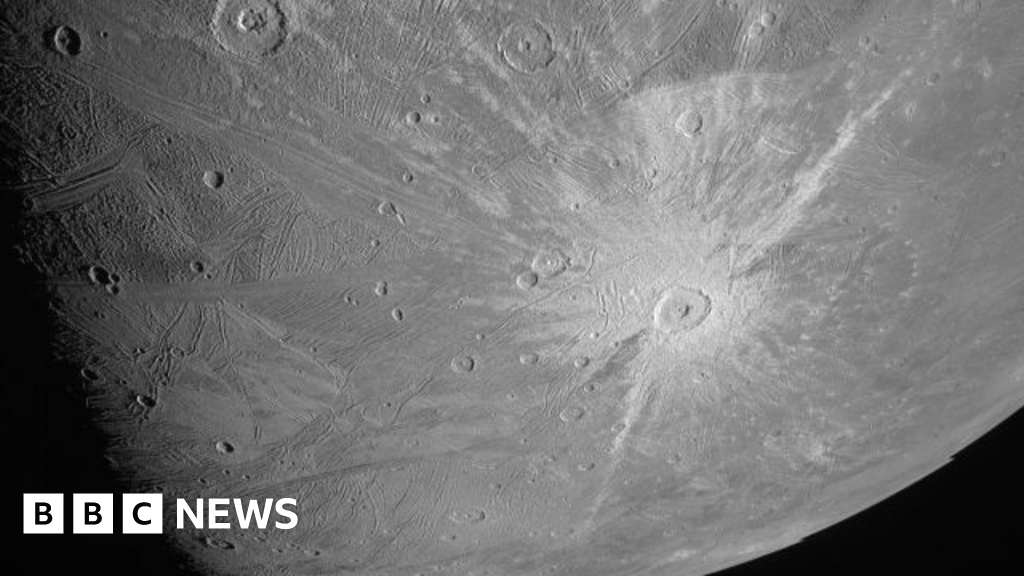
The American space agency's Juno probe has returned some close-in views of Ganymede - one of Jupiter's four Galilean moons and the largest natural satellite in the Solar System.


NASA’s Juno Will Perform Close Flyby of Jupiter’s Icy Moon Europa​

As the spacecraft makes a close approach of the moon, it is expected to provide valuable science – and remarkable imagery – for NASA’s upcoming Europa Clipper mission.
On Thursday, Sept. 29, at 2:36 a.m. PDT (5:36 a.m. EDT), NASA’s Juno spacecraft will come within 222 miles (358 kilometers) of the surface of Jupiter’s ice-covered moon, Europa. The solar-powered spacecraft is expected to obtain some of the highest-resolution images ever taken of portions of Europa’s surface, as well as collect valuable data on the moon’s interior, surface composition, and ionosphere, along with its interaction with Jupiter’s magnetosphere.

Such information could benefit future missions, including the agency’s Europa Clipper, which is set to launch in 2024 to study the icy moon. “Europa is such an intriguing Jovian moon, it is the focus of its own future NASA mission,” said Juno Principal Investigator Scott Bolton of the Southwest Research Institute in San Antonio. “We’re happy to provide data that may help the Europa Clipper team with mission planning, as well as provide new scientific insights into this icy world.”

https://www.nasa.gov/feature/jpl/nasa-s-juno-will-perform-close-flyby-of-jupiter-s-icy-moon-europa

See raw images from the spacecraft’s JunoCam imager
 
Vulcanos, vulcanos, vulcanos!


NASA's Juno mission captured this infrared view of Jupiter's volcanic moon Io on July 5, 2022, when the spacecraft was about 50,000 miles (80,000 kilometers) away. This infrared image was derived from data collected by the Jovian Infrared Auroral Mapper (JIRAM) instrument aboard Juno. In this image, the brighter the color the higher the temperature recorded by JIRAM. https://photojournal.jpl.nasa.gov/catalog/PIA25698
PIA25698~orig.jpg
 
No, it can't. Juno doesn't have the delta-v to do it, no operational spacecraft does. It's just one of Avi Loeb's crazy ideas and he doesn't know the Juno spacecraft (main engine offline since February 2017 when helium valves in the propulsion system malfunctioned preventing anymore main engine burns) and he is not a flight dynamics expert. He's just get published because of his affiliation to Harvard University, if he wasn't, no one would listen to his crazy ideas.
 
Back
Top