News Japan Earthquake, Tsunami, & Nuclear Disaster

http://www.rian.ru/jpquake_help/20110314/353779842.html

Russia is ready to supply 6000 MegaWatts of electricity fom Russian Far East to Japan - Igor Setchin

http://www.rian.ru/jpquake_help/20110314/353778926.html

In April and May Gazprom company will supply 100,000 tonnes of liquified gas to Japan - Igor Setchin

Also, forces of Russian Emergency Command are deployed to Japan in two airplanes to search for and rescue survivors in the areas hit by the earthquake (which happens for the 1st time in history). They are accompanied by experts in nuclear energy, whose offer of help was also accepted by Japanese government.
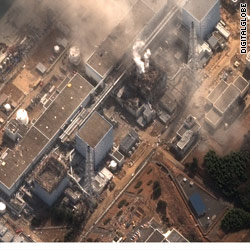
 
Sat picture of the Fukushima-1 after the second explosion:

t1main.powerplant.jpg
 
Oh, didn't know it decays so fast. I knew that most decay there is nitrogen, which will be practically gone after a few minutes, but I didn't expect such a rapid drop.

Nitrogen (N-16) is present in the cooling water of a light water reactor when the core is critical and has a half life of around 5 seconds. The main isotope chains that contribute to decay heat are actually contained within the fuel itself (and inside the cladding unless it is breached as it would appear is the case here). Cesium and Iodine are two of the principle isotopes involved, and if you detect them, particularly off-site, you have some level of fuel damage. The zirconium-alloy cladding that surrounds the fuel undergoes a significant reaction with water when heated to around 2200 degrees (F). This is where the majority of the hydrogen is produced, the zirc-water reaction. The damage to the reactor cores, and the subsequent release of hydrogen, cesium and iodine is very similar to what happened at Three Mile Island. In that accident, over the top five feet of a twelve foot core was completely destroyed. Every news report I've seen so far seems to confirm that at least a partial melting and fuel cladding breach has (and is probably still) occurred in Japan. One item that doesn't seem to get much mention, if you are supplying seawater to the core as a coolant, how is the heat being rejected? Boiling? Then you must release steam somewhere. If the water is being injected, then drained off, cooled and re-injected, you limit the radioactive material release and have achieved a long-term cooling condition, provided the pumps and heat-exchangers involved remain in service and intact.
 
Last edited:
If the water is being injected, then drained off, cooled and re-injected, you limit the radioactive material release and have achieve a long-term cooling condition, provided the pumps and heat-exchangers involved remain in service and intact.

That is how the ECCS system is *supposed* to work. I'm not sure what they are attempting now that the ECCS system has failed.
 
That is how the ECCS system is *supposed* to work. I'm not sure what they are attempting now that the ECCS system has failed.

Yes, and in some extreme cases, you actually cause a breach of the RCS in order to achieve long-term recirc cooling. The use of seawater could be the result of a loss of the dedicated water source and some of the ECCS pumps and piping may still be available. Getting accurate information is making assessments and predictions almost impossible, and speculation based upon news reports is usually a fruitless endeavour.

It would appear that this is another (classic) example of Perrow's "Normal Accidents" theory.

http://www.amazon.com/Normal-Accidents-Living-High-Risk-Technologies/dp/0691004129
 
As far as I can understand the official information, the sea water is pumped into the Torus/Suppression Pool and then pumped by something that still works into the reactor core. The sea water in the suppression pool also cools down any steam that is vented from the reactor. Which is why the 100°C temperature limit of the suppression pool is so critical.
 
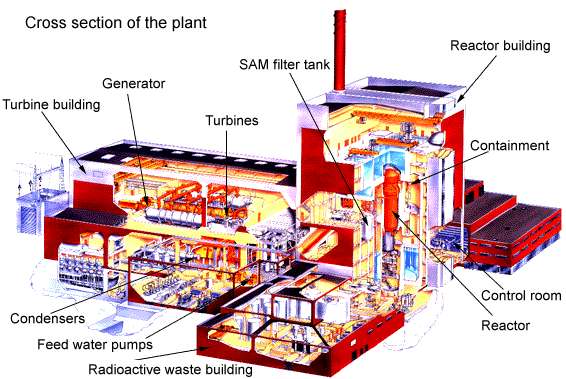
I'm monitoring exchange at pripyat.com forum regarding the current situation at Fukushima-Daichi and other plants. They have raised a concern there that the past explosion at block #3 might have damaged the adjacent radioactive waste storage building visible at the chart:

bwr_inside.jpg


In case it held worked-out fuel rods, and now the stuff is littering the place, situation may be ugly.
 
In case it held worked-out fuel rods, and now the stuff is littering the place, situation may be ugly.

I would already be more concerned if this building was already having tsunami damage. The water in such a building BTW, has to be cooled as well.
 
BWR Technical Specifications (Bases)

For anyone that is really interested, here is a link to the NRC NUREG document for BWR/4. The reactors in question are likely BWR/1, however the systems are very similar. The tech specs themselves are also available, however the Bases is typically what you use to determine the reasons "why" behind the requirements for various systems, etc.

http://www.nrc.gov/reading-rm/doc-collections/nuregs/staff/sr1433/r3/v2/sr1433r3v2.pdf

---------- Post added at 09:17 ---------- Previous post was at 09:16 ----------

No offense David but I found this typo somewhat amusing :) (the grim circumstances of it all notwithstanding ofcourse)

Blame my haste...no offense taken.
 
Another thought... Where's the Emperor? Three days have gone by and the Head of State has yet to make an appearance to offer condolences.

The movie "The King's Speech" shows the morale impact of a monarch appearing to offer hope and solidarity in times of crisis. If a monarch can't even be bothered to do that, what on earth is he for?

I am not sure that at present Emperor really has a right to address Japanese people directly. I did no research, but the list of his duties available on Wikipedia doesn't contain such item. It seems like most that he could do was to perform a public religious ceremony related to the event. But I think that ultimately relations between Japanese Emperor and his people is not a business of anyone else.
 
For anyone that is really interested, here is a link to the NRC NUREG document for BWR/4. The reactors in question are likely BWR/1, however the systems are very similar. The tech specs themselves are also available, however the Bases is typically what you use to determine the reasons "why" behind the requirements for various systems, etc.

Unit 1 is a BWR/3, Unit 2 & 3 a BWR/4.

of the already completely powered down units, units 4&5 are BWR/4, Unit 6 is BWR/5.
 
You're right that it isn't the business of foreigners to get involved in the relation between the head of state and the people. But if he doesn't appear in public and say something, he sure isn't like any head of state I've ever seen - and I've lived in several republics and a pair of constitutional monarchies.

Not a criticism, a "what's going on here?" kind of point. And not of real importance.
 
A silly question: how many tons of uranium and plutonium (assuming most likely burnup %) are we talking about for Fukushima I Units 1,2 and 3, Fukushima II Units 1 and 4, Tokai 2 and Onagawa?
 
A silly question: how many tons of uranium and plutonium (assuming most likely burnup %) are we talking about for Fukushima I Units 1,2 and 3, Fukushima II Units 1 and 4, Tokai 2 and Onagawa?

I can't even tell when the last refuel was for them.

According to the operating history at Wikipedia:

[ame="http://en.wikipedia.org/wiki/Fukushima_I_Nuclear_Power_Plant"]Fukushima I Nuclear Power Plant - Wikipedia, the free encyclopedia[/ame]

Unit 1 had the last year with minimal power output in 2007.
_____________

Lufthansa is now having the airport fire departments check their incoming planes from Japan for any radiation.
 
Last edited:
A silly question: how many tons of uranium and plutonium (assuming most likely burnup %) are we talking about for Fukushima I Units 1,2 and 3, Fukushima II Units 1 and 4, Tokai 2 and Onagawa?

Some quick numbers:

Total number of fuel assemblies: 748, 8x8 assembly array
Total number of fuel rods: 46,376

Total amount of fuel (UO2) ~ 155 metric tons

Fresh Fuel assay: average 2.8% U-235
Spent Fuel assay: 0.8% U-235, 0.6% Pu-239,241

Refueling sequence: Approximately one-fourth for the fuel per year to one-third per 18 months
 
As the plant (at least unit 1) was scheduled to go offline this month (something spotted by Urwumpe and only noted by Al-Jazeera that I've seen), might we assume the fuel level was minimal?
 
Thanks for that.
For the first reactor that lost its cooling systems, its understandable why the mobile generators trucked in couldn't start the cooling systems after the explosion.
Anyone know why the mobile diesel generators are not able to operate the cooling systems at that second reactor now without its main and emergency cooling systems?
I've seen some explanations that "the plugs didn't fit". That doesn't seem like a reasonable explanation. You cut off the plugs and weld the cables together if you have to.

Ever happen to you that you're watching a news program or interview and an obvious but very important question doesn't get asked? Remember how frustrating that is?
An obvious question not asked is if these mobile diesel generators were trucked in why is it they did not work? Was it really because the plugs did not fit? After three days they couldn't get adapters to go from one set of connectors to another? After three days they couldn't find a diesel generator of the same type they used at the plant? After three days they couldn't figure out a way to cut off the connectors and splice the cables directly together?


Bob Clark
 
Last edited:
An obvious question not asked is if these mobile diesel generators were trucked in why is it they did not work? Was it really because the plugs did not fit? After three days they couldn't get adapters to go from one set of connectors to another? After three days they couldn't find a diesel generator of the same type they used at the plant? After three days they couldn't figure out a way to cut off the connectors and splice the cables directly together?

best answers I have so far: All Diesel generators had been on ground level, protected by a low Tsunami protection wall. This wall was strong enough to withstand the water and designed for the worst known tsunami, but not for a kilometer long and 10m high wave. When the power from outside was cut by the tsunami and Earthquake damage, the Diesel generators got started, but quickly failed because of water damage in their compartment.

About the rest, that isn't that easy. Especially for AC, you need the right voltage and the right frequency and the right set of phases. On a good day, when everything works, you can produce any adapter for compatible currents in a few hours.

When your metal workshop is out of electricity like the rest of the place, you can't.

Also, getting mobile generators from another part of the country there, isn't easy at all, you can see the damage to roads there. Such generators are also too heavy for transport helicopters.

Really, it is too easy here to say what should be done, especially if your thinking is still quick to assume normal infrastructure everywhere. The situation is much worse. The reactor is just what you look at because it is the most scary thing that can get worse in the next days, but in reality around the powerplant, the country was shaken back into the 19th century.

And what you imagine as nuclear powerplant from afar, looks more like Stalingrad 1943 from up close because of the Tsunami damage. Inside everything is likely only lightly damaged, but outside you have chaos, that will take months to repair and clean. You could have a dozens of mobile generators on the site, but in the worst outcome of such a tsunami, they are stuck in meters of sticky mud, waiting for a excavator to permit pulling them into the workshop or junk yard.

The situation is more comparable to Apollo 13. But the crew is in this case a whole country, and mission control is sitting on-board.
 
Back
Top