Updates ISS UPDATES

From ISS On-Orbit Status Report for 18/06/2011.

Crew tasks today focused on closing up ATV-2 (Automated Transfer Vehicle-2) "Johannes Kepler" and getting it ready for tomorrow's undocking (2:48 PM GMT):

FE-3 Ron Garan spent about an hour on the installation of the REBR (Re-Entry Breakup Recorder) in ATV-2 and its activation and video documentation. [Activities included connecting wires, test activation, applying copper tape over wires, transferring REBR-H to the spacecraft and attaching it to the Rack Adapter Plate. REBR-H is a kind of "black box" for re-entry vehicles of 2 kg mass and ~12 inch diameter, containing GPS, temperature sensors, accelerometers, data recorder & an Iridium modem for taking reentry data and "phoning" them "home", to be activated just before hatch closure. The first REBR was installed last March in HTV-2 (HII Transfer Vehicle-2).]

Using tools & equipment such as ratchet wrench, air exchange duct bag, flashlight, helmet, dust mask, goggles, gloves, tape, vacuum cleaner, FE-1 Alexander Samokutyayev spent ~1h 45m on preparing the ATV for hatch closure. This included removing smoke detectors, GLA (General Luminaire Assembly) light fixtures, fire extinguisher and other useful equipment from the ATV for recycling.

Afterwards, Samokutyayev & FE-4 Sergei Volkov stepped through final preparations for tomorrow's undocking of "Johannes Kepler" by:
  • Removing the quick-release screw clamps which had rigidized the docking joint.
  • Taking & downlinking ATV/SM (Service Module) interface photo/video documentation before hatch closure.
  • Closing the ATV-SU (outer) and SU-PrK (inner) transfer vestibule hatches (~3:20 PM GMT).
  • Performing the usual one-hour leak check on both hatches (not later than 57 min after hatch closure).
 
From ISS On-Orbit Status Report for 20/06/2011.

ATV Adieu: At 2:46 PM GMT, ATV-2 (Automated Transfer Vehicle-2) "Johannes Kepler" undocked from the ISS SM (Service Module) Aft port and 60 sec later performed its departure boost, with FE-1 Aleksandr Samokutyayev & FE-4 Sergei Volkov standing by to monitor separation maneuvers and telemetry parameters as CDR Andrey Borisenko, as planned, recorded imagery of the ATV front cone during departure. ATV-2 performed nominal separation burns and is scheduled for re-entry tomorrow after the last of two deorbit maneuvers at ~8:05 PM GMT for burn-up in the atmosphere and ocean impact of surviving parts (~8:52 PM GMT).
 
From ISS On-Orbit Status Report for 21/06/2011.

At the Baikonur Cosmodrome in Kazakhstan, the new cargo ship Progress M-11M/43P (#411) was launched this morning on time at 2:38 PM GMT on a Soyuz-U rocket fueled with 392 tons of LO2, over 80 tons of kerosene, and nearly 70 tons of LN2, H2O2 and other elements. Ascent was nominal, and all spacecraft systems were without issues. All arrays and antennas deployed nominally (2 solar arrays, 5 KURS antennas, 1 Rassvet-M antenna for TORU, 1 SBI/M-BITS onboard measurement / telemetry system antenna). Docking to the ISS at the SM (Service Module) Aft port is planned for Thursday, 23/06, at ~4:37 PM GMT.
 
Thanks to the ATV, ISS is now quite a lot higher than it has been since about 2004:
OrbitHeightPlot.aspx

800px-Internationale_Raumstation_Bahnh%C3%B6he_%28dumb_version%29.png
 
Last edited:
Are they planning to boost it further after STS-135?
 
JAXA Press Release:

June 15, 2011 (JST)
Japan Aerospace Exploration Agency (JAXA)​

The Japan Aerospace Exploration Agency (JAXA) plans the demonstration of small satellites deployment from the Japanese Experiment Module "Kibo" of the International Space Station (ISS) in order to enhance the capability of Kibo's utilization and to offer more launch oppotunities to small satellites.
We selected the following small satellites as the first participants in this demonstration mission, which is expected to be launched to ISS in around Sep. 2012, and to be the first small satellites deployed from the ISS using the robotic arm.

Satellite name: RAIKO
Proposer: Wakayama University
Size: 2U
Missions:
  1. Shooting images of the Earth through a fish-eye lens camera
  2. Measuring relative movement when deployed from the ISS through photo shooting
  3. Experiment of a star sensor
  4. Orbit descending experiment using membrane deployment
  5. Development of a small movable ground station and receiving signals via international cooperation
  6. Orbit determination experiment by Doppler frequency measurement of Ku-band beacon radio wave
  7. High speed data communication experiment by Ku-band communication equipment

Satellite name: FITSAT-1
Proposer: Fukuoka Institute of Technology
Size: 1U
Missions:
  1. Demonstration of a high-speed transmission module for a small satellite
  2. Visible light communication experiment by high power LED

Satellite name: WE WISH
Proposer: Meisei Electric Co., Ltd.
Size: 1U
Missions:
  1. To contribute to local technology education and to promote utilization of data acquired by a small satellite
  2. Demonstration of an ultra-small thermal infrared camera
 
Are they planning to boost it further after STS-135?

No. Apart from the now decreased amount of standard reboost, there are no plans to raise the ISS' orbit any further at this time.
 
The ISS crew have just had to to take shelter in their respective Soyuzes due to a late notification about a piece of space debris, that passed the ISS at a distance of just 850 feet (for comparison, Shuttle RPMs are done at 600 feet). The object has now passed with no collision, and the crew are out of the Soyuzes and are continuing with their day.
 
Last edited:
From ISS On-Orbit Status Report for 28/06/2011.

Conjunction Alert:
Last night at ~10:00 PM GMT, NASA Houston FCT (Flight Control Team) received notification of an upcoming "red threshold" conjunction of the ISS with a piece of orbital debris (Object 82618, UNKNOWN), with a TCA (Time of Closest Approach) today at 12:08 PM GMT - which was too late to begin planning for a DAM (Debris Avoidance Maneuver). Therefore, FCT and crew made preparations for crew sheltering in Soyuz TMA-21/26S & TMA-02M/27S. PC (Probability of Collision) at last tracking fix (11:20 AM GMT) remained in the Red box, at ~0.003, with a miss distance of 0.25 km radial, 0.375 km downtrack, 0.570 m crosstrack. The necessary reconfiguration procedures (USOS hatches closed, etc.) began 1.5 hrs before TCA (10:38 AM GMT), and the six crewmembers ingressed their Soyuz vehicles. At 12:08 PM GMT the object cleared the ISS with no impact, and shortly thereafter the crew was given the Go for returning to the ISS. [The late notification occurred because of the high air resistance (drag) of the object (~175 times higher than ISS) which made its trajectory very sensitive to small errors in atmospheric density predictions at the current solar flux. Due to the high drag, there is no chance of a recurrence of Object 82618).]

ISS Reboost:
A one-burn reboost of ISS is scheduled tomorrow (29/06) at 12:15 PM GMT using Progress M-11M/43P propulsion (4 R&D thrusters). Planned burn duration: 33 min 6 sec; delta-V: 2.1 m/s. Purpose of the reboost is to gain altitude and set up phasing conditions for STS-135/ULF-7.

SPDM Relocation:
Beginning today at 4:55 PM GMT, the SSRMS SPDM (Space Station Remote Manipulator System | Special Purpose Dexterous Manipulator) will be relocated under ground commanding from MBS PDGF-2 (Mobile Base System | Power & Data Grapple Fixture-2) to the Lab PDGF. SSRMS will then grapple MBS PDGF-2. For the relocation, Russian thrusters will be disabled from 8:15 PM – 11:00 PM GMT.
 
Conjunction Alert:
Last night at ~10:00 PM GMT, NASA Houston FCT (Flight Control Team) received notification of an upcoming "red threshold" conjunction of the ISS with a piece of orbital debris (Object 82618, UNKNOWN), with a TCA (Time of Closest Approach) today at 12:08 PM GMT - which was too late to begin planning for a DAM (Debris Avoidance Maneuver). Therefore, FCT and crew made preparations for crew sheltering in Soyuz TMA-21/26S & TMA-02M/27S. PC (Probability of Collision) at last tracking fix (11:20 AM GMT) remained in the Red box, at ~0.003, with a miss distance of 0.25 km radial, 0.375 km downtrack, 0.570 m crosstrack. The necessary reconfiguration procedures (USOS hatches closed, etc.) began 1.5 hrs before TCA (10:38 AM GMT), and the six crewmembers ingressed their Soyuz vehicles. At 12:08 PM GMT the object cleared the ISS with no impact, and shortly thereafter the crew was given the Go for returning to the ISS. [The late notification occurred because of the high air resistance (drag) of the object (~175 times higher than ISS) which made its trajectory very sensitive to small errors in atmospheric density predictions at the current solar flux. Due to the high drag, there is no chance of a recurrence of Object 82618).]

Is there any chance to see a TLE for this 82618 at some moment close to conjunction?
 
Looks like that the first spacewar will be fought against space debris... :shifty:
 
I wonder whether any of the ISS crew saw the debris part zipping past. That would have been pretty cool to see it whipping past at a few km/s (and scary to boot!). Any idea how bit it was?
 
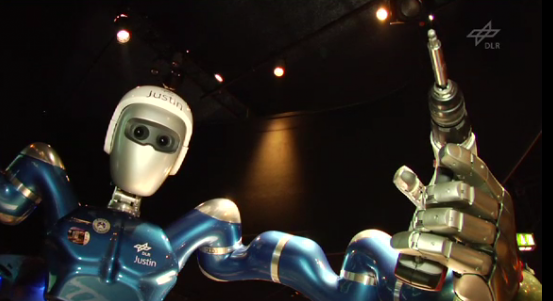
ESA: Driving a robot from Space Station:
29 June 2011

Meet Justin, an android who will soon be controlled remotely by the astronauts in ESA’s Columbus laboratory on the International Space Station. With this and other intriguing experiments like the Eurobot rover, ESA is paving the way for exploring the Moon and planets with tele-operated robots.

[table=head]
Click on image to enlarge​

[/table]​

In two to three years, the experimental robot on Earth will faithfully mimic the movements of an astronaut on the Space Station.

By wearing an exoskeleton – a combination of arm and glove with electronic aids to reproduce the sensations a human hand would feel – a distant operator can work as though he were there.

To help turn robotics and telepresence into a standard tool for space missions, ESA is linking the Space Station and Earth for remotely controlling terrestrial robotic experiments from the orbital outpost.

{...}
 
Roscosmos:
ISS Orbit Raised by Russian Progress
:: 29.06.2011

In accordance with the International Space Station mission ballistics support program, ISS reboost was carried out on June 29.
The maneuver was assisted by attitude thrusters of Progress M-11M cargo vehicle.
After the burn, the parameters of the ISS orbit are:
  • min altitude – 383,98 km;
  • max altitude – 397,58 km;
  • revolution – 92,2 min;
  • inclination – 51,66 deg.
 
From ISS On-Orbit Status Report for 29/06/2011.

Reboost Update:
A one-burn reboost of ISS was performed successfully today at 12:15 PM GMT using the Progress M-11M/43P DPO rendezvous & docking thrusters, with attitude control handover to RS MCS (Motion Control System) at 10:50 AM GMT and return to USOS CMGs at 1:30 PM GMT. Due to the thruster malfunction during 43P docking, only 4 thrusters were used this morning (instead of the usual 8). Burn duration: 33m 31s (25s longer than expected). To provide the ISS with the remaining part of the intended delta-velocity, a second firing is scheduled in 01/07 (Friday). Numbers will be forthcoming. Purpose of the reboost is to gain altitude and set up phasing conditions for STS-135/ULF-7.
 
Last edited:
From ISS On-Orbit Status Report for 30/06/2011.

FE-6 Mike Fossum & FE-3 Ron Garan had 5h 30m blocked out on their timeline for major IFM (Inflight Maintenance) in Node 2, removing & replacing the failed CCAA (Common Cabin Air Assembly) heat exchanger in the P3 Midbay with a new spare HX ORU (Heat Exchanger | Orbital Replaceable Unit) and lines. Fossum later closed out the activity. [Access to QDs (Quick Disconnects) required rotation of the Port 4 rack to make room. The Node 2 ducting was inspected by Mike & Ron for microbial growth and cleaned. The removed CCAA HX ITCS (Internal Thermal Control System) lines require an injection of air for thermal expansion before being returned to the ground on STS-135/ULF-7 along with the HX. The CCAA HX ORU has become degraded and had to be replaced. Its purpose is to remove moisture from the cabin atmosphere, but experts on the ground have seen indications of water passing into the downstream ducting. If water has been collecting in this duct, there may be microbes growing; thus, Ron looked for that.]

Preparatory to the subsequent Robotics activities, FE-5 Satoshi Furukawa powered up the RWS UOP (Robotic Workstation | Utility Outlet Panel) in the Cupola, checked out the RWS DCP (Display & Control Panel), verified proper calibration of the Lab RWS hand controller and installed the CCR (Cupola Crew Restraint), which stabilizes the SSRMS (Space Station Remote Manipulator System) operator.

Next, Furukawa & Fossum operated the SSRMS, walking it off the MBS (Mobile Base System) to Node 2 to preposition it for STS-135/ULF-7. Later, Ron removed the CCR, and Satoshi disabled the RWS UOP. [During the walkoff, the arm switched bases from MBS PDGF-2 (Power & Data Grapple Fixture-2) to the Node 2 PDGF: In the first half of the procedure the arm, which was double-grappled to the MBS, released the MBS PDGF-3 with the tip LEE (Latching End Effector) and maneuvered it to grapple the Node 2 PDGF. From there, the ground performed the base change (~4:15 PM GMT). Afterwards, Furukawa and Garan commanded the SSRMS to release the MBS PDGF-2 and maneuvered it to the ULF-7 start configuration between the JPM (JEM Pressurized Module) and the truss via a series of JOCAS (Joint Operator Commanded Auto Sequence) movements.]

Reboost Update:
The first one-burn ISS reboost (of 2) was performed yesterday morning at 12:15 AM GMT using the Progress M-11M/43P DPO rendezvous & docking thrusters, with attitude control handover to RS MCS (Russian Segment | Motion Control System) at 10:50 AM GMT and return to US CMGs (Control Moment Gyroscopes) at 1:30 PM GMT. Due to the thruster malfunction during 43P docking, only 4 thrusters were used (instead of the usual 8). Burn duration: 33m 31s,- 25s longer than expected. Actual Delta-V was 2.24 m/s (7.35 ft/s) rather than 2.10 m/s (6.9 ft/s) expected. New mean altitude: 384.9 km (207.8 nmi), instead of 384.6 km (207.7 nmi), which put ISS in a potential conjunction situation, requiring DAM (Debris Avoidance Maneuver) planning – which was subsequently cancelled as not necessary.

Reboost 2:
To provide the ISS with the remaining part of the intended delta-velocity, a second firing is scheduled tomorrow (Friday). Recalculated parameters: TIG (Time of Ignition): 12:16 PM GMT; burn duration: 30m 43s; delta-V expected: 1.95 m/s (6.4 ft/s); mean altitude expected: 388.3 km (209.7 nmi). Purpose of the reboosts is to gain altitude and set up phasing conditions for ULF-7.

Robotics Update:
In further preparation for ULF-7, the MT (Mobile Transporter) will be moved from WS-5 (Worksite-5) to WS-7 by ground control at 9:50 PM-11:50 PM GMT. The MT will be temporarily disabled from 9:35 PM-12:08 AM GMT.
 
Pete,

Where did the CTC that dextre was holding, finally end up ?
 
Back
Top