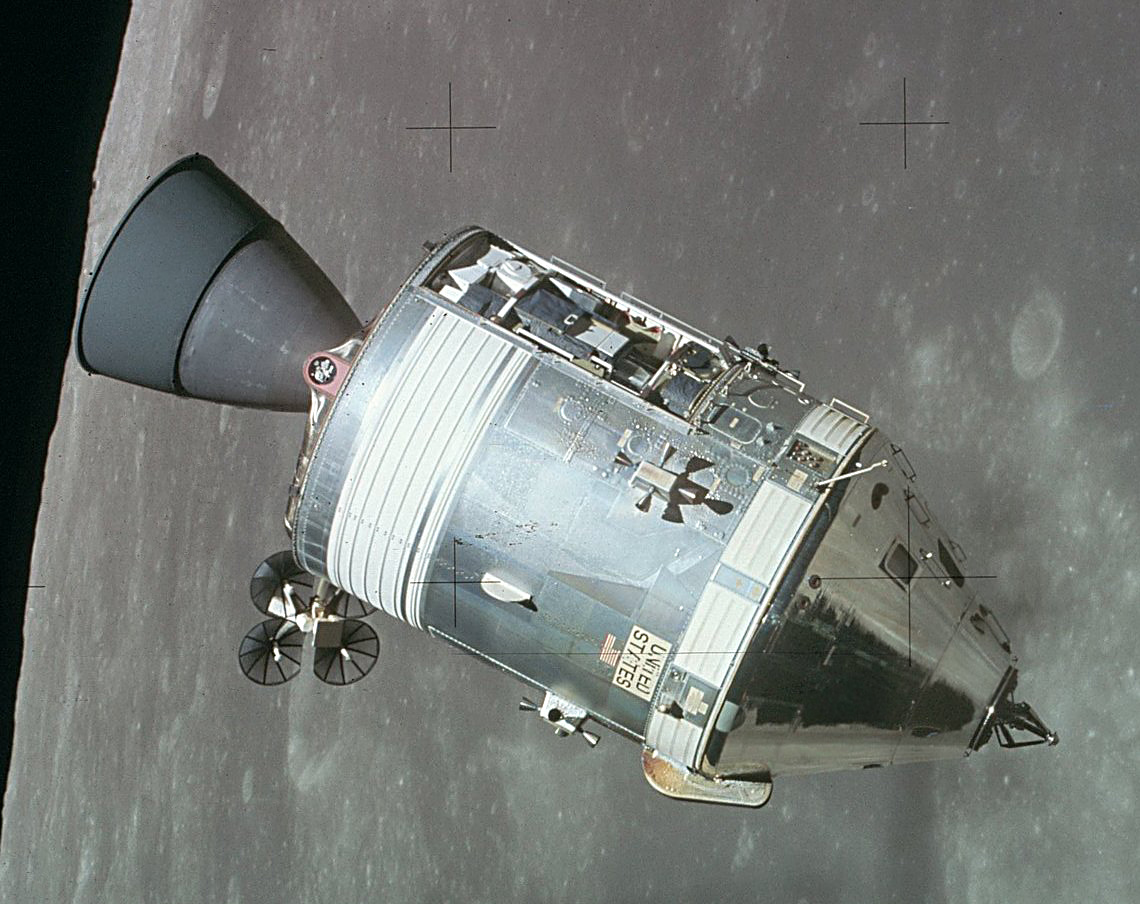
...it seems to me that the moon should be our prime-objective.
If launching such 'crates of super-glass', full of useful 'stuff', that could survive earth-reentry and fall into the ocean without breaking apart just to be scooped up by us and used... then we could perhaps have it 'raining money/energy from the sky'
If the launch-trajectory from the moon could be made precise enough to need no further corrections underway at all, then maybe we could get such glass-crates to fall down into a fairly specific area on their own? Maybe a designated area at sea?
Does that sound too sci-fi?
Yes, that is sci-fi. Because mining in space has to be really special (unobtanium) to be profitable.
Apollo retrieved 382 kilograms of lunar material. Apollo cost was estimated in 2005 as 170 billion USD (at 2005 inflation rates). The cost/kg of gold at the time of posting is $43 970. If Apollo retrieved 382 kg of pure gold, it would have recouped less than a ten-thousandth of it's total cost.
Let's make it a bit better. Halve the cost, quadruple the return payload. $85 billion cost, 1528 kg of gold returned. Less than a thousandth the total cost. Again, not economically viable whatsoever.
Now, I know everyone is going to say, Apollo was 1960s, it wasn't optimised for returning materials to the moon, etc etc. But the fact is that it doesn't matter, because you're not going to find pure gold on the Moon. Or pure uranium, or pure platinum, or pure anything for that matter. You're going to have to mine and refine whatever you want, and that is going to require a huge amount of technology.
In the entire human history of spaceflight, we have only introduced about 178.8 tons of manmade material to the Moon- a good portion of which is intentionally crashed rocket stages, and low-mass unmanned probes. So much for launching the gigantic mine and refining plant.
Helium 3? It is only found in concentrations of 0.01 ppm in sunlight areas, and 0.05 ppm in shaded ones. So you again run into the mining and refining problem.
Let's say, we want to power a fourth of the world's energy needs on Helium 3 (a power production of 4 terawatts). Helium 3-deuterium fusion has an energy density of (if my math is correct) 350 877 000 MJ/kg. Let's say the fusion reactor(s) have an efficiency of 30%...
This means you need to return 1.2 million kilograms, or 1 200 tons, to Earth, every year. If the return payloads are monthly, that is 100 tons being returned to Earth. A lunar vehicle, not to mention a reentry vehicle, that can carry 100 tons, would be a major feat. And yes, glass cubes launched by a gigantic mass driver... it is a nice idea, but it has many problems.
Furthermore, since you only have 0.01 ppm in most regions, you need to sift through over 300 tons of regolith a day. Which is an absolutely huge, infrastructure. Especially on the Moon.
This and more, makes me think it isn't too economically sound... :uhh:
If we can eventually build huge and strong structures on the moon, then maybe our first human mission to Mars and beyond should begin from such a lunar rail-launcher? Then we perhaps wouldn't be so limited in what we might be able to actually launch into space.
A huge, mainly made of super-glass, spaceship with all the needed shielding and holding space The weight of such a thing is less relevant if we could actually launch it by simply speeding it up along a long railway on the moon using electric power harvested from the sun.
If the materials to build these things are already present in the lunar regolith, it probably isn't going to get much easier anytime soon.
You speak of such a railgun launching things into lunar orbit as if it is so easy. It is not. It will be many times harder to launch anything from the Moon, than it will be from the Earth. Why? Because spaceflight is not dominated by physics- surprisingly. It is dominated by economics and political pressure. And the economics and political pressure to build a lunar base, a lunar factory for building spacecraft, and a gigantic accelerator to launch it from the surface, are so bad it isn't even funny.
Economically it make so little sense, to field such a gigantic program if it is uneeded for a relatively small task.
One day we will probably mine the Moon. But it will be nowhere near economic in the forseeable future.