

Unstung
Active member
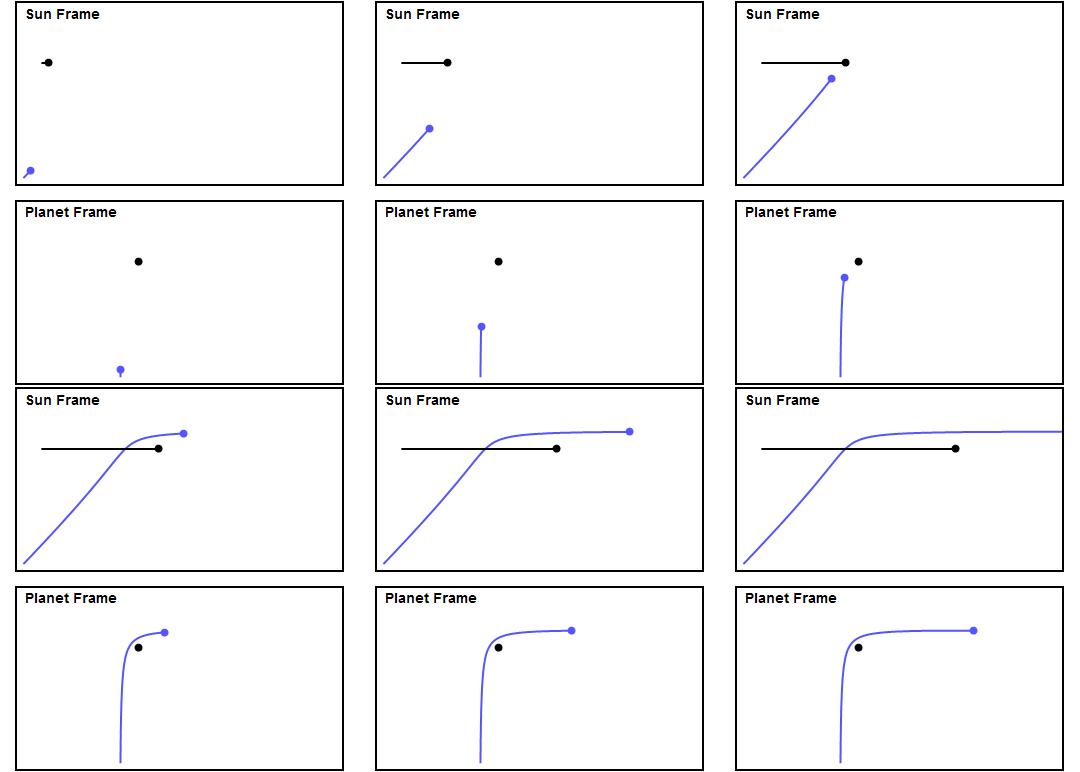
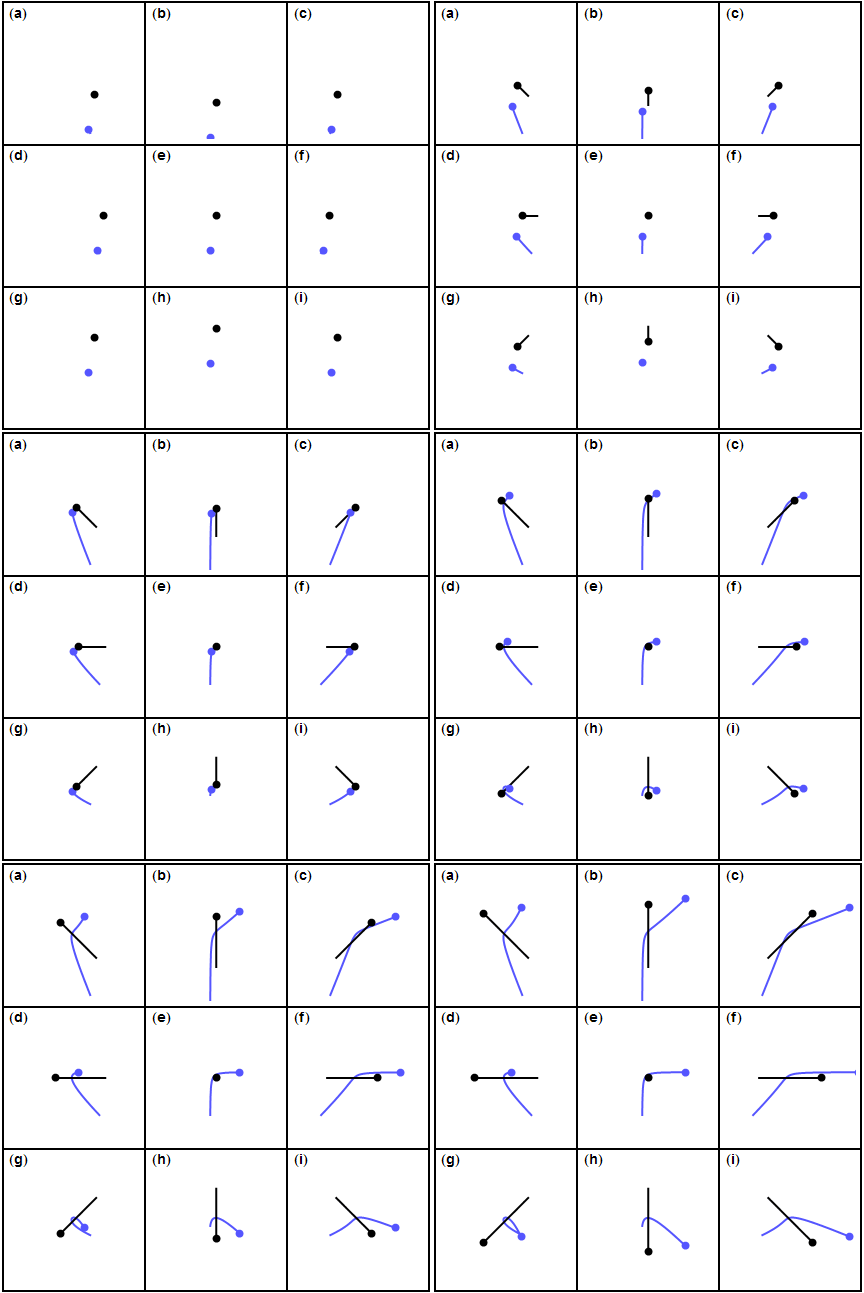
There is an excellent article written for the Planetary Society, simply titled "Gravity assist". Although I knew how the technique worked (the transfer of orbital momentum between a planet and spacecraft), this gave me a better qualitative (and some quantitative) understanding of the process. I wasn't aware at which specific direction would the spacecraft would gain or lose velocity.
The article describes gravity assists in reference frames and using potential and kinetic energy, giving the reader a rather "proper" physics-based understanding of the subject. There's a pretty cool example using Voyager 2's trajectory. The graphics are also mesmerizing and descriptive.
The article describes gravity assists in reference frames and using potential and kinetic energy, giving the reader a rather "proper" physics-based understanding of the subject. There's a pretty cool example using Voyager 2's trajectory. The graphics are also mesmerizing and descriptive.
[table="head;width=800"]{colsp=2}Some Animations
 |
|
 [/table]
This is a general rule of thumb for gravity assists: if, after the encounter, the spacecraft is pointing more along the planet's direction than it was before the encounter, its speed will increase. But where does the energy come from to accelerate the spacecraft? In fact it comes from the planet's own energy of motion. In the Sun frame, there is a transfer of momentum and kinetic energy from the planet to the spacecraft. The planet slows down very slightly in its orbit, and the spacecraft speeds up. Newton's third law states, "To every action there is an equal and opposite reaction," and that's true in this case. Because the planet is so much more massive than the spacecraft, the transfer doesn't affect the planet to any measurable extent, but to the spacecraft it's a big deal. For example, we can calculate that during the Voyager encounters with Jupiter in 1979, Jupiter slowed down by roughly 10 to the -24th power kilometers per second -- a change much too small to measure. But each Voyager gained about 10 km/s, a pretty big number and enough to put them on a fast path to Saturn (and in the case of Voyager 2, to Uranus and Neptune as well) and eventual escape from the solar system.
[...]


