Follow along with the video below to see how to install our site as a web app on your home screen.
Note: This feature may not be available in some browsers.
ORBITER-FORUM will be temporarily closed at 2026-07-23 18:00 UTC while we complete some OF maintenance tasks. The amount of downtime is expected to take up to one hour, but probably less.
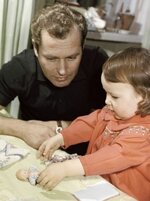
История советской космонавтики в фотографиях. Космонавт Герман Титов с дочерью. The history of Soviet cosmonautics in photographs. Cosmonaut German Titov with his daughter. La historia de la cosmonáutica soviética en fotografías. El cosmonauta German Titov con su hija.
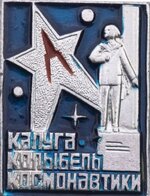
Значок "Калуга - колыбель космонавтики". На значке изображен памятник одному из пионеров космонавтики Константину Эдуардовичу Циолковскому. The "Kaluga – Cradle of Cosmonautics" badge features a monument to one of the pioneers of cosmonautics, Konstantin Eduardovich Tsiolkovsky. La insignia "Kaluga – Cuna de la Cosmonáutica" presenta un monumento a uno de los pioneros de la cosmonáutica, Konstantin Eduardovich Tsiolkovsky.
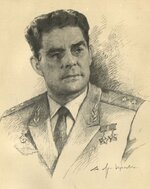
Портреты советских космонавтов. Летчик-космонавт СССР дважды Герой Советского Союза генерал-лейтенант авиации Георгий Тимофеевич Береговой. Portraits of Soviet cosmonauts.
Soviet pilot-cosmonaut, twice Hero of the Soviet Union, Lieutenant General of Aviation Georgy Timofeevich Beregovoy. Retratos de cosmonautas soviéticos. El piloto cosmonauta soviético Georgy Timofeevich Beregovoy, dos veces Héroe de la Unión Soviética y Teniente General de Aviación.
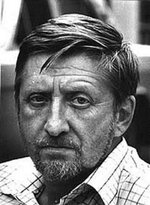
Яросла́в Кири́ллович Голова́нов (1932 - 2003) — советский и российский журналист, писатель и популяризатор науки. Главная тема творчества — космонавтика. Автор 20 книг, более 1200 газетных и 160 журнальных статей. Главная тема творчества — космонавтика. С темой космоса связаны книги «Кузнецы грома», «Правда о программе Apollo», «Этюды об учёных», «Этюды о великом», «Архитектура невесомости», «Наш Гагарин», «Марсианин», «Космонавт № 1». Книга «Дорога на космодром» — история космонавтики от мифического Икара до Юрия Гагарина. Около 30 лет проработал над фундаментальной биографией главного конструктора Сергея Павловича Королева «Королёв. Факты и мифы», выпущенной издательством «Наука» в 1994 году. Автор сценария вышедшего в 1982 году фильма-биографии о Королёве «Разбег».
В 1966—1970-е годы входил в коллектив авторов-фантастов, печатавшихся под псевдонимом Павел Багряк (Па́вел Багря́к — коллективный псевдоним, под которым издавалась фантастическая проза содружества шести авторов: писателей Валерия Аграновского, Дмитрия Биленкина, Ярослава Голованова, Владимира Губарева, Виктора Комарова и художника Павла Бунина. В 1998—1999 годах опубликовал записные книжки «Заметки вашего современника».В июле-августе 1965 года проходил медицинское обследование в Институте Медико-биологических проблем Министерства здравоохранения СССР в рамках подготовки полёта в космос журналиста (в группе совместно с Юрием Летуновым из «Всесоюзного радио» и полковником Михаилом Ребровым из газеты «Красная Звезда»), однако после смерти Королёва программа была свёрнута. В течение 10 лет он — специальный корреспондент газеты «Комсомольская Правда» на космодроме Байконур. За пропаганду достижений в освоении космоса награжден медалями К. Циолковского, С. Королева, М. Келдыша, Н. Пилюгина, В. Макеева, почетным дипломом Ю. Гагарина.9 марта 2001 года в честь Я. К. Голованова назван астероид 7729 Golovanov, открытый в 1977 году советским астрономом Н. С. Черных.
Yaroslav Kirillovich Golovanov (1932–2003) was a Soviet and Russian journalist, writer, and popularizer of science. The main theme of his work was cosmonautics. He was the author of 20 books, more than 1,200 newspaper articles, and 160 magazine articles.
The central theme of his creative work was space exploration. Among his books devoted to space are The Forgers of Thunder, The Truth About the Apollo Program, Studies of Scientists, Studies of the Great, Architecture of Weightlessness, Our Gagarin, The Martian, and Cosmonaut No. 1. His book Road to the Cosmodrome presents the history of astronautics from the legendary Icarus to Yuri Gagarin. He spent nearly thirty years working on the fundamental biography of Chief Designer Sergey Pavlovich Korolev, Korolev: Facts and Myths, published by Nauka Publishing House in 1994. He was also the screenwriter of the 1982 biographical film about Korolev, Run-Up.
From 1966 through the 1970s, he was a member of a collective of science-fiction authors who published under the pseudonym Pavel Bagryak(Pavel Bagryak was a collective pen name used by a group of six creators: writers Valery Agranovsky, Dmitry Bilenkin, Yaroslav Golovanov, Vladimir Gubarev, Viktor Komarov, and artist Pavel Bunin). In 1998–1999, Golovanov published his notebooks under the title Notes of Your Contemporary.
In July–August 1965, he underwent medical examinations at the Institute of Biomedical Problems of the USSR Ministry of Health as part of a program preparing a journalist for spaceflight. He was examined together with Yuri Letunov from All-Union Radio and Colonel Mikhail Rebrov from the newspaper Krasnaya Zvezda. However, after Korolev's death, the program was canceled.
For ten years, he served as a special correspondent for the newspaper Komsomolskaya Pravda at the Baikonur Cosmodrome. For his contributions to the popularization of achievements in space exploration, he was awarded medals named after Konstantin Tsiolkovsky, Sergey Korolev, Mstislav Keldysh, Nikolai Pilyugin, and Viktor Makeyev, as well as the Yuri Gagarin Honorary Diploma.
On March 9, 2001, asteroid 7729 Golovanov, discovered in 1977 by Soviet astronomer Nikolai Chernykh, was named in honor of Yaroslav K. Golovanov. Yaroslav Kiríllovich Golovánov (1932–2003) fue un periodista, escritor y divulgador científico soviético y ruso. El tema principal de su obra fue la cosmonáutica. Fue autor de 20 libros, más de 1.200 artículos periodísticos y 160 artículos publicados en revistas.
El tema central de su actividad creativa fue la exploración espacial. Entre sus libros dedicados al espacio se encuentran Los forjadores del trueno, La verdad sobre el programa Apollo, Estudios sobre científicos, Estudios sobre los grandes, Arquitectura de la ingravidez, Nuestro Gagarin, El marciano y Cosmonauta n.º 1. Su libro Camino hacia el cosmódromo presenta la historia de la astronáutica desde el legendario Ícaro hasta Yuri Gagarin. Dedicó casi treinta años a la elaboración de una biografía fundamental del Diseñador Jefe Serguéi Pávlovich Koroliov, Koroliov: hechos y mitos, publicada por la editorial Nauka en 1994. También fue el guionista de la película biográfica sobre Koroliov Despegue, estrenada en 1982.
Entre 1966 y la década de 1970 formó parte de un colectivo de autores de ciencia ficción que publicaban bajo el seudónimo Pavel Bagryak(Pavel Bagryak fue un seudónimo colectivo utilizado por seis creadores: los escritores Valeri Agranovski, Dmitri Bilenkin, Yaroslav Golovánov, Vladímir Gubarev, Víktor Komárov y el artista Pavel Bunin). En 1998–1999 publicó sus cuadernos de notas bajo el título Notas de vuestro contemporáneo.
En julio y agosto de 1965 se sometió a exámenes médicos en el Instituto de Problemas Biomédicos del Ministerio de Salud de la URSS como parte de un programa para preparar a un periodista para un vuelo espacial. Formaba parte del grupo junto con Yuri Letunov, de la Radio de Toda la Unión, y el coronel Mijaíl Rebrov, del periódico Krasnaya Zvezda. Sin embargo, tras la muerte de Koroliov, el programa fue cancelado.
Durante diez años trabajó como corresponsal especial del periódico Komsomólskaya Pravda en el cosmódromo de Baikonur. Por su contribución a la divulgación de los logros de la exploración espacial fue condecorado con las medallas Konstantín Tsiolkovski, Serguéi Koroliov, Mstislav Kéldysh, Nikolái Pilyuguin y Víktor Makéyev, así como con el Diploma Honorífico Yuri Gagarin.
El 9 de marzo de 2001, el asteroide 7729 Golovanov, descubierto en 1977 por el astrónomo soviético Nikolái Chernyj, recibió su nombre en honor de Yaroslav K. Golovánov.
"Разговор со Шкловским. Он интересно подметил: вот уже исполнилось 20 лет космической эры, но её главный результат: ничего нового в космосе не обнаружено, представления предыдущих веков лишь уточнились, но не опровергнуты.
Иосиф Самуилович считает Юпитер наполовину звездой, наполовину планетой. Частицы высоких энергий в магнитном поле Юпитера открыты и на Земле, радиационные пояса Юпитера обнаружили в Пулково. Ракеты позволяют лишь детально изучать планеты. Планетология скоро отпочкуется от астрономии, так же, как отпочковались от нее науки о Земле. Мы присутствуем при начале освоения ближнего космоса. Иосиф Самуилович считает, что сегодня надо заниматься не изучением (принципиально новых открытий не будет), а освоением ближнего космоса: строить там солнечные электростанции, промышленные предприятия, обитаемые острова на манер «бубликов» и цилиндров О'Нейла". (Ярослав Голованов. "Заметки вашего современника"; том 2. 1970-1983).
Примечание:Ио́сиф Самуи́лович Шкло́вский (1916 — 1985) — советский учёный, астроном и астрофизик.Джерард О’Нилл ( Gerard Kitchen "Gerry" O'Neill) (1927 — 1992) — американский физик, сторонник активных мер по изучению Вселенной.
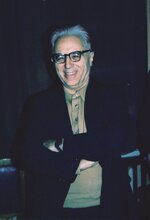
На верхнем фото И. С. Шкловский (в очках). На нижнем фото Джерард О’Нилл. A Conversation with Shklovsky
He made an interesting observation: twenty years of the Space Age have already passed, yet its main result is that nothing fundamentally new has been discovered in space. The ideas of previous centuries have only been refined, not overturned.
Iosif Samuilovich considers Jupiter to be half star and half planet. High-energy particles in Jupiter's magnetic field were first discovered on Earth, and Jupiter's radiation belts were detected at the Pulkovo Observatory. Rockets make it possible only to study the planets in greater detail. Planetology will soon branch off from astronomy, just as the sciences of the Earth once branched off from it.
We are witnessing the beginning of the practical development of near space. Iosif Samuilovich believes that today we should focus not on exploration (since no fundamentally new discoveries are expected), but on the utilization of near-Earth space: building solar power stations there, industrial facilities, and habitable islands in the form of O'Neill-style "doughnuts" and cylinders.
(Yaroslav Golovanov, Notes of Your Contemporary, Volume 2, 1970–1983)
Note: Iosif Samuilovich Shklovsky (1916–1985) was a Soviet scientist, astronomer, and astrophysicist. Gerard Kitchen "Gerry" O'Neill (1927–1992) was an American physicist and advocate of active human expansion into space.
In the upper photograph: I. S. Shklovsky (wearing glasses). In the lower photograph: Gerard O'Neill. Una conversación con Shklovski
Hizo una observación interesante: ya han pasado veinte años desde el comienzo de la Era Espacial, y su principal resultado es que no se ha descubierto nada fundamentalmente nuevo en el cosmos. Las ideas de los siglos anteriores solo se han precisado, pero no se han refutado.
Iosif Samuilovich considera que Júpiter es mitad estrella y mitad planeta. Las partículas de alta energía presentes en el campo magnético de Júpiter fueron descubiertas primero en la Tierra, y los cinturones de radiación de Júpiter fueron detectados en el Observatorio de Púlkovo. Los cohetes permiten únicamente estudiar los planetas con mayor detalle. La planetología pronto se separará de la astronomía, del mismo modo que las ciencias de la Tierra se separaron de ella en el pasado.
Estamos presenciando el comienzo de la explotación práctica del espacio cercano. Iosif Samuilovich cree que hoy debemos dedicarnos no tanto a la exploración (ya que no se esperan descubrimientos fundamentalmente nuevos), sino al aprovechamiento del espacio próximo a la Tierra: construir allí centrales solares, instalaciones industriales y hábitats espaciales en forma de "rosquillas" y cilindros al estilo de O'Neill.
(Yaroslav Golovanov, Notas de un contemporáneo, tomo 2, 1970–1983)
Nota: Iósif Samuilovich Shklovski (1916–1985) fue un científico, astrónomo y astrofísico soviético. Gerard Kitchen "Gerry" O'Neill (1927–1992) fue un físico estadounidense y defensor de la expansión activa de la humanidad en el espacio.
En la fotografía superior: I. S. Shklovski (con gafas). En la fotografía inferior: Gerard O'Neill.
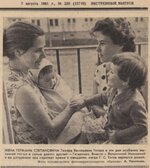
История советской космонавтики в фотографиях. Жёны космонавтов Юрия Гагарина и Германа Титова. Фото специального фотокорреспондента газеты "Правда" А.Пахомова от 7 августа 1961 года. Номер газеты был посвящён посадке космического корабля "Восток-2". The history of Soviet cosmonautics in photographs. The wives of cosmonauts Yuri Gagarin and Gherman Titov. Photo by special photojournalist A. Pakhomov of the Pravda newspaper, August 7, 1961. The newspaper issue was dedicated to the landing of the Vostok 2 spacecraft. La historia de la cosmonáutica soviética en fotografías. Las esposas de los cosmonautas Yuri Gagarin y Gherman Titov. Fotografía del fotoperiodista especial A. Pakhomov del periódico Pravda, 7 de agosto de 1961. La edición del periódico estaba dedicada al aterrizaje de la nave espacial Vostok 2.
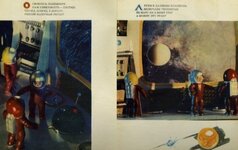
По страницам книги "Как мы на ракете летали". Авторы Сергей Баруздин и Вадим Гортинский. Сказка - путешествие. Издательство "Детский мир".1963 год. From the pages of the book "How We Flew on a Rocket." Authors: Sergey Baruzdin and Vadim Gortinsky. A fairy tale journey. Published by "Detsky Mir." 1963. Fragmento del libro «Cómo volamos en cohete». Autores: Sergey Baruzdin y Vadim Gortinsky. Un viaje de cuento de hadas. Publicado por «Detsky Mir». 1963.
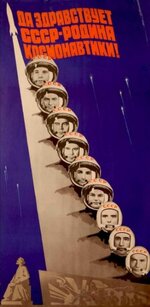
Плакат "Да здравствует СССР – родина космонавтики!" Москва, 1964 г. Авторы: Ю. Кершин, В. Трухачев. Poster "Long live the USSR – the birthplace of cosmonautics!" Moscow, 1964. Authors: Yu. Kershin, V. Trukhachev. Cartel "¡Viva la URSS, cuna de la cosmonáutica!" Moscú, 1964. Autores: Yu. Kershin, V. Trukhachev.
"Прыжок в космические просторы с каждым годом все более и более облекался в ощутимые очертания, и освоение космоса казалось близким. "Одни изобретают и вычисляют, другие более доступно излагают эти труды, а третьи посвящают им роман", - писал К. Э. Циолковский 5 января 1935 года Александру Романовичу Беляеву относительно его романа "Прыжок в ничто". В этом романе ученый увидел счастливое сближение с его научным исследованием по освоению космоса, прекрасное средство популяризации его идей. Вот почему он с таким большим удовлетворением писал Беляеву: Он( т.е роман "Прыжок в ничто") более будет распространять значение и интерес к великой задаче 20 века чем другие популярные рассказы, не исключая даже иностранных...Что же касается до посвящения его мне, то я считаю это Вашей любезностью и честью для себя". А затем уже в марте 1935 года написал предисловие ко второму изданию собрания сочинений А. Р. Беляева : "Из всех известных мне рассказов, оригинальных и переводных, на тему о межпланетных сообщениях роман А. Р. Беляева мне кажется наиболее содержательным и научным...
Поэтому я сердечно и искренне приветствую появление второго издания, которое, несомненно, будет способствовать распространению в массах интереса к заатмосферным полетам.
Вероятно, их ожидает великое будущее".
К. Э. Циолковский значение научной фантастики никогда не снижал и с поля боя за научную фантастику не уходил. "Фантастические рассказы на темы межпланетных рейсов несут новую мысль в массы. Кто этим занимается, тот делает полезное дело: вызывает интерес, побуждает к деятельности мозг, рождает сочувствующих и будущих работников великих намерений,- развивал ученый свою мысль о значении научной фантастики в письме В. Н. Журавлеву 24 января 1935 го. - До последнего времени я предполагал, что нужны сотни лет для осуществления полетов с астрономической скоростью( 8 -17 км в секунду)..Но непрерывная работа в последнее время поколебала эти мои пессимистические взгляды: найдены приемы, которые дадут изумительные результаты уже через десятки лет".(С.И. Самойлович. "Гражданин вселенной").
.....................................................................................................................
Цит. по: СЕРГЕЙ ИВАНОВИЧ САМОЙЛОВИЧ
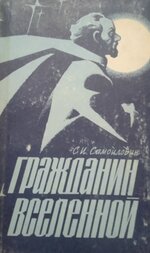
ГРАЖДАНИН ВСЕЛЕННОЙ Калуга/ Государственный музей истории космонавтики им. К.Э. Циолковского/ 1969 год
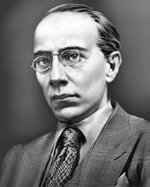
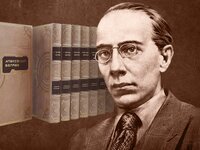
На верхнем фото обложка книги "Гражданин Вселенной". На нижнем фото советский фантаст Александр Беляев. "The leap into the vastness of space was acquiring more and more tangible outlines with each passing year, and the conquest of space seemed near.
'Some invent and calculate, others present these works in a more accessible form, and still others dedicate a novel to them,' wrote K. E. Tsiolkovsky to Alexander Romanovich Belyaev on January 5, 1935, regarding his novel Leap into Nothingness. In this novel, the scientist saw a fortunate convergence with his own scientific research on space exploration, a splendid means of popularizing his ideas. That is why he wrote to Belyaev with such satisfaction:
'It (that is, the novel Leap into Nothingness) will do more to spread the significance of and interest in the great task of the twentieth century than other popular stories, including foreign ones... As for its dedication to me, I regard it as your kindness and an honor for myself.'
Then, in March 1935, he wrote the preface to the second edition of A. R. Belyaev’s collected works:
'Of all the stories known to me, both original and translated, on the subject of interplanetary travel, A. R. Belyaev’s novel seems to me the most substantial and scientifically grounded...
Therefore, I warmly and sincerely welcome the appearance of this second edition, which will undoubtedly contribute to spreading among the masses an interest in journeys beyond the atmosphere.
Most likely, a great future awaits them.'
K. E. Tsiolkovsky never diminished the importance of science fiction and never withdrew from the struggle for it.
'Fantastic stories on the subject of interplanetary voyages carry new ideas to the masses. Whoever engages in this performs a useful service: they awaken interest, stimulate the mind to activity, create sympathizers and future workers for great endeavors,' the scientist developed his thoughts on the significance of science fiction in a letter to V. N. Zhuravlev on January 24, 1935.
'Until recently, I assumed that hundreds of years would be required to achieve flights at astronomical velocities (8–17 km per second)... But continuous work in recent times has shaken these pessimistic views of mine: methods have been found that will produce astonishing results within mere decades.'
Kaluga / K. E. Tsiolkovsky State Museum of the History of Cosmonautics / 1969
In the upper photograph: the cover of the book Citizen of the Universe.
In the lower photograph: Soviet science-fiction writer Alexander Belyaev. "El salto hacia las inmensidades del espacio adquiría cada año contornos cada vez más concretos, y la conquista del cosmos parecía cercana.
'Unos inventan y calculan, otros exponen estos trabajos de manera más accesible, y otros les dedican una novela', escribió K. E. Tsiolkovski a Aleksandr Románovich Beliáyev el 5 de enero de 1935 acerca de su novela Salto hacia la nada. En esta obra, el científico vio una feliz coincidencia con sus propias investigaciones sobre la exploración espacial, así como un magnífico medio para popularizar sus ideas. Por eso escribió a Beliáyev con tanta satisfacción:
'Ella (es decir, la novela Salto hacia la nada) difundirá más la importancia y el interés por la gran tarea del siglo XX que otros relatos populares, sin excluir siquiera los extranjeros... En cuanto a que me la haya dedicado, lo considero una muestra de su amabilidad y un honor para mí.'
Posteriormente, en marzo de 1935, escribió el prólogo para la segunda edición de las obras completas de A. R. Beliáyev:
'De todos los relatos que conozco, originales o traducidos, sobre el tema de los viajes interplanetarios, la novela de A. R. Beliáyev me parece la más rica en contenido y la más científica...
Por ello saludo cordial y sinceramente la aparición de esta segunda edición, que sin duda contribuirá a difundir entre las masas el interés por los vuelos más allá de la atmósfera.
Probablemente les espera un gran futuro.'
K. E. Tsiolkovski nunca restó importancia a la ciencia ficción y jamás abandonó la defensa de su valor.
'Los relatos fantásticos sobre viajes interplanetarios llevan nuevas ideas a las masas. Quien se dedica a ello realiza una labor útil: despierta el interés, estimula la actividad del pensamiento, crea simpatizantes y futuros trabajadores de grandes empresas', desarrolló el científico sus ideas sobre la importancia de la ciencia ficción en una carta a V. N. Zhuravliov el 24 de enero de 1935.
'Hasta hace poco suponía que serían necesarios cientos de años para realizar vuelos a velocidades astronómicas (8–17 km por segundo)... Pero el trabajo continuo de los últimos tiempos ha sacudido estas opiniones pesimistas mías: se han encontrado métodos que producirán resultados asombrosos en apenas unas décadas.'
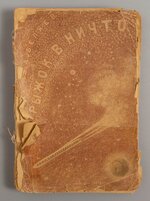
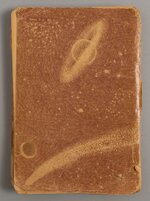
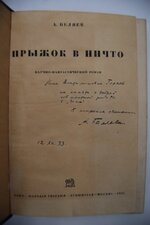
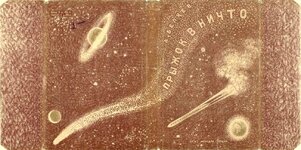
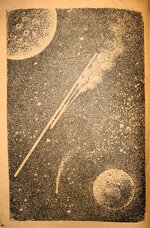
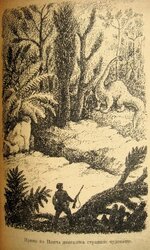
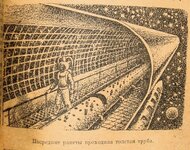
Александр Беляев"Прыжок в ничто" авторская книга, первое издание.
Издательство «Молодая гвардия» (Ленинградское отделение), 1933 г.
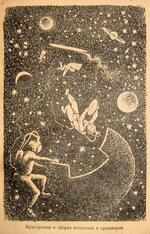
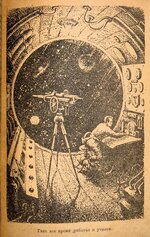
Тираж: 20 325 экз. На фотографиях обложка и некоторые иллюстрации художника Н.А. Травина.
На титульном листе дарственная подпись А. Беляева. Alexander Belyaev, "Leap into Nothingness" Author's book, first edition.
Molodaya Gvardiya Publishing House (Leningrad branch), 1933
Circulation: 20,325 copies. The photographs show the cover and some illustrations by artist N.A. Travin.
On the title page there is a signature of A. Belyaev. Alexander Belyaev, «Salto a la nada» Libro del autor, primera edición.
Editorial Molodaya Gvardiya (sucursal de Leningrado), 1933
Tirada: 20.325 ejemplares. Las fotografías muestran la portada y algunas ilustraciones del artista N.A. Travin.
En la página del título aparece la firma de A. Belyaev.
Алекса́ндр Рома́нович Беля́ев(1884 — 1942) — русский писатель-фантаст, репортёр и адвокат, журналист. Один из основоположников советской научно-фантастической литературы, первый из советских писателей, целиком посвятивший себя этому жанру. Среди наиболее известных его романов — «Голова профессора Доуэля», «Человек-амфибия», «Ариэль», «Звезда КЭЦ» и многие другие (всего более 70 научно-фантастических произведений, в том числе 17 романов). За значительный вклад в русскую фантастику и провидческие идеи Беляева называют «русским Жюлем Верном» В своих научно-фантастических романах Александр Беляев предвосхитил появление огромного количества изобретений, хотя при жизни писателя его идеи часто расценивали как «научно несостоятельные» и «лишённые познавательного значения». Часть из них связана с освоением моря: подводные поселения и фермы, подводная съёмка и телевидение, ранцы-буксировщики для пловцов («Подводные земледельцы», «Чудесное око»). Другая — с освоением космоса: пилотируемые космические полёты, выход в открытый космос, полёт на Луну и орбитальные станции («Звезда КЭЦ», «Прыжок в ничто»). Также предсказаны достижения в биологии и медицине: создание новых органов человека, сохранение жизнедеятельности изолированных органов, трансплантология, операции на хрусталике, пластическая хирургия, управление настроениями и действиями живого организма, регулирование роста через воздействие на эндокринную систему, препараты, снимающие утомление и стимулирующие умственную деятельность, замораживание как способ временно приостановить биологическое функционирование («Человек-амфибия», «Голова профессора Доуэля», «Человек, потерявший лицо» и другие). Кроме того, мобильный телефон, радиолокатор, интроскоп/интравизор («Борьба в эфире»), беспилотные летательные аппараты(«Властелин мира»); микробиологическое производство («Вечный хлеб»), искусственная шаровая молнияи другие. Alexander Romanovich Belyaev (1884–1942) was a Russian science fiction writer, reporter, lawyer, and journalist. He is considered one of the founders of Soviet science fiction literature and the first Soviet writer to devote himself entirely to this genre.
Among his most famous novels are Professor Dowell’s Head, Amphibian Man, Ariel, KETS Star, and many others (more than 70 science fiction works in total, including 17 novels). For his significant contribution to Russian science fiction and his visionary ideas, Belyaev is often called the “Russian Jules Verne.”
In his science fiction novels, Alexander Belyaev anticipated the appearance of a vast number of inventions, although during his lifetime his ideas were often regarded as “scientifically unsound” and “devoid of educational value.” Some of these predictions were related to the exploration of the seas: underwater settlements and farms, underwater photography and television, and diver propulsion devices (“Underwater Farmers,” “The Wonderful Eye”). Others were connected with space exploration: manned space flights, spacewalks, lunar missions, and orbital stations (KETS Star, Leap into Nothing).
He also foresaw achievements in biology and medicine: the creation of new human organs, preservation of the vital functions of isolated organs, transplantation, lens surgery, plastic surgery, control of moods and actions in living organisms, regulation of growth through influence on the endocrine system, drugs that relieve fatigue and stimulate mental activity, and cryogenic preservation as a means of temporarily suspending biological functions (Amphibian Man, Professor Dowell’s Head, The Man Who Lost His Face, and others).
In addition, he predicted the mobile phone, radar, introscope/intravisor (Struggle in the Ether), unmanned aerial vehicles (The Ruler of the World), microbiological production (Eternal Bread), artificial ball lightning, and many other technological developments.
Aleksandr Románovich Beliáyev (1884–1942) fue un escritor ruso de ciencia ficción, reportero, abogado y periodista. Es considerado uno de los fundadores de la literatura soviética de ciencia ficción y el primer escritor soviético que se dedicó por completo a este género.
Entre sus novelas más conocidas se encuentran La cabeza del profesor Dowell, El hombre anfibio, Ariel, La estrella KETS y muchas otras (más de 70 obras de ciencia ficción en total, incluidas 17 novelas). Por su importante contribución a la ciencia ficción rusa y por sus ideas visionarias, Beliáyev suele ser llamado el “Julio Verne ruso”.
En sus novelas de ciencia ficción, Aleksandr Beliáyev anticipó la aparición de una enorme cantidad de inventos, aunque durante su vida sus ideas fueron consideradas con frecuencia “científicamente inconsistentes” y “carentes de valor cognitivo”. Algunas de estas predicciones estaban relacionadas con la exploración de los mares: asentamientos y granjas submarinas, fotografía y televisión submarinas, y dispositivos de propulsión para buceadores (“Los agricultores submarinos”, “El ojo maravilloso”). Otras estaban vinculadas con la exploración espacial: vuelos espaciales tripulados, caminatas espaciales, viajes a la Luna y estaciones orbitales (La estrella KETS, Salto a la nada).
También predijo avances en biología y medicina: la creación de nuevos órganos humanos, la conservación de la actividad vital de órganos aislados, los trasplantes, la cirugía del cristalino, la cirugía plástica, el control de los estados de ánimo y las acciones de los organismos vivos, la regulación del crecimiento mediante la influencia sobre el sistema endocrino, medicamentos para eliminar la fatiga y estimular la actividad mental, y la criopreservación como método para suspender temporalmente las funciones biológicas (El hombre anfibio, La cabeza del profesor Dowell, El hombre que perdió el rostro y otras obras).
Además, anticipó la aparición del teléfono móvil, el radar, el introscopio/intravisor (La lucha en el éter), los vehículos aéreos no tripulados (El amo del mundo), la producción microbiológica (El pan eterno), el rayo en bola artificial y muchos otros avances tecnológicos.
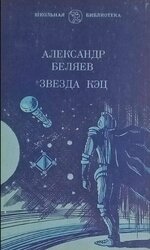
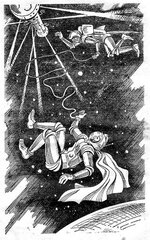
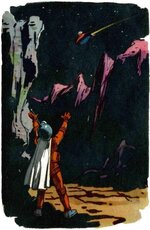
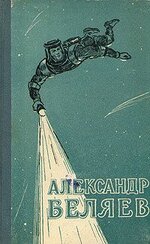
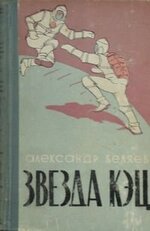
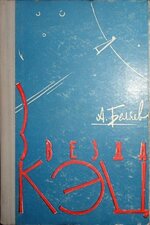
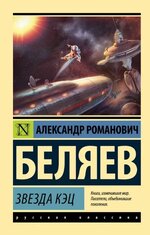
Обложка и иллюстрации к книге Александра Беляева "Звезда КЭЦ" 1988 г. Город Барнаул. Алтайское книжное издательство. Художник А.Курдюмов. Cover and illustrations for Alexander Belyaev's book "Star of the KEC," 1988. City of Barnaul. Altai Book Publishing House. Artist A. Kurdyumov. Portada e ilustraciones del libro de Alexander Belyaev, "Estrella del KEC", 1988. Ciudad de Barnaul. Editorial Altai Book. Artista: A. Kurdyumov.
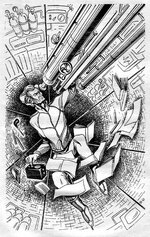
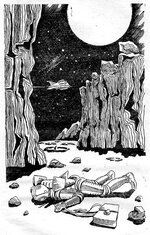
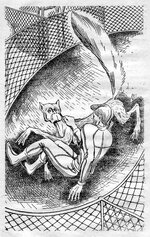
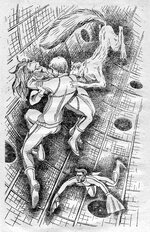
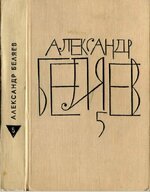
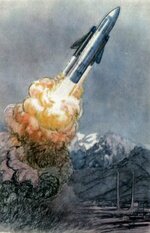
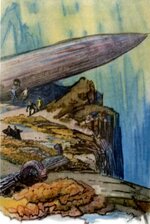
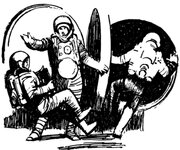
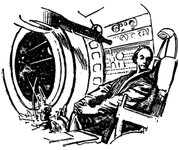
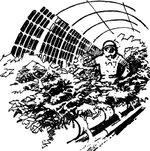
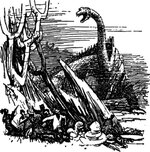
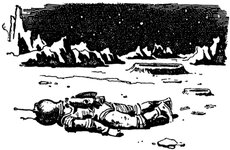
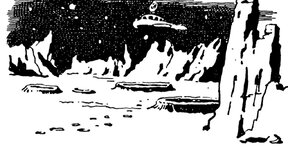
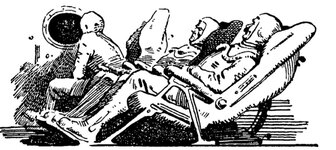
Обложка (художник В.Маркевич) 5 тома сочинений Александра Беляева издания 1964 года. Иллюстрации к книге "Прыжок в ничто"(художник П.Луганский). Cover (artist V. Markevich) of the 5th volume of the works of Alexander Belyaev, published in 1964. Illustrations for the book "Leap into Nothing" (artist P. Lugansky). Portada (artista V. Markevich) del quinto volumen de las obras de Alexander Belyaev, publicado en 1964. Ilustraciones para el libro "Salto a la nada" (artista P. Lugansky).
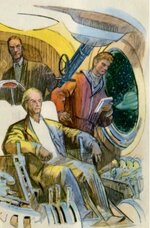
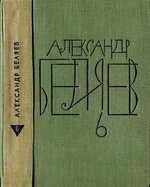
Обложка (художник В.Маркевич) 6 тома сочинений Александра Беляева издания 1964 года. Иллюстрации к книге "Звезда КЭЦ"(художник Ст.Забалуев.). Cover (artist V. Markevich) of the 6th volume of the works of Alexander Belyaev, published in 1964. Illustrations for the book "Star of the KEC" (artist St. Zabaluev). Portada (artista V. Markevich) del sexto volumen de las obras de Alexander Belyaev, publicado en 1964. Ilustraciones para el libro "Estrella del KEC" (artista St. Zabaluev).
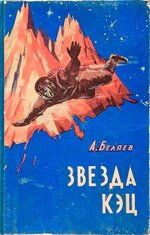
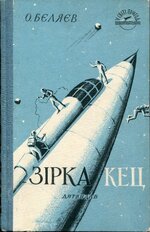
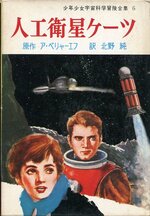
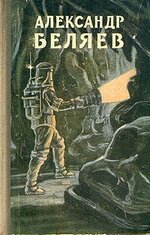
Обложки разных изданий книги "Звезда КЭЦ". Covers of various editions of the book "Star of KEC". Portadas de varias ediciones del libro "Estrella de KEC".
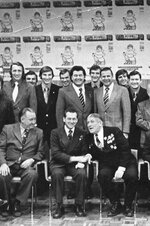
Уникальное фото. Хоккейный турнир Приз "Известий". 1975 год. Нижний ряд(сидят на стульях), слева направо: Борис Павлович Кулагин — советский хоккеист, тренер; Вита́лий Ива́нович Севастья́нов — лётчик-космонавт СССР, кандидат технических наук, дважды Герой Советского Союза; Николай Афанасьевич Крючко́в — советский и российский актёр театра и кино, герой Социалистического Труда, народный артист СССР.
В верхнем ряду советские хоккеисты : Александр Якушев, Владислав Третьяк, Виктор Жлуктов; легендарный футбольный вратарь Лев Яшин; тренер сборной СССР по хоккею Владимир Владимирович Юрзинов.
....................................................................... Примечание: МЕЖДУНАРО́ДНЫЙ ТУРНИ́Р НА ПРИЗ ГАЗЕ́ТЫ «ИЗВЕ́СТИЯ» (Приз «Известий»), международный турнир по хоккею (Москва), проводился до 1996 года. Первый турнир состоялся в 1967 году в СССР и носил название "Московский международный турнир на приз Федерации хоккея СССР". С 1969 года по предложению спортивного комментатора Бориса Федосова турнир взяла под патронаж редакция газеты «Известия», и он получил постоянную эмблему (идея которой также принадлежит Федосову) — снеговика с клюшкой. В состязаниях участвовали национальные сборные ведущих хоккейных держав. A unique photo. Izvestia Prize. 1975. Bottom row (seated on chairs), left to right: Boris Pavlovich Kulagin, Soviet hockey player and coach; Vitaly Ivanovich Sevastyanov, USSR pilot-cosmonaut, PhD in engineering, twice Hero of the Soviet Union; Nikolai Afanasyevich Kryuchkov, Soviet and Russian theater and film actor, Hero of Socialist Labor, People's Artist of the USSR.
Top row: Soviet hockey players: Alexander Yakushev, Vladislav Tretiak, Viktor Zhluktov; legendary soccer goalkeeper Lev Yashin; USSR national hockey team coach Vladimir Vladimirovich Yurzinov. ...................................................................... Note: The International Ice Hockey Tournament for the Prize of the Newspaper "IZVESTIA" (Izvestia Prize), an international hockey tournament (Moscow), was held until 1996. The first tournament was held in 1967 in the USSR and was called the "Moscow International Tournament for the Prize of the USSR Ice Hockey Federation." Since 1969, at the suggestion of sports commentator Boris Fedosov, the Izvestia newspaper took over the tournament's patronage, and it received a permanent emblem (also conceived by Fedosov)—a snowman with a hockey stick. The national teams of the leading hockey nations participated in the competition. Una fotografía única. Premio Izvestia. 1975. Fila inferior (sentados en sillas), de izquierda a derecha: Boris Pavlovich Kulagin, jugador y entrenador de hockey soviético; Vitaly Ivanovich Sevastyanov, piloto-cosmonauta de la URSS, doctor en ingeniería, dos veces Héroe de la Unión Soviética; Nikolai Afanasyevich Kryuchkov, actor de teatro y cine soviético y ruso, Héroe del Trabajo Socialista, Artista del Pueblo de la URSS.
Fila superior: Jugadores de hockey soviéticos: Alexander Yakushev, Vladislav Tretiak, Viktor Zhluktov; el legendario portero de fútbol Lev Yashin; el entrenador de la selección nacional de hockey de la URSS, Vladimir Vladimirovich Yurzinov. ...................................................................... Nota: El Torneo Internacional de Hockey sobre Hielo por el Premio del Periódico "IZVESTIA" (Premio Izvestia), un torneo internacional de hockey (Moscú), se celebró hasta 1996. El primer torneo tuvo lugar en 1967 en la URSS y se denominó "Torneo Internacional de Moscú por el Premio de la Federación de Hockey sobre Hielo de la URSS". Desde 1969, a sugerencia del comentarista deportivo Boris Fedosov, el periódico Izvestia asumió el patrocinio del torneo, que recibió un emblema permanente (también ideado por Fedosov): un muñeco de nieve con un palo de hockey. Las selecciones nacionales de los principales países de hockey participaron en la competición.
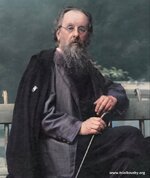
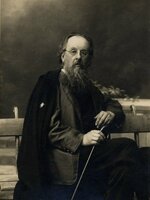
Константин Эдуардович Циолковский(1857 - 1935).Колоризация фотографии. Оригинальное чёрно - белое фото 1924 года. Konstantin Eduardovich Tsiolkovsky (1857 - 1935). Photograph colorization. Original black-and-white photo from 1924. Konstantin Eduardovich Tsiolkovsky (1857 - 1935). Fotografía coloreada. Fotografía original en blanco y negro de 1924.
"А как же с продолжительностью полета? Всякий ли выход в космос есть полет? "Если летательный аппарат, - отвечает Сергей Павлович, - совершает полет вокруг Земли хотя бы в течение не менее одного оборота, не падая на Землю, то такой полет является космическим. Здесь надо отметить, что в общем случае космический полет может происходить и не обязательно вокруг Земли, но тогда протяженность полета либо его длительность должны быть соизмеримы с одним оборотом спутника. Например, теоретически возможен вертикальный космический полет".
И как вывод из всего сказанного - формулировка: "Космическим полетом называется полет летательного аппарата со скоростью движения, равной или большей первой космической, выше плотных слоев атмосферы в течение достаточно длительного времени. При этом происходит потеря состояния естественной земной весомости".
Определения вроде бы завершены, но размышления продолжаются. Уже незадолго до старта Ю. Гагарина, 19 марта 1961 года, он снова возвращается к мысли о посадке. Сергей Павлович записывает: "Космический полет предусматривает посадку на Землю. Иначе это падение, выстрел и т. д.". Ниже делает уточнение: "Не всегда на Землю!".
Так тщательно отрабатывалась терминология. И, разумеется, во сто крат тщательнее готовились сами полеты.
В ходе подготовки к полету человека в космос Сергей Павлович особое внимание уделял надежности всех систем и безопасности космонавта. Надо было обеспечить практически безотказное действие систем, агрегатов, установок, узлов в условиях космического полета. Требование надежности легко понять, если вспомнить, что каждый корабль-спутник состоит из сотен сложнейших систем, тысяч и десятков тысяч узлов и деталей. И достаточно выйти из строя незначительному элементу, как полет может оказаться неудачным.
Чтобы добиться высокой надежности, говорил Сергей Павлович, о ней надо думать, начиная с момента проектирования. Поэтому заранее предусматривалась возможность проверки работы любой конструкции на земле и в полете.
А в ходе производства он строжайше следил за соблюдением технологии, за "самочувствием" всех систем, каждую из которых прежде чем установить на корабль многократно и в самых разнообразных условиях испытывали. А потом уже корабль и его системы испытывались на земле. И только после этого начинались запуски и полеты по орбите". (П.Т. Асташенков. "Академик С. П. Королев" ).
..................................................................................
Цит.по : П. Т. АСТАШЕНКОВ
АКАДЕМИК С. П. КОРОЛЕВ
Под редакцией К. И. Трунова
ИЗДАТЕЛЬСТВО "МАШИНОСТРОЕНИЕ" Москва 1969
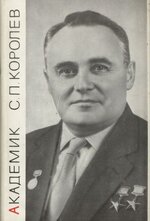
На фото обложка книги "Академик С.П.Королев". “And what about the duration of a flight? Can every venture into space be called a flight?
‘If a flying vehicle,’ Sergey Pavlovich answered, ‘makes at least one complete orbit around the Earth without falling back to it, then such a journey is a spaceflight. It should be noted that, in the general case, a spaceflight does not necessarily have to occur around the Earth; however, the distance covered or the duration of the flight must be comparable to that of one satellite revolution. For example, a vertical spaceflight is theoretically possible.’
And as a conclusion from all that has been said, he formulated the following definition:
‘A spaceflight is a flight of a vehicle moving at a velocity equal to or greater than the first cosmic velocity, above the dense layers of the atmosphere, for a sufficiently long period of time. In this case, the natural condition of terrestrial weight is lost.’
The definitions seemed complete, but the reflections continued. Shortly before Yuri Gagarin’s launch, on March 19, 1961, he once again returned to the idea of landing. Sergey Pavlovich wrote:
‘A spaceflight implies a landing on Earth. Otherwise, it is a fall, a shot, and so on.’
Below, he added a clarification:
‘Not always on Earth!’
This is how carefully the terminology was developed. And, of course, the flights themselves were prepared a hundred times more carefully.
During the preparation for sending a human into space, Sergey Pavlovich paid special attention to the reliability of all systems and to the safety of the cosmonaut. It was necessary to ensure virtually failure-free operation of systems, assemblies, units, and mechanisms under the conditions of spaceflight. The requirement for reliability is easy to understand if one remembers that each spacecraft consists of hundreds of highly complex systems and thousands, even tens of thousands, of components and parts. It was enough for a minor element to fail for the entire mission to become unsuccessful.
To achieve a high degree of reliability, Sergey Pavlovich said, one must think about reliability from the very moment of design. Therefore, the possibility of testing the operation of any structure both on Earth and in flight was provided in advance.
During production, he strictly monitored compliance with technological procedures and the “well-being” of all systems. Before being installed on the spacecraft, each system underwent repeated testing under a wide variety of conditions. After that, the spacecraft and its systems were tested on the ground. Only then did launches and orbital flights begin.”
(P. T. Astashenkov, “Academician S. P. Korolev”)
Moscow, 1969
The photo shows the cover of the book "Academician S.P. Korolev". «¿Y qué ocurre con la duración del vuelo? ¿Puede considerarse vuelo cualquier salida al espacio?
—Si un vehículo volador —respondía Serguéi Pávlovich— realiza al menos una órbita completa alrededor de la Tierra sin caer sobre ella, entonces dicho viaje constituye un vuelo espacial. Cabe señalar que, en el caso general, un vuelo espacial no tiene por qué realizarse necesariamente alrededor de la Tierra; sin embargo, la distancia recorrida o la duración del vuelo deben ser comparables a una revolución orbital de un satélite. Por ejemplo, teóricamente es posible un vuelo espacial vertical.
Y como conclusión de todo lo dicho, formuló la siguiente definición:
«Se denomina vuelo espacial al vuelo de un aparato que se desplaza a una velocidad igual o superior a la primera velocidad cósmica, por encima de las capas densas de la atmósfera y durante un tiempo suficientemente prolongado. En este caso, se pierde el estado natural de peso terrestre.»
Las definiciones parecían completas, pero las reflexiones continuaban. Poco antes del lanzamiento de Yuri Gagarin, el 19 de marzo de 1961, volvió una vez más a la idea del aterrizaje. Serguéi Pávlovich escribió:
«Un vuelo espacial implica el aterrizaje en la Tierra. De lo contrario, es una caída, un disparo, etcétera.»
Debajo añadió una aclaración:
«¡No siempre en la Tierra!»
Así de cuidadosamente se elaboraba la terminología. Y, por supuesto, los propios vuelos se preparaban con un rigor cien veces mayor.
Durante la preparación del primer vuelo humano al espacio, Serguéi Pávlovich prestó una atención especial a la fiabilidad de todos los sistemas y a la seguridad del cosmonauta. Era necesario garantizar un funcionamiento prácticamente libre de fallos de los sistemas, mecanismos, unidades y conjuntos en las condiciones del vuelo espacial. La exigencia de fiabilidad es fácil de comprender si recordamos que cada nave espacial consta de cientos de sistemas extremadamente complejos y de miles, incluso decenas de miles, de componentes y piezas. Bastaba con que fallara un elemento aparentemente insignificante para que toda la misión pudiera fracasar.
Para lograr un alto nivel de fiabilidad, decía Serguéi Pávlovich, hay que pensar en ella desde el mismo momento del diseño. Por ello, se preveía de antemano la posibilidad de comprobar el funcionamiento de cualquier estructura tanto en la Tierra como durante el vuelo.
Durante la producción, vigilaba rigurosamente el cumplimiento de los procesos tecnológicos y el «estado de salud» de todos los sistemas. Antes de ser instalados en la nave espacial, cada uno de ellos era sometido a múltiples pruebas en las condiciones más diversas. Después, la nave y todos sus sistemas eran probados en tierra. Solo entonces comenzaban los lanzamientos y los vuelos orbitales.»
(P. T. Astashenkov, «Académico S. P. Koroliov»)
This site uses cookies to help personalise content, tailor your experience and to keep you logged in if you register.
By continuing to use this site, you are consenting to our use of cookies.