30-31 августа.
После совместного завтрака космонавты международной экспедиции работали по программе начатого накануне эксперимента "Метаболизм бактерий".
Расскажем еще об одном эксперименте, выполненном космонавтами. В космическом полете большая нагрузка приходится на слуховой анализатор, являющийся одним из важных каналов приема информации. На космическом аппарате имеются постоянные источники шума (вентиляторы, коммутаторы, гидронасосы и т. д.), которые влияют на слуховое восприятие полезной информации. Особое значение представляет исследование слуха в период адаптации. Наземные эксперименты показали, что перераспределение крови в организме влияет на органы чувств, в том числе и на слух. У ряда космонавтов в полетах проявлялись индивидуальные повышенные реакции на шумовой фон и на радиосигналы.
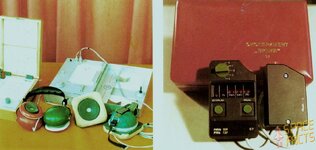
Исследование слуха до полета с участием космонавтов СССР и ГДР в космосе не проводилось. Чтобы восполнить этот пробел, космонавтами был выполнен совместный эксперимент "Аудио" (он был начат после завтрака). Основная его задача-определение влияния воздействия комплекса факторов космического полета на слух. Эксперимент проводился с помощью прибора ручного аудиометра "Эльба", разработанного Народным предприятием "Прецитроник" (г. Дрезден). Он позволяет определить величину слуховых порогов для чистых тонов в диапазоне от 500 до 6000 Гц. Питание аппаратуры осуществляется от автономного источника. Масса прибора с укладками 3 кг. Эксперимент проводился два раза в день-утром и вечером.
Чтобы оценить влияние окружающего шума на проведение эксперимента "Аудио", необходимо было измерить как общий уровень шума, так и его частотные характеристики. Для этого использовались модифицированные шумомер и октавный фильтр производства Народного предприятия измерительной техники РФТ Мессэлектроник "Отто Шён" (г. Дрезден). Полоса пропускания аппаратуры - от 20 Гц до 12,5 кГц, диапазон измерения интенсивности акустических сигналов от 30 до 140 дБ. Питание аппаратуры автономное, ее масса 3,8 кг.
В эксперименте участвовали одновременно два космонавта: один - обследуемый, другой - исследователь, с последующей переменой ролей. Первый космонавт надевал наушники, а исследователь подключал их к прибору, укреплял бланк аудиограммы на приборе и затем включал прибор. Исследователь вращением ручки громкости подавал постепенно нарастающие звуковые сигналы в наушники. Как только появлялся слышимый звук (порог слуха), обследуемый давал сигнал. Эта интенсивность звука и регистрировалась на бланке аудиограммы. Такая процедура проводилась на всех выбранных частотах по три замера на каждой. Порог слуховой чувствительности определялся на шести частотах. Отметим, что для этого эксперимента были специально разработаны наушники, имеющие повышенную звукоизоляцию.
Полученные данные используются для решения вопросов медицинского обеспечения полетов. Они, в частности, позволили выявить зоны с повышенным шумом в отсеках станции.
Большую часть рабочего времени космонавтов в эти дни заняли работы по программе изучения окружающей среды, исследования природных ресурсов, визуальных наблюдений за поверхностью Земли и акваторией Мирового океана. Это эксперименты-"Радуга-М", "Поляризация", "Биосфера", "Полярное сияние". Для выполнения экспериментов по программе изучения окружающей среды и исследованию природных ресурсов комплекс "Салют-6" - "Союз-29" - "Союз-31" был переведен космонавтами основного экипажа в режим орбитальной ориентации. И в полдень 30 августа В. Быковский начал проведение первого цикла фотографирования поверхности Земли и акватории Мирового океана с помощью многозональной космической фотоаппаратуры МКФ-6М. 3. Йен в это время выполнял эксперимент "Поляризация" (о нем будет рассказано ниже.). Эти работы продолжались и на следующий день.
Эксперимент "Радуга-М" является продолжением работ по многозональной съемке земной поверхности с целью изучения природных ресурсов Земли, а также по дальнейшей отработке методов космической фотосъемки. На основе анализа фотоснимков проводятся исследования гео - и биосферы, минеральных и биологических ресурсов.
Важное значение имеют исследования Мирового океана. Они проводятся в интересах морского флота, рыбного хозяйства, океанологии, метеорологии, других отраслей народного хозяйства. Космические съемки позволяют, в частности, оценить биологическую продуктивность отдельных районов океана.
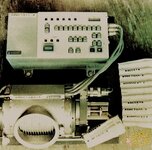
В эксперименте "Поляризация" решались задачи по визуально-инструментальным исследованиям поляризации солнечного света, рассеянного атмосферой и отраженного Землей. Изучение поляризации дает возможность познать природу, состав и структуру различных сред (твердых, жидких, газообразных), их смесей, а также характер их поверхности и взаимодействие. Проведение из космоса таких глобальных измерений имеет большое значение для атмосферной оптики, метеорологии, дистанционного зондирования Земли. Измерения проводились на фоне изменяющихся облаков и ландшафта с целью выявления условий, влияющих на поляризацию. Для этих исследований использовался прибор ВПА-1 (визуальный поляризационный анализатор), созданный советскими специалистами. Эксперимент выполнялся 3. Йеном.
В конце рабочего дня 30 августа космонавты международного экипажа выполняли эксперименты "Аудио", "Репортер", "Метаболизм бактерий".
Изучению окружающей среды был посвящен геофизический эксперимент "Биосфера", начатый в полдень 31 августа и продолженный во второй половине дня. Здесь ставилась задача получения информации с помощью визуально-инструментальных наблюдений о гео- и биосфере, изучения динамики долговременных природных процессов, проведения работ в интересах геологии, океанологии и метеорологии. При его выполнении экипаж проводил наблюдения и съемки различных ландшафтов, океанических областей и метеорологических явлений, а в интересах охраны окружающей среды регистрировались пылевые и дымовые образования, источниками которых являются промышленные центры, загрязнения атмосферы и морей. Эксперимент "Биосфера" подготовлен совместно Центральным институтом физики Академии Наук Германской Демократической Республики и советским Государственным центром "Природа".
А. Иванченков рассказывал, что бури в Африке поднимают на большую высоту песчаную пыль, которая проносится через Атлантику, долетая до побережья Южной и Северной Америки. Облака в этот период желтеют.
Примечательны наблюдения и 3. Йена. Он рассказал, что реки в начале течения бывают, как правило, чистыми, однако ближе к устью они становятся мутными, изменяют цвет из-за того, что загрязняются промышленными и бытовыми отходами. Эта грязь выплескивается в океан, и течения переносят ее на огромные расстояния.
Вечером 30 и 31 августа В. Быковский и 3. Йен проводили эксперимент "Полярное сияние".
В одном из сеансов 3. Йен наблюдал полярное сияние необычного, бледно-серого цвета, едва заметное на горизонте. Он тщательно зарисовал его в бортжурнал и несколько раз сфотографировал.
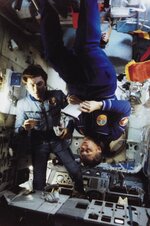
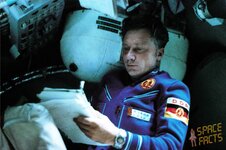
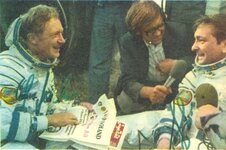
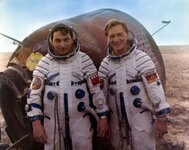
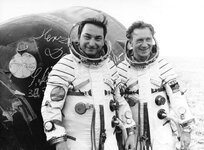
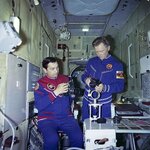
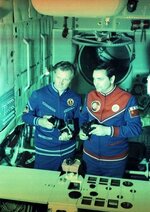
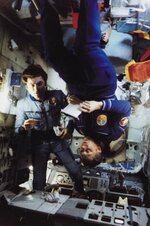
На фото: Виктор Коваленок и Зигмунд Йен.
August 30–31. The Experiments Continue
After a joint breakfast, the members of the international crew continued working on the "Bacterial Metabolism" experiment that had begun the previous day.
Let us describe another experiment carried out by the cosmonauts. During a spaceflight, a significant load falls upon the auditory analyzer, which is one of the most important channels for receiving information. A spacecraft contains constant sources of noise (fans, switching units, hydraulic pumps, etc.) that affect the perception of useful information. The study of hearing during the adaptation period is especially important.
Ground-based experiments had shown that the redistribution of blood within the body affects the sensory organs, including hearing. Some cosmonauts had demonstrated increased individual sensitivity to background noise and radio signals during flights.
Before this mission, no hearing studies involving Soviet and East German cosmonauts in space had been conducted. To fill this gap, the crew performed the joint experiment "Audio" (which began after breakfast). Its main objective was to determine the influence of the combined factors of spaceflight on hearing.
The experiment was conducted using the Elba portable audiometer, developed by the VEB Precitronic enterprise in Dresden. It allowed the measurement of hearing thresholds for pure tones in the range from 500 to 6000 Hz. The equipment operated from an independent power source. The mass of the instrument and its accessories was 3 kg. The experiment was conducted twice a day, in the morning and in the evening.
To assess the influence of ambient noise on the Audio experiment, it was necessary to measure both the overall noise level and its frequency characteristics. For this purpose, a modified sound-level meter and octave filter manufactured by the RFT Messelektronik “Otto Schön” enterprise in Dresden were used. The equipment covered a frequency range from 20 Hz to 12.5 kHz and measured acoustic signals from 30 to 140 dB. It was powered independently and had a mass of 3.8 kg.
Two cosmonauts participated simultaneously: one acted as the subject and the other as the researcher, after which they exchanged roles. The subject put on headphones, while the researcher connected them to the instrument, secured the audiogram sheet, and switched on the device. The researcher gradually increased the volume. As soon as the subject heard a sound (the hearing threshold), he signaled. That sound intensity was recorded on the audiogram sheet. This procedure was repeated three times at each selected frequency. Hearing sensitivity thresholds were measured at six frequencies. Special high-sound-insulation headphones had been developed specifically for this experiment.
The data obtained were used in solving problems related to the medical support of space missions. In particular, they made it possible to identify areas of increased noise within the station's compartments.
Most of the crew’s working time during these days was devoted to environmental studies, natural resource investigations, visual observations of Earth's surface and the World Ocean. These included the experiments "Raduga-M," "Polarization," "Biosphere," and "Aurora."
To conduct these environmental and resource studies, the Salyut-6 – Soyuz-29 – Soyuz-31 complex was placed into orbital orientation mode by the resident crew. At noon on August 30, V. Bykovsky began the first cycle of photographing Earth's surface and the World Ocean using the MKF-6M multispectral camera system. At the same time, S. Jähn carried out the Polarization experiment. These activities continued the following day.
The Raduga-M experiment was a continuation of multispectral photography of Earth's surface for the study of natural resources and the further development of space-photography techniques. Analysis of the images provided information about the geosphere, biosphere, mineral resources, and biological resources.
Research on the World Ocean was especially important. Such studies served the interests of maritime transport, fisheries, oceanography, meteorology, and other sectors of the economy. Space imagery made it possible, among other things, to assess the biological productivity of different ocean regions.
The Polarization experiment involved visual and instrumental investigations of sunlight scattered by the atmosphere and reflected from Earth. The study of polarization makes it possible to understand the nature, composition, and structure of solids, liquids, gases, their mixtures, and surface properties. Such global measurements from space were of great importance for atmospheric optics, meteorology, and remote sensing of Earth.
Measurements were conducted against changing clouds and landscapes to determine the conditions influencing polarization. The experiment used the VPA-1 (Visual Polarization Analyzer), developed by Soviet specialists. The experiment was performed by S. Jähn.
At the end of the working day on August 30, Bykovsky and Jähn continued the Audio, Reporter, and Bacterial Metabolism experiments.
The geophysical experiment Biosphere, devoted to environmental studies, began at noon on August 31 and continued later that day. Its purpose was to obtain information about the geosphere and biosphere through visual and instrumental observations, to study long-term natural processes, and to support geology, oceanography, and meteorology.
During the experiment, the crew observed and photographed landscapes, ocean regions, and meteorological phenomena. In the interests of environmental protection, dust and smoke formations produced by industrial centers, as well as atmospheric and marine pollution, were recorded.
The Biosphere experiment was jointly prepared by the Central Institute of Physics of the Academy of Sciences of the German Democratic Republic and the Soviet State Center “Priroda.”
A. Ivanchenkov noted that storms in Africa lift sand dust to great heights, carrying it across the Atlantic Ocean to the coasts of North and South America. During such periods, clouds acquire a yellowish color.
S. Jähn also made noteworthy observations. He reported that rivers are usually clear near their sources but become increasingly muddy near their mouths because of industrial and domestic pollution. This contamination flows into the oceans, where currents transport it across vast distances.
On the evenings of August 30 and 31, Bykovsky and Jähn conducted the Aurora experiment.
During one observation session, S. Jähn witnessed an unusual aurora of a pale gray color, barely visible above the horizon. He carefully sketched it in the flight log and photographed it several times.
Photo: Viktor Kovalyonok and Sigmund Jähn.
После совместного завтрака космонавты международной экспедиции работали по программе начатого накануне эксперимента "Метаболизм бактерий".
Расскажем еще об одном эксперименте, выполненном космонавтами. В космическом полете большая нагрузка приходится на слуховой анализатор, являющийся одним из важных каналов приема информации. На космическом аппарате имеются постоянные источники шума (вентиляторы, коммутаторы, гидронасосы и т. д.), которые влияют на слуховое восприятие полезной информации. Особое значение представляет исследование слуха в период адаптации. Наземные эксперименты показали, что перераспределение крови в организме влияет на органы чувств, в том числе и на слух. У ряда космонавтов в полетах проявлялись индивидуальные повышенные реакции на шумовой фон и на радиосигналы.
Исследование слуха до полета с участием космонавтов СССР и ГДР в космосе не проводилось. Чтобы восполнить этот пробел, космонавтами был выполнен совместный эксперимент "Аудио" (он был начат после завтрака). Основная его задача-определение влияния воздействия комплекса факторов космического полета на слух. Эксперимент проводился с помощью прибора ручного аудиометра "Эльба", разработанного Народным предприятием "Прецитроник" (г. Дрезден). Он позволяет определить величину слуховых порогов для чистых тонов в диапазоне от 500 до 6000 Гц. Питание аппаратуры осуществляется от автономного источника. Масса прибора с укладками 3 кг. Эксперимент проводился два раза в день-утром и вечером.
Чтобы оценить влияние окружающего шума на проведение эксперимента "Аудио", необходимо было измерить как общий уровень шума, так и его частотные характеристики. Для этого использовались модифицированные шумомер и октавный фильтр производства Народного предприятия измерительной техники РФТ Мессэлектроник "Отто Шён" (г. Дрезден). Полоса пропускания аппаратуры - от 20 Гц до 12,5 кГц, диапазон измерения интенсивности акустических сигналов от 30 до 140 дБ. Питание аппаратуры автономное, ее масса 3,8 кг.
В эксперименте участвовали одновременно два космонавта: один - обследуемый, другой - исследователь, с последующей переменой ролей. Первый космонавт надевал наушники, а исследователь подключал их к прибору, укреплял бланк аудиограммы на приборе и затем включал прибор. Исследователь вращением ручки громкости подавал постепенно нарастающие звуковые сигналы в наушники. Как только появлялся слышимый звук (порог слуха), обследуемый давал сигнал. Эта интенсивность звука и регистрировалась на бланке аудиограммы. Такая процедура проводилась на всех выбранных частотах по три замера на каждой. Порог слуховой чувствительности определялся на шести частотах. Отметим, что для этого эксперимента были специально разработаны наушники, имеющие повышенную звукоизоляцию.
Полученные данные используются для решения вопросов медицинского обеспечения полетов. Они, в частности, позволили выявить зоны с повышенным шумом в отсеках станции.
Большую часть рабочего времени космонавтов в эти дни заняли работы по программе изучения окружающей среды, исследования природных ресурсов, визуальных наблюдений за поверхностью Земли и акваторией Мирового океана. Это эксперименты-"Радуга-М", "Поляризация", "Биосфера", "Полярное сияние". Для выполнения экспериментов по программе изучения окружающей среды и исследованию природных ресурсов комплекс "Салют-6" - "Союз-29" - "Союз-31" был переведен космонавтами основного экипажа в режим орбитальной ориентации. И в полдень 30 августа В. Быковский начал проведение первого цикла фотографирования поверхности Земли и акватории Мирового океана с помощью многозональной космической фотоаппаратуры МКФ-6М. 3. Йен в это время выполнял эксперимент "Поляризация" (о нем будет рассказано ниже.). Эти работы продолжались и на следующий день.
Эксперимент "Радуга-М" является продолжением работ по многозональной съемке земной поверхности с целью изучения природных ресурсов Земли, а также по дальнейшей отработке методов космической фотосъемки. На основе анализа фотоснимков проводятся исследования гео - и биосферы, минеральных и биологических ресурсов.
Важное значение имеют исследования Мирового океана. Они проводятся в интересах морского флота, рыбного хозяйства, океанологии, метеорологии, других отраслей народного хозяйства. Космические съемки позволяют, в частности, оценить биологическую продуктивность отдельных районов океана.
В эксперименте "Поляризация" решались задачи по визуально-инструментальным исследованиям поляризации солнечного света, рассеянного атмосферой и отраженного Землей. Изучение поляризации дает возможность познать природу, состав и структуру различных сред (твердых, жидких, газообразных), их смесей, а также характер их поверхности и взаимодействие. Проведение из космоса таких глобальных измерений имеет большое значение для атмосферной оптики, метеорологии, дистанционного зондирования Земли. Измерения проводились на фоне изменяющихся облаков и ландшафта с целью выявления условий, влияющих на поляризацию. Для этих исследований использовался прибор ВПА-1 (визуальный поляризационный анализатор), созданный советскими специалистами. Эксперимент выполнялся 3. Йеном.
В конце рабочего дня 30 августа космонавты международного экипажа выполняли эксперименты "Аудио", "Репортер", "Метаболизм бактерий".
Изучению окружающей среды был посвящен геофизический эксперимент "Биосфера", начатый в полдень 31 августа и продолженный во второй половине дня. Здесь ставилась задача получения информации с помощью визуально-инструментальных наблюдений о гео- и биосфере, изучения динамики долговременных природных процессов, проведения работ в интересах геологии, океанологии и метеорологии. При его выполнении экипаж проводил наблюдения и съемки различных ландшафтов, океанических областей и метеорологических явлений, а в интересах охраны окружающей среды регистрировались пылевые и дымовые образования, источниками которых являются промышленные центры, загрязнения атмосферы и морей. Эксперимент "Биосфера" подготовлен совместно Центральным институтом физики Академии Наук Германской Демократической Республики и советским Государственным центром "Природа".
А. Иванченков рассказывал, что бури в Африке поднимают на большую высоту песчаную пыль, которая проносится через Атлантику, долетая до побережья Южной и Северной Америки. Облака в этот период желтеют.
Примечательны наблюдения и 3. Йена. Он рассказал, что реки в начале течения бывают, как правило, чистыми, однако ближе к устью они становятся мутными, изменяют цвет из-за того, что загрязняются промышленными и бытовыми отходами. Эта грязь выплескивается в океан, и течения переносят ее на огромные расстояния.
Вечером 30 и 31 августа В. Быковский и 3. Йен проводили эксперимент "Полярное сияние".
В одном из сеансов 3. Йен наблюдал полярное сияние необычного, бледно-серого цвета, едва заметное на горизонте. Он тщательно зарисовал его в бортжурнал и несколько раз сфотографировал.
На фото: Виктор Коваленок и Зигмунд Йен.
August 30–31. The Experiments Continue
After a joint breakfast, the members of the international crew continued working on the "Bacterial Metabolism" experiment that had begun the previous day.
Let us describe another experiment carried out by the cosmonauts. During a spaceflight, a significant load falls upon the auditory analyzer, which is one of the most important channels for receiving information. A spacecraft contains constant sources of noise (fans, switching units, hydraulic pumps, etc.) that affect the perception of useful information. The study of hearing during the adaptation period is especially important.
Ground-based experiments had shown that the redistribution of blood within the body affects the sensory organs, including hearing. Some cosmonauts had demonstrated increased individual sensitivity to background noise and radio signals during flights.
Before this mission, no hearing studies involving Soviet and East German cosmonauts in space had been conducted. To fill this gap, the crew performed the joint experiment "Audio" (which began after breakfast). Its main objective was to determine the influence of the combined factors of spaceflight on hearing.
The experiment was conducted using the Elba portable audiometer, developed by the VEB Precitronic enterprise in Dresden. It allowed the measurement of hearing thresholds for pure tones in the range from 500 to 6000 Hz. The equipment operated from an independent power source. The mass of the instrument and its accessories was 3 kg. The experiment was conducted twice a day, in the morning and in the evening.
To assess the influence of ambient noise on the Audio experiment, it was necessary to measure both the overall noise level and its frequency characteristics. For this purpose, a modified sound-level meter and octave filter manufactured by the RFT Messelektronik “Otto Schön” enterprise in Dresden were used. The equipment covered a frequency range from 20 Hz to 12.5 kHz and measured acoustic signals from 30 to 140 dB. It was powered independently and had a mass of 3.8 kg.
Two cosmonauts participated simultaneously: one acted as the subject and the other as the researcher, after which they exchanged roles. The subject put on headphones, while the researcher connected them to the instrument, secured the audiogram sheet, and switched on the device. The researcher gradually increased the volume. As soon as the subject heard a sound (the hearing threshold), he signaled. That sound intensity was recorded on the audiogram sheet. This procedure was repeated three times at each selected frequency. Hearing sensitivity thresholds were measured at six frequencies. Special high-sound-insulation headphones had been developed specifically for this experiment.
The data obtained were used in solving problems related to the medical support of space missions. In particular, they made it possible to identify areas of increased noise within the station's compartments.
Most of the crew’s working time during these days was devoted to environmental studies, natural resource investigations, visual observations of Earth's surface and the World Ocean. These included the experiments "Raduga-M," "Polarization," "Biosphere," and "Aurora."
To conduct these environmental and resource studies, the Salyut-6 – Soyuz-29 – Soyuz-31 complex was placed into orbital orientation mode by the resident crew. At noon on August 30, V. Bykovsky began the first cycle of photographing Earth's surface and the World Ocean using the MKF-6M multispectral camera system. At the same time, S. Jähn carried out the Polarization experiment. These activities continued the following day.
The Raduga-M experiment was a continuation of multispectral photography of Earth's surface for the study of natural resources and the further development of space-photography techniques. Analysis of the images provided information about the geosphere, biosphere, mineral resources, and biological resources.
Research on the World Ocean was especially important. Such studies served the interests of maritime transport, fisheries, oceanography, meteorology, and other sectors of the economy. Space imagery made it possible, among other things, to assess the biological productivity of different ocean regions.
The Polarization experiment involved visual and instrumental investigations of sunlight scattered by the atmosphere and reflected from Earth. The study of polarization makes it possible to understand the nature, composition, and structure of solids, liquids, gases, their mixtures, and surface properties. Such global measurements from space were of great importance for atmospheric optics, meteorology, and remote sensing of Earth.
Measurements were conducted against changing clouds and landscapes to determine the conditions influencing polarization. The experiment used the VPA-1 (Visual Polarization Analyzer), developed by Soviet specialists. The experiment was performed by S. Jähn.
At the end of the working day on August 30, Bykovsky and Jähn continued the Audio, Reporter, and Bacterial Metabolism experiments.
The geophysical experiment Biosphere, devoted to environmental studies, began at noon on August 31 and continued later that day. Its purpose was to obtain information about the geosphere and biosphere through visual and instrumental observations, to study long-term natural processes, and to support geology, oceanography, and meteorology.
During the experiment, the crew observed and photographed landscapes, ocean regions, and meteorological phenomena. In the interests of environmental protection, dust and smoke formations produced by industrial centers, as well as atmospheric and marine pollution, were recorded.
The Biosphere experiment was jointly prepared by the Central Institute of Physics of the Academy of Sciences of the German Democratic Republic and the Soviet State Center “Priroda.”
A. Ivanchenkov noted that storms in Africa lift sand dust to great heights, carrying it across the Atlantic Ocean to the coasts of North and South America. During such periods, clouds acquire a yellowish color.
S. Jähn also made noteworthy observations. He reported that rivers are usually clear near their sources but become increasingly muddy near their mouths because of industrial and domestic pollution. This contamination flows into the oceans, where currents transport it across vast distances.
On the evenings of August 30 and 31, Bykovsky and Jähn conducted the Aurora experiment.
During one observation session, S. Jähn witnessed an unusual aurora of a pale gray color, barely visible above the horizon. He carefully sketched it in the flight log and photographed it several times.
Photo: Viktor Kovalyonok and Sigmund Jähn.