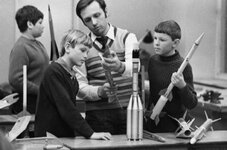
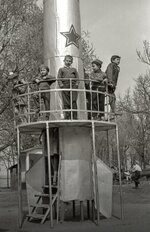
Космические мечты советских школьников. Занятия ракетомодельного кружка. 1982 .............................................................. Soviet schoolchildren's space dreams. Rocket modeling club activities. 1982 .............................................................. Sueños espaciales de escolares soviéticos. Actividades del club de modelismo de cohetes. 1982 .............................................................
"Если бы кто - нибудь, пытаясь узнать, что люди думают о себе, о прожитых годах, распространил анкету, в которой был бы один единственный вопрос: "Что в вашей жизни было самым главным?" - то Юрий Гагарин наверняка бы ответил, что самого главного, важного и значительного у него еще не было, что оно впереди. Иначе зачем тогда наступит завтра? Жизнь - это долг, хотя бы она была мгновением, так сказал Гете. Эти слова, прочитанные однажды, глубоко запали Юрию в сердце...Свое назначение он понимал так: быть человеком ответственно, быть первым ответственно вдвойне. Вот что основное в его характере, его натуре.
Не сразу он открылся таким. Не сразу таким стал. Но было в нем что - то такое, что крепло и росло с годами. Я не знаю, как точнее это назвать. Наверное строгость. Строгость к себе. Строгость в большом и малом...
И еще. Доброта.
Откуда у Юры такой характер?
Откуда его внимание и любовь к людям?
Любовь искренняя и бескорыстная...Откуда его стремление помочь человеку, разделить чужую беду, подставить свое плечо пошатнувшемуся?
О характере Юры можно сказать словами его матери Анны Тимофеевны. Кто мог знать его лучше, чем мать, которую он очень любил.
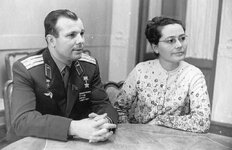
"Он был очень веселый, редко злился и не любил ссор, наоборот шуткой и смехом всех мирил. И его все любили. Он общим баловнем был. Да вы посмотрите на Юрины фотографии - лицо у него всюду счастливое . Этим он и приметен.. Все это так. И все это служит ответом на вопросы, которые я задаю себе, да и не только я". ( Валентина Гагарина. "108 минут и вся жизнь").Москва/ Издательство "Молодая гвардия"/ 1986 год. На фото: Юрий Гагарин с женой. “If someone, trying to find out what people think about themselves and the years they have lived, were to distribute a questionnaire containing only one single question: ‘What was the most important thing in your life?’ — Yuri Gagarin would probably have answered that the most important, significant, and meaningful thing in his life had not yet happened, that it still lay ahead. Otherwise, why would tomorrow come? Life is a duty, even if it lasts only a moment — so said Johann Wolfgang von Goethe. These words, once read, sank deeply into Yuri’s heart… He understood his mission this way: it is a responsibility to be a human being, and to be the first is a responsibility twice as great. That was the essence of his character and nature.
He did not reveal himself in this way immediately. He did not become such a person all at once. But there was something in him that grew stronger and deeper with the years. I do not know how to name it more precisely. Perhaps discipline. Strictness with himself. Strictness in great matters and in small ones…
And one more thing. Kindness.
Where did Yura get such a character?
Where did his attention and love for people come from?
A sincere and selfless love… Where did his desire come from to help a person, to share another’s sorrow, to lend his shoulder to someone who had stumbled?
One can speak about Yura’s character using the words of his mother, Anna Timofeyevna Gagarina. Who could have known him better than his mother, whom he loved very much?
‘He was very cheerful, rarely became angry, and did not like quarrels. On the contrary, he reconciled everyone with jokes and laughter. And everyone loved him. He was everyone’s favorite. Just look at Yuri’s photographs — his face everywhere looks happy. That is what makes him so recognizable…’
All this is true. And all this answers the questions that I ask myself — and not only I.”
(Valentina Gagarina, “108 Minutes and a Lifetime”.
Moscow — Molodaya Gvardiya, 1986.) Photo: Yuri Gagarin with his wife Valentina Gagarina. «Si alguien, tratando de averiguar qué piensan las personas sobre sí mismas y sobre los años vividos, distribuyera un cuestionario con una sola pregunta: “¿Qué fue lo más importante en su vida?” — Yuri Gagarin probablemente respondería que lo más importante, lo más significativo y lo más valioso en su vida aún no había sucedido, que estaba por delante. De lo contrario, ¿para qué llegaría mañana? La vida es un deber, aunque sea solo un instante — así dijo Johann Wolfgang von Goethe. Estas palabras, leídas una vez, se grabaron profundamente en el corazón de Yuri… Él entendía su misión de esta manera: ser un ser humano es una responsabilidad, y ser el primero es una responsabilidad doble. Eso es lo esencial en su carácter, en su naturaleza.
No se mostró así de inmediato. No se volvió así de inmediato. Pero había en él algo que se fortalecía y crecía con los años. No sé cómo llamarlo con mayor precisión. Tal vez rigor. Rigor consigo mismo. Rigor en lo grande y en lo pequeño…
Y además. Bondad.
¿De dónde tenía Yura un carácter así?
¿De dónde venían su atención y su amor por las personas?
Un amor sincero y desinteresado… ¿De dónde venía su deseo de ayudar a los demás, de compartir la desgracia ajena, de ofrecer su hombro a quien había tropezado?
Sobre el carácter de Yura se puede hablar con las palabras de su madre, Anna Timofeyevna Gagarina. ¿Quién podía conocerlo mejor que su madre, a la que él amaba profundamente?
«Era muy alegre, rara vez se enfadaba y no le gustaban las peleas. Al contrario, con bromas y risas reconciliaba a todos. Y todos lo querían. Era el favorito de todos. Miren las fotografías de Yuri: en todas tiene un rostro feliz. Eso es lo que lo distingue…»
Todo esto es cierto. Y todo esto responde a las preguntas que me hago — y no solo yo».
(Valentina Gagarina, «108 minutos y toda una vida».
Moscú — Molodaya Gvardiya, 1986.) Foto: Yuri Gagarin con su esposa Valentina Gagarina.
"Много раз на различных международных конгрессах, конференциях, симпозиумах мне приходилось выступать с докладами об использовании космических средств, помогающих решить человеку и чисто научные и прикладные проблемы. Практическую прикладную пользу космических полетов уже сегодня в должной мере оценили специалисты многих вполне земных служб. Метеорологии космонавтика обещает надежность долгосрочных прогнозов погоды, поставляет оперативную информацию о возникновении и продвижении циклонов, цунами, пылевых бурь.
Немалую роль для прогнозирования сыграет разведка ледяных и снежных покровов планеты. Наземным метеорологическим станциям, которые не в состоянии дать глобальные, в планетарном масштабе, сведения о физическом состоянии атмосферы и ее взаимодействии с Мировым океаном, помогает космическая система «Метеор». И уж, конечно, человек не сможет научиться управлять погодой без космических средств.
В пользу геодезии и картографии космонавтика решает проблему глобального картирования поверхности нашей планеты. Космическое кино — и фотографирование, телевизионный контроль, а в будущем и голографическая съемка Земли позволяют постоянно следить за ее «лицом», которое довольно быстро меняется и под воздействием сил природы и вследствие хозяйственной деятельности человека.
Нетрудно представить, как велика роль космических средств для контроля среды и изучения природных ресурсов планеты. На фотоснимках из космоса, сделанных в различных лучах спектра, отчетливо видны количество и состояние растительного покрова Земли, различаются характер флоры, влагоснабжения и засоленность почв, лесные пожары, миграции биологических вредителей.
Околоземное пространство — прекрасная позиция для биологического изучения замкнутых и открытых водоемов Земли, биоресурсов Мирового океана.
А сельское хозяйство! Из космоса «как на ладони» видны четкие прямоугольники посевов различных культур, разрушенные эрозией почвы, маршруты опустошения, причиненного сельскохозяйственными вредителями. Взгляд из космоса позволяет оценить действенность мелиоративных систем и гидротехнических сооружений, обнаружить подземные запасы пресных вод в засушливых и полупустынных районах.
На снимках из космоса много геологической информации. Их анализ уже теперь становится самостоятельным методом изучения структуры земной коры. Снимки отражают такие черты ее строения, которые обусловлены наиболее глобальными причинами. Отдельные детали и местности, сливаясь на снимках в части крупных элементов рельефа, дают целостное изображение рельефа обширных районов планеты. Оказалось даже, что сквозь рыхлые отложения как бы просвечивает строение глубинных горизонтов земной коры. Так, например, опираясь на новые материалы из космоса, геологи заключили: подвижная зона смятия и разломов Уральской складчатой системы продолжается далеко на юг. Судя по всему, она пересекает пустыни Средней Азии и выходит к Персидскому заливу". (Виталий Севастьянов. "Дневник над облаками").
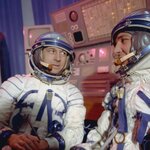
На фото слева направо: Космонавт Виталий Севастьянов, космонавт Петр Климук. “Many times at various international congresses, conferences, and symposia I had to give reports on the use of space technologies that help humanity solve both purely scientific and practical problems. The practical benefits of space flights have already been properly appreciated by specialists from many entirely Earth-based services. For meteorology, cosmonautics promises reliable long-term weather forecasts and provides оперативе information about the formation and movement of cyclones, tsunamis, and dust storms.
Exploration of the planet’s ice and snow cover will also play an important role in forecasting. Ground meteorological stations, which are unable to provide global, planetary-scale information about the physical state of the atmosphere and its interaction with the World Ocean, are assisted by the space system Meteor. And, of course, humanity will never learn to control the weather without space technologies.
In the interests of geodesy and cartography, cosmonautics solves the problem of global mapping of our planet’s surface. Space cinematography and photography, television monitoring, and in the future holographic imaging of the Earth make it possible to constantly observe its “face,” which changes rather rapidly both under the influence of natural forces and as a result of human economic activity.
It is easy to imagine how great the role of space technologies is in environmental monitoring and in the study of the planet’s natural resources. In photographs from space taken in different parts of the spectrum, the quantity and condition of the Earth’s vegetation cover are clearly visible; differences in flora, moisture supply, and soil salinity can be distinguished, as well as forest fires and the migration of biological pests.
Near-Earth space is an excellent vantage point for biological studies of both closed and open bodies of water on Earth and of the biological resources of the World Ocean.
And agriculture! From space, as if “in the palm of one’s hand,” one can see the clear rectangular fields of different crops, soil destroyed by erosion, and the routes of devastation caused by agricultural pests. The view from space makes it possible to evaluate the effectiveness of land-reclamation systems and hydraulic engineering structures and to discover underground reserves of fresh water in arid and semi-desert regions.
Photographs from space contain a great deal of geological information. Their analysis is already becoming an independent method for studying the structure of the Earth’s crust. The images reflect features of its structure caused by the most global processes. Individual details of terrain merge in the photographs into parts of large relief elements, giving a holistic picture of the relief of vast regions of the planet. It even turned out that through loose deposits the structure of the deep horizons of the Earth’s crust can seemingly be seen. Thus, relying on new materials from space, geologists concluded that the mobile zone of folding and faults of the Ural Fold System continues far to the south. Apparently it crosses the deserts of Central Asia and reaches the Persian Gulf.”
(Vitaly Sevastyanov, “Diary Above the Clouds”) Photo (left to right): Vitaly Sevastyanov, Pyotr Klimuk. «Muchas veces, en diversos congresos, conferencias y simposios internacionales, tuve que presentar informes sobre el uso de los medios espaciales que ayudan al ser humano a resolver tanto problemas puramente científicos como problemas aplicados. Los beneficios prácticos de los vuelos espaciales ya han sido debidamente apreciados por especialistas de muchos servicios completamente terrestres. Para la meteorología, la cosmonáutica promete la fiabilidad de las previsiones meteorológicas a largo plazo y proporciona información оператива sobre la formación y el desplazamiento de ciclones, tsunamis y tormentas de polvo.
La exploración de las capas de hielo y nieve del planeta también desempeñará un papel importante para el pronóstico. A las estaciones meteorológicas terrestres, que no pueden proporcionar información global a escala planetaria sobre el estado físico de la atmósfera y su interacción con el Océano Mundial, las ayuda el sistema espacial Meteor. Y, por supuesto, el ser humano no podrá aprender a controlar el clima sin medios espaciales.
En beneficio de la geodesia y la cartografía, la cosmonáutica resuelve el problema de la cartografía global de la superficie de nuestro planeta. El cine y la fotografía espaciales, el control televisivo y, en el futuro, la filmación holográfica de la Tierra permiten observar constantemente su “rostro”, que cambia con bastante rapidez tanto por la acción de las fuerzas de la naturaleza como por la actividad económica del ser humano.
No es difícil imaginar cuán grande es el papel de los medios espaciales para el control del medio ambiente y el estudio de los recursos naturales del planeta. En las fotografías tomadas desde el espacio en distintos rangos del espectro se distinguen claramente la cantidad y el estado de la cubierta vegetal de la Tierra, las características de la flora, el suministro de humedad y la salinidad de los suelos, así como los incendios forestales y las migraciones de plagas biológicas.
El espacio cercano a la Tierra es una excelente posición para el estudio biológico de los cuerpos de agua cerrados y abiertos del planeta y de los recursos biológicos del Océano Mundial.
¡Y la agricultura! Desde el espacio, “como en la palma de la mano”, se ven los rectángulos claros de los cultivos de diferentes plantas, los suelos destruidos por la erosión y las rutas de devastación causadas por plagas agrícolas. La observación desde el espacio permite evaluar la eficacia de los sistemas de irrigación y de las estructuras hidráulicas, así como descubrir reservas subterráneas de agua dulce en regiones áridas y semidesérticas.
Las fotografías tomadas desde el espacio contienen mucha información geológica. Su análisis ya se está convirtiendo en un método independiente para estudiar la estructura de la corteza terrestre. Las imágenes reflejan rasgos de su estructura determinados por las causas más globales. Los detalles individuales del terreno se funden en las fotografías en partes de grandes elementos del relieve, proporcionando una imagen integral del relieve de amplias regiones del planeta. Incluso resultó que a través de los depósitos sueltos parece “transparentarse” la estructura de los horizontes profundos de la corteza terrestre. Así, basándose en nuevos materiales obtenidos desde el espacio, los geólogos concluyeron que la zona móvil de plegamientos y fallas del sistema geológico Ural Fold System continúa mucho más al sur. Al parecer, atraviesa los desiertos de Asia Central y llega hasta el Golfo Pérsico.»
(Vitaly Sevastyanov, «Diario sobre las nubes») Foto (de izquierda a derecha): Vitaly Sevastyanov, Pyotr Klimuk.
"Земля — шар. Как и все, я знал это еще с детства. И так же, наверное, как и остальных, меня это нисколько не удивляло: шар так шар... Не квадратной же ей, в самом деле, быть или, скажем, треугольной? Космическое тело, и все тут; частица вселенной... И все же Земля — та самая Земля, на которой мы все живем, — шар! Теперь это уже не кажется мне столь простым и привычным.
Дело, разумеется, не в самой форме. Дело в том, что я своими глазами, так же как и не один десяток моих коллег — космонавтов и астронавтов, видел эту шарообразность Земли, что я близко знаю людей, которые собственными ногами стояли еще на одном шарообразном теле — Луне; это американские астронавты Нил Армстронг, Эдвин Олдрин и еще десять их товарищей. Тесно знаком я и с теми, кто осуществлял посадку автоматических станций на поверхность Венеры — раскаленный до четырехсот пятидесяти градусов мир, окутанный плотной, густой, как суп, атмосферой. Как космонавту также известно мне, может быть, лучше, чем многим другим, и то, что планы дальнейшего освоения солнечной системы не тактика сегодняшнего дня, а стратегия, устремленная в будущее человечества, что все сбывшееся за последние пятнадцать лет — не эпизод, а лишь начало грядущих великих свершений... Одним словом, теперь, когда вселенная перестала для большинства людей быть отвлеченным понятием и Земля, как ее частица, все чаще и все настойчивее заявляет о себе как о космическом теле — одном из бесконечно многих; именно теперь все, что казалось прежде само собой разумеющимся, обрело и новые масштабы, и новый смысл.
Под грохот стартующих с Земли кораблей космос стал реальностью. Не той, что связывали с существованием звезд и галактик ученые в обсерваториях или посетители планетариев, а реальностью, властно вторгнувшейся в нашу повседневность, изменившей не только наш способ ощущать, видеть, мыслить, но и вместе с тем и нас самих. Люди стали чувствовать себя не просто гражданами своей страны, не просто представителями какой-либо нации, народа, расы, но еще и землянами.
Пока это слово не успело войти в широкий обиход, его еще редко произносят вслух, но то самоощущение, которое связано с ним, уже возникло и никогда не исчезнет; наоборот, год от года оно станет усиливаться, крепнуть, упрочаться в сознании людей, объединяя их в единое сообщество — в человечество, уже на иной, неизмеримо более глубокой и прочной основе. "Я думаю, еще никогда два человека не были так физически удалены от остального мира, как были удалены мы, и в то же время никогда еще не были так тесно объединены с миром через посредство тех людей на Земле, которые поддерживали с нами связь и которые так много сделали, чтобы помочь нам достичь Луны и вернуться обратно, — сказал, делясь своими впечатлениями, Эдвин Олдрин по возвращении на Землю. — В тот момент мы чувствовали — честное слово, чувствовали! — эту почти мистическую сплоченность народов всего мира". (Георгий Береговой. "Небо начинается на земле").МОСКВА. Издательство "Молодая гвардия". 1976 “Earth is a sphere. Like everyone else, I knew this from childhood. And, probably like most people, it did not surprise me at all: a sphere, so a sphere… It could hardly be square or, say, triangular. A cosmic body, nothing more; a particle of the universe… And yet the Earth—the very Earth on which we all live—is a sphere! Now this no longer seems so simple and ordinary to me.
The point, of course, is not the shape itself. The point is that with my own eyes, just like dozens of my colleagues—cosmonauts and astronauts—I have seen the spherical form of the Earth. I personally know people who have stood with their own feet on another spherical body—the Moon. These are the American astronauts Neil Armstrong, Buzz Aldrin, and ten of their comrades. I am also closely acquainted with those who carried out the landing of automatic stations on the surface of Venus—a world heated to four hundred and fifty degrees and enveloped in a dense atmosphere, thick as soup.
As a cosmonaut, I also know—perhaps better than many others—that the plans for further exploration of the Solar System are not the tactics of today but a strategy directed toward the future of humanity, and that everything accomplished during the past fifteen years is not an episode, but only the beginning of great achievements to come.
In short, now that the universe has ceased to be an abstract concept for most people, and the Earth, as a part of it, more and more persistently declares itself to be a cosmic body—one among infinitely many—everything that once seemed self-evident has acquired new scale and new meaning.
To the thunder of spacecraft launching from Earth, space has become a reality. Not the reality that scientists in observatories or visitors to planetariums associated with the existence of stars and galaxies, but a reality that has powerfully entered our everyday life, changing not only the way we feel, see, and think, but also ourselves. People have begun to feel not only like citizens of their own country, not only representatives of a nation, a people, or a race, but also inhabitants of Earth.
This word has not yet entered wide everyday use and is still rarely spoken aloud, but the sense of identity connected with it has already arisen and will never disappear. On the contrary, year after year it will grow stronger, becoming firmly rooted in human consciousness and uniting people into a single community—humanity—on a new, immeasurably deeper and stronger foundation.
“I think that never before had two people been so physically distant from the rest of the world as we were, and at the same time never had anyone been so closely united with the world through those people on Earth who maintained contact with us and who did so much to help us reach the Moon and return safely,” said Buzz Aldrin when sharing his impressions after returning to Earth. “At that moment we felt—honestly, we felt!—this almost mystical unity of the peoples of the entire world.” (Georgy Beregovoy, “The Sky Begins on Earth”, Moscow, Molodaya Gvardiya, 1976) «La Tierra es una esfera. Como todos, yo lo sabía desde la infancia. Y, probablemente como a los demás, esto no me sorprendía en absoluto: una esfera, pues una esfera… No iba a ser cuadrada ni, digamos, triangular. Un cuerpo cósmico, nada más; una partícula del universo… Y sin embargo la Tierra —esa misma Tierra en la que todos vivimos— ¡es una esfera! Ahora esto ya no me parece tan simple ni tan habitual.
La cuestión, por supuesto, no está en la forma misma. La cuestión es que yo, con mis propios ojos, al igual que decenas de mis colegas —cosmonautas y astronautas— he visto la forma esférica de la Tierra. Conozco de cerca a personas que han estado con sus propios pies sobre otro cuerpo esférico: la Luna. Son los astronautas estadounidenses Neil Armstrong, Buzz Aldrin y diez de sus compañeros. También conozco bien a quienes realizaron el aterrizaje de estaciones automáticas en la superficie de Venus, un mundo calentado hasta cuatrocientos cincuenta grados y envuelto en una atmósfera densa, espesa como una sopa.
Como cosmonauta sé también —quizás mejor que muchos otros— que los planes de дальнейшего освоения del Solar System no son la táctica de hoy, sino una estrategia dirigida hacia el futuro de la humanidad, y que todo lo logrado en los últimos quince años no es un episodio, sino solo el comienzo de grandes realizaciones venideras.
En una palabra, ahora que el universo ha dejado de ser un concepto abstracto para la mayoría de las personas, y la Tierra, como parte de él, se afirma cada vez con mayor insistencia como un cuerpo cósmico —uno entre infinitamente muchos—, todo lo que antes parecía evidente ha adquirido nuevas dimensiones y un nuevo significado.
Al estruendo de las naves que parten desde la Tierra, el cosmos se ha convertido en una realidad. No la realidad que los científicos en los observatorios o los visitantes de los planetarios asociaban con la existencia de estrellas y galaxias, sino una realidad que ha irrumpido con fuerza en nuestra vida cotidiana, cambiando no solo nuestra manera de sentir, ver y pensar, sino también a nosotros mismos. Las personas comenzaron a sentirse no solo ciudadanos de su país, no solo representantes de una nación, de un pueblo o de una raza, sino también habitantes de la Tierra.
Esta palabra todavía no ha entrado en el uso cotidiano general y aún se pronuncia raramente en voz alta, pero el sentimiento que la acompaña ya ha surgido y nunca desaparecerá. Al contrario, año tras año se fortalecerá y se afianzará en la conciencia de las personas, uniéndolas en una sola comunidad: la humanidad, sobre una base nueva, incomparablemente más profunda y sólida.
«Creo que nunca antes dos personas habían estado tan físicamente alejadas del resto del mundo como lo estuvimos nosotros y, al mismo tiempo, nunca habían estado tan estrechamente unidos con el mundo a través de aquellas personas en la Tierra que mantenían contacto con nosotros y que hicieron tanto para ayudarnos a llegar a la Luna y regresar», dijo Buzz Aldrin al compartir sus impresiones después de regresar a la Tierra. «En aquel momento sentimos —de verdad, lo sentimos— esa casi mística unión de los pueblos de todo el mundo». (Georgy Beregovoy, «El cielo comienza en la Tierra», Moscú, Molodaya Gvardiya, 1976)
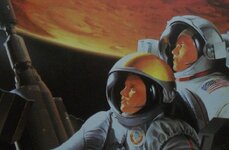
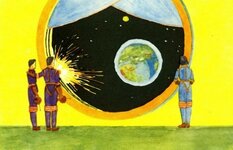
Советская космонавтика в живописи зарубежных художников. "Вместе на Марс". 1986 год. Художник Памела Ли(Pamela Lee).
Картина символизирует будущий совместный полёт американских и советских космонавтов.
.............................................................................. Примечание: Памела Ли (р.1949) - художник - иллюстратор, проявляющий глубокий интерес к космическим исследованиям. Она получила степень бакалавра искусств в Аризонском университете и продолжала образование в художественных школах Пасадины и Сан - Франциско. Ее работы экспонировались на выставках в музеях и планетариях. Рисунки Памелы Ли комментировал на орбите астронавт Уильям Фишер (полет "Шаттла", 1985).
Soviet cosmonautics in the paintings of foreign artists. "Together to Mars." 1986. Artist Pamela Lee.
The painting symbolizes the future joint flight of American and Soviet cosmonauts.
................................................................................ Note: Pamela Lee (b. 1949) is an artist and illustrator with a deep interest in space exploration. She received a BFA from the University of Arizona and continued her education at art schools in Pasadena and San Francisco. Her work has been exhibited at museums and planetariums. Astronaut William Fisher (Space Shuttle flight, 1985) commented on Pamela Lee's drawings in orbit.
La cosmonáutica soviética en las pinturas de artistas extranjeros. «Juntos a Marte». 1986. Artista: Pamela Lee.
La pintura simboliza el futuro vuelo conjunto de cosmonautas estadounidenses y soviéticos.
................................................................................ Nota: Pamela Lee (n. 1949) es una artista e ilustradora con un profundo interés en la exploración espacial. Se licenció en Bellas Artes por la Universidad de Arizona y continuó su formación en escuelas de arte de Pasadena y San Francisco. Su obra se ha expuesto en museos y planetarios. El astronauta William Fisher (vuelo del transbordador espacial, 1985) comentó sobre los dibujos de Pamela Lee en órbita.
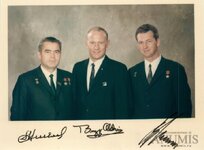
История советской космонавтики в фотографиях. Фотография летчиков-космонавтов СССР А.Г.Николаева, В.И.Севастьянова и астронавта НАСА Б.Олдрина с их автографами. 1970 г.
The history of Soviet cosmonautics in photographs.
Photograph of Soviet cosmonauts A.G. Nikolaev and V.I. Sevastyanov, and NASA astronaut B. Aldrin, with their autographs. 1970.
La historia de la cosmonáutica soviética en fotografías. Fotografía de los cosmonautas soviéticos A.G. Nikolaev y V.I. Sevastyanov, y del astronauta de la NASA B. Aldrin, con sus autógrafos. 1970.
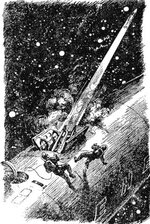
Рисунок художника Г. Малакова из книги Владимира Владко "Аргонавты Вселенной". .................................................................. Примечание: "Аргонавты Вселенной" - Научно-фантастический роман рассказывает о необычайных приключениях космонавтов, которые совершили путешествие на планету Венеру.
Drawing by artist G. Malakov from Vladimir Vladko's book "Argonauts of the Universe." ................................................................ Note: "Argonauts of the Universe" is a science fiction novel about the extraordinary adventures of astronauts who journeyed to the planet Venus.
Ilustración del artista G. Malakov, basada en el libro «Argonautas del Universo» de Vladimir Vladko. ................................................................ Nota: «Argonautas del Universo» es una novela de ciencia ficción que narra las extraordinarias aventuras de los astronautas que viajaron al planeta Venus.
История советской космонавтики в фотографиях. Космонавт Валерий Быковский на встрече с пионерами. The history of Soviet cosmonautics in photographs.
Cosmonaut Valery Bykovsky at a meeting with pioneers. La historia de la cosmonáutica soviética en fotografías.
El cosmonauta Valery Bykovsky en un encuentro con pioneros.
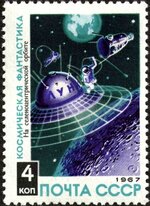
Космическая филателия в СССР. Серия марок "Космическая фантастика".
"На селеноцентрической орбите". Темпера, бумага. 1966–1967 гг.Художники – А.К. Соколов, космонавт А.А. Леонов. Почтовая марка СССР, 4 коп., 20 октября 1967 г., Каталог ЦФА № 3545, Michel № 3403, Scott № 3382, Yvert № 3282. Бумага мелованная. Офсетная печать. Зубцовка гребенчатая 12×12½. Размер марки – 30×42 мм. Тираж 6 000 000.
Space Philately in the USSR. The "Space Science Fiction" stamp series.
"In Selenocentric Orbit." Tempera on paper. 1966–1967. Artists: A.K. Sokolov, cosmonaut A.A. Leonov. USSR postage stamp, October 20, 1967, CFA Catalogue No. 3545, Michel No. 3403, Scott No. 3382, Yvert No. 3282. Coated paper. Offset printing. Comb perforation 12×12.5 mm. Stamp size: 30×42 mm. Mintage: 6,000,000.
Filatelia espacial en la URSS. Serie de sellos «Ciencia ficción espacial».
«En órbita selenocéntrica». Témpera sobre papel. 1966-1967. Artistas: A.K. Sokolov, cosmonauta A.A. Leonov. Sello postal de la URSS, 20 de octubre de 1967. Catálogo CFA n.º 3545, Michel n.º 3403, Scott n.º 3382, Yvert n.º 3282. Papel estucado. Impresión offset. Perforación de peine: 12 × 12,5 mm. Tamaño del sello: 30 × 42 mm. Tirada: 6.000.000.
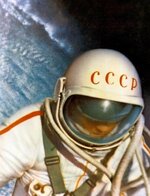
История советской космонавтики в фотографиях. Советский космонавт Алексей Леонов во время выхода за пределы космического корабля «Восход-2». 18 марта 1965 года. Первый человек в открытом космосе. The history of Soviet cosmonautics in photographs. Soviet cosmonaut Alexei Leonov during a spacewalk outside the Voskhod 2 spacecraft. March 18, 1965. The first human in outer space.
La historia de la cosmonáutica soviética en fotografías. El cosmonauta soviético Alexei Leonov durante una caminata espacial fuera de la nave espacial Voskhod 2. 18 de marzo de 1965. El primer ser humano en el espacio exterior.
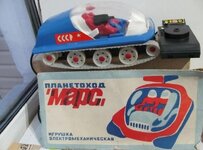
Советские космические игрушки. Планетоход "Марс".
____________________________________________________________________ Soviet space toys. The Mars rover.
____________________________________________________________________ Juguetes espaciales soviéticos. El rover de Marte.
Рисунки советских детей, присланные на конкурс в газету "Пионерская правда" в 1961 году. Редактор Н. Игнатьев. "Родная земля". Игорь Макаревич, 13 лет. Посёлок Пиндуши, Карелия.
_______________________________________________________________________________________________________________________________ Space drawings by Soviet children, submitted to a competition in the newspaper "Pionerskaya Pravda" in 1961. Editor N. Ignatyev. "Native Land." Igor Makarevich, 13. Pindushi village, Karelia. ______________________________________________________________________________________________________________________________ Dibujos espaciales realizados por niños soviéticos, presentados a un concurso del periódico «Pionerskaya Pravda» en 1961. Editor: N. Ignatyev.
«Patria». Igor Makarevich, 13 años. Pueblo de Pindushi, Karelia.
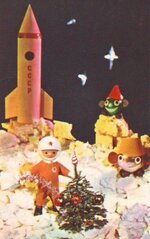
Новогодние космические открытки в СССР. "С новым годом!": Цветная открытка.
Художники Курчаков, В.; Фурманов, А.
Москва/Издательство "Изобразительное искусство"/ 1977 год. ____________________________________________________________________________ New Year's space cards in the USSR. "Happy New Year!": Colored postcard.
Artists: V. Kurchakov; A. Furmanov.
Moscow/Fine Art Publishing House/1977. ___________________________________________________________________________ Tarjetas espaciales de Año Nuevo en la URSS. «¡Feliz Año Nuevo!»: Postal a color. Artistas: V. Kurchakov; A. Furmanov.
Moscú/Editorial de Bellas Artes/1977.
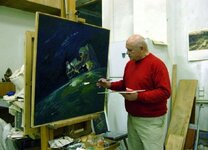
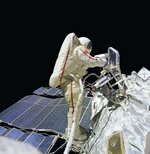
История советской космонавтики в фотографиях. Летчик - космонавт СССР Владимир Джанибеков в процессе работы над картиной "Сварка в космосе". .................................................................. Примечание: Влади́мир Алекса́ндрович Джанибе́ков (род. 13 мая 1942, посёлок Искандер, Южно-Казахстанская область, Казахская ССР, СССР) — лётчик-космонавт СССР (1978), дважды Герой Советского Союза (1978, 1981), генерал-майор авиации (1985). Общая продолжительность полётов — 145 суток 15 часов 58 минут 35 секунд. Общая продолжительность 2 выходов в открытый космос — 8 часов 34 минуты. The history of Soviet cosmonautics in photographs. USSR pilot-cosmonaut Vladimir Dzhanibekov working on the painting "Welding in Space." ................................................................ Note: Vladimir Aleksandrovich Dzhanibekov (born May 13, 1942, in Iskander, South Kazakhstan Region, Kazakh SSR, USSR) was a USSR pilot-cosmonaut (1978), a Hero of the Soviet Union (1978, 1981), and a Major General of Aviation (1985). His total flight time was 145 days, 15 hours, 58 minutes, and 35 seconds. His two spacewalks totaled 8 hours and 34 minutes. Historia de la cosmonáutica soviética en fotografías. El piloto cosmonauta soviético Vladimir Dzhanibekov trabajando en la pintura "Soldadura en el espacio". ................................................................ Nota: Vladimir Aleksandrovich Dzhanibekov (nacido el 13 de mayo de 1942 en Iskander, región de Kazajistán Meridional, RSS de Kazajistán, URSS) fue piloto cosmonauta soviético (1978), Héroe de la Unión Soviética (1978, 1981) y Mayor General de Aviación (1985). Su tiempo total de vuelo fue de 145 días, 15 horas, 58 minutos y 35 segundos. Sus dos caminatas espaciales sumaron 8 horas y 34 minutos.
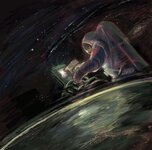
Космическая живопись в СССР. "Сварка в космосе". Художник: дважды Герой Советского Союза, генерал-майор авиации Владимир Александрович Джанибеков.
На картине изображена Светлана Савицкая( лётчик - космонавт СССР). .............................................................
Примечание: 25 июля 1984 года Владимир Джанибеков и Светлана Савицкая осуществили выход в открытый космос, продолжительностью 3 часа 35 минут. Во время работы в открытом космосе Владимир Джанибеков и Светлана Савицкая проводили испытания различных инструментов, предназначенных для работы с металлами в открытом космосе, в том числе Универсального Ручного Инструмента (УРИ), позволяющего производить в открытом космосе сварку, резку и пайку металлов. Светлана Савицкая стала первой женщиной, осуществившей выход в открытый космос.
Space painting in the USSR. "Welding in Space." Artist: twice Hero of the Soviet Union, Major General of Aviation Vladimir Aleksandrovich Dzhanibekov.
The painting depicts Svetlana Savitskaya (Soviet pilot and cosmonaut).
............................................................. Note: On July 25, 1984, Vladimir Dzhanibekov and Svetlana Savitskaya conducted a spacewalk lasting 3 hours and 35 minutes. During their spacewalk, they tested various tools designed for working with metals in outer space, including the Universal Hand Tool (URI), which allows for welding, cutting, and soldering metals in outer space. Svetlana Savitskaya became the first woman to conduct a spacewalk.
Pintura espacial en la URSS. "Soldadura en el espacio". Artista: Vladimir Aleksandrovich Dzhanibekov, dos veces Héroe de la Unión Soviética y Mayor General de Aviación.
La pintura representa a Svetlana Savitskaya (piloto y cosmonauta de la URSS).
............................................................ Nota: El 25 de julio de 1984, Vladimir Dzhanibekov y Svetlana Savitskaya realizaron una caminata espacial de 3 horas y 35 minutos. Durante la misma, probaron diversas herramientas diseñadas para trabajar con metales en el espacio, incluyendo la Herramienta Manual Universal (URI), que permite soldar, cortar y unir metales en el espacio. Svetlana Savitskaya se convirtió en la primera mujer en realizar una caminata espacial.
Помимо ряда экспериментов, проводимых на борту станции, космонавт Владимир Джанибеков также совершил выход в открытый космос со Светланой Савицкой. Впервые в открытом космосе были проведены эксперименты по электронно-лучевой сварке. Проведенные космонавтами Савицкой и Джанибековым эксперименты показали, что оборудование имеет высокую степень надежности, а сварка в космосе – весьма перспективное дело.
Владимир Джанибеков рассказывает :"Пришлось порядком потрудиться. Мне тогда довелось выполнять работу носильщика, сварщика и даже… папарацци. Нужно было взять с собой в открытый космос целую кипу вещей: сварочный аппарат, образцы металлов, теле- и фотокамеры. Все, конечно же, тащил я. Это был мой первый выход в открытый космос. Руки заняты ношей, хвататься за выступы на станции приходилось ногами. Поэтому сложно было удержать равновесие. Светлана тем временем надежно заякорилась в месте, отведенном для эксперимента. Она приступила к работе, а я снимал об этом телерепортаж, затем вооружился фотоаппаратом и щелкал им, словно папарацци. Светлана сварила и спаяла по одному шву. С остальными образцами работал я. Скажу честно, к концу эксперимента у меня немели руки: их так передавили металлические кольца, которыми перчатки крепятся к скафандру выше запястья, что кровь к пальцам едва поступала".
Продолжительность выхода составила три с половиной часа.
На фото: Светлана Савицкая-первая женщина космонавт вышедшая в открытый космос.
In addition to a number of experiments conducted aboard the station, cosmonaut Vladimir Dzhanibekov also performed a spacewalk together with Svetlana Savitskaya. For the first time in open space, experiments in electron-beam welding were carried out. The experiments conducted by Savitskaya and Dzhanibekov showed that the equipment was highly reliable and that welding in space is a very promising field.
Vladimir Dzhanibekov recalls:
“We really had to work hard. During that mission I had to play the role of a porter, a welder and even… a paparazzi.
We had to take a whole pile of equipment into open space: a welding device, metal samples, television and photo cameras. Naturally, I carried it all. It was my first spacewalk. My hands were occupied with the load, so I had to grab the station’s handholds with my legs. Because of this it was difficult to keep my balance.
Meanwhile Svetlana securely anchored herself at the place prepared for the experiment. She began working, while I filmed a TV report about it. Then I picked up a camera and started clicking away like a paparazzi.
Svetlana welded and soldered one seam each. I worked on the remaining samples. I must say honestly that by the end of the experiment my hands had gone numb: the metal rings that attach the gloves to the spacesuit above the wrist pressed so tightly that blood barely reached my fingers.”
The spacewalk lasted three and a half hours. Photo: Svetlana Savitskaya, the first woman in history to perform a spacewalk.
Además de varios experimentos realizados a bordo de la estación, el cosmonauta Vladimir Dzhanibekov también efectuó una caminata espacial junto con Svetlana Savitskaya. Por primera vez en el espacio abierto se llevaron a cabo experimentos de soldadura por haz electrónico. Los experimentos realizados por Savitskaya y Dzhanibekov demostraron que el equipo tenía un alto grado de fiabilidad y que la soldadura en el espacio es un campo muy prometedor.
Vladimir Dzhanibekov recuerda:
«Tuvimos que trabajar bastante. En aquella ocasión me tocó desempeñar el papel de cargador, soldador e incluso… paparazzi.
Tuvimos que llevar al espacio abierto todo un montón de cosas: el aparato de soldadura, muestras de metales, cámaras de televisión y de fotografía. Naturalmente, yo lo llevaba todo. Era mi primera salida al espacio. Como tenía las manos ocupadas con la carga, tenía que agarrarme a los salientes de la estación con las piernas. Por eso era difícil mantener el equilibrio.
Mientras tanto, Svetlana se ancló firmemente en el lugar destinado para el experimento. Ella empezó a trabajar y yo filmaba un reportaje para televisión. Luego tomé la cámara fotográfica y disparaba como un paparazzi.
Svetlana soldó y unió una costura cada una. Con las demás muestras trabajé yo. Debo decir sinceramente que al final del experimento se me entumecieron las manos: los anillos metálicos que sujetan los guantes al traje espacial por encima de la muñeca apretaban tanto que la sangre apenas llegaba a los dedos».
La duración de la caminata espacial fue de tres horas y media. En la foto: Svetlana Savitskaya, la primera mujer cosmonauta que realizó una caminata espacial.
Работа в условиях, когда от глубокого вакуума человека отделяет лишь оболочка скафандра, заставляет космонавтов относиться к своей одежде с особым вниманием. Ведь ее случайное повреждение о какую-либо режущую или колющую поверхность чревато разгерметизацией, а это будет уже серьезная нештатная ситуация, для преодоления которой потребуется много сил. Конечно, все инструменты, с которыми манипулируют в открытом космосе, делаются максимально безопасными для скафандра, а на корпусе станций закрывают, насколько возможно, все потенциально опасные места. Но полностью исключить опасность случайного повреждения скафандра нельзя. Вот и при сварке в вакууме пластины на выходе из инструмента луч имел температуру более 1000° С и прожигал даже металл. Чтобы не повредить скафандр, следовало работать аккуратно, очень четко контролировать каждое свое действие.
Учитывая все это, я и включила инструмент. Первая операция — резка. Так же, как и на Земле в барокамере, она прошла четко, лишь светящееся пятно на узенькой полоске металла говорило о том, что там бушует "электронный пожар". После окончания режима стали видны две полоски разреза.Пока шел первый режим, Володя Джанибеков находился в нескольких метрах за мной и вел телерепортаж — создатели инструмента могли видеть все своими глазами. В наушниках я слышала их уверенные голоса, старающиеся, с одной стороны, не мешать, а с другой — вовремя подсказать, дать полезный совет.Впрочем, никаких сюрпризов УРИ не преподносил.Так же четко прошла сварка двух пластин. Лишь яркое,бьющее через все светофильтры прямо в глаза солнце чуть затрудняло работу". (Светлана Савицкая. "Вчера и всегда").
.........................................................................
Цит.по: Светлана Евгеньевна Савицкая
ВЧЕРА И ВСЕГДА
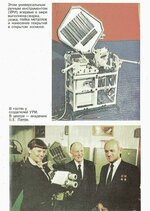
Издательство агентства печати НОВОСТИ. 1988. Верхнее фото: Этим универсальным ручным инструментом (УРИ) впервые в мире выполнена сварка, резка, пайка металлов и нанесение покрытий в открытом космосе.
Нижнее фото: В гостях у создателей УРИ. Слева космонавт Светлана Савицкая, в центре академик Б.Е. Патон. Справа косонавт В. Джанибеков.
"Working in conditions where only the shell of a spacesuit separates a person from the deep vacuum forces cosmonauts to treat their clothing with special care. Any accidental damage caused by a sharp or pointed surface could lead to depressurization, which would already be a serious emergency situation requiring great effort to overcome. Of course, all the tools used in open space are designed to be as safe as possible for the spacesuit, and on the outer surface of space stations all potentially dangerous elements are covered whenever possible. But it is impossible to completely eliminate the risk of accidental damage to the spacesuit.
During welding in a vacuum, the beam leaving the instrument had a temperature of more than 1000°C and could burn even metal. To avoid damaging the spacesuit, it was necessary to work carefully and to control every action very precisely.
Taking all this into account, I switched on the instrument.
The first operation was cutting. Just as on Earth in the pressure chamber, it went smoothly; only the glowing spot on the narrow strip of metal showed that an “electronic fire” was raging there. After the mode ended, two lines of the cut became visible.
While the first mode was running, Vladimir Dzhanibekov was several meters behind me and was filming a television report—so that the creators of the instrument could see everything with their own eyes. In my headphones I heard their confident voices trying, on the one hand, not to interfere, and on the other hand to give timely advice and useful suggestions.
However, the Universal Hand Tool (UHT) presented no surprises.
The welding of the two plates also proceeded smoothly. Only the bright Sun, piercing through all the filters directly into my eyes, made the work a little more difficult".
(Svetlana Savitskaya Yesterday and Always).
.......................................................................................
Quoted from:
Yesterday and Always
by Svetlana Savitskaya
Publishing House of the Novosti Press Agency Publishing House, 1988.
Upper photo:
With this Universal Hand Tool (UHT), welding, cutting, brazing of metals, and coating deposition were performed for the first time in the world in open space.
Lower photo:
Visiting the creators of the UHT.
From left to right: cosmonaut Svetlana Savitskaya,
in the center — academician Boris Paton, on the right — cosmonaut Vladimir Dzhanibekov.
"Trabajar en condiciones en las que solo la envoltura del traje espacial separa al ser humano del vacío profundo obliga a los cosmonautas a tratar su “ropa” con especial cuidado. Cualquier daño accidental causado por una superficie cortante o punzante puede provocar una despresurización, lo que ya sería una situación de emergencia grave que exigiría mucho esfuerzo para superarla. Por supuesto, todas las herramientas utilizadas en el espacio abierto se diseñan para ser lo más seguras posible para el traje espacial, y en el exterior de las estaciones se cubren, en la medida de lo posible, todos los lugares potencialmente peligrosos. Pero es imposible eliminar completamente el riesgo de un daño accidental al traje.
Durante la soldadura en el vacío, el haz que salía del instrumento tenía una temperatura de más de 1000 °C y podía incluso quemar metal. Para no dañar el traje espacial era necesario trabajar con cuidado y controlar cada acción con gran precisión.
Teniendo todo esto en cuenta, encendí el instrumento.
La primera operación fue el corte. Igual que en la Tierra, en la cámara de presión, todo transcurrió con precisión; solo el punto brillante en la estrecha tira de metal indicaba que allí ardía un “fuego electrónico”. Después de finalizar el modo se hicieron visibles dos líneas de corte.
Mientras funcionaba el primer modo, Vladimir Dzhanibekov se encontraba a varios metros detrás de mí filmando un reportaje televisivo, para que los creadores del instrumento pudieran verlo todo con sus propios ojos. En los auriculares escuchaba sus voces seguras que, por un lado, trataban de no interferir y, por otro, de dar consejos útiles en el momento oportuno.
Sin embargo, el instrumento manual universal (IMU) no presentó ninguna sorpresa.
La soldadura de las dos placas también se realizó con precisión. Solo el brillante Sol, que atravesaba todos los filtros y daba directamente en los ojos, dificultaba un poco el trabajo".
(Svetlana Savitskaya «Ayer y siempre»).
............................................................................................
Citado según:
«Ayer y siempre»
de Svetlana Savitskaya
Editorial de la agencia de prensa Novosti, 1988.
Foto superior:
Con este instrumento manual universal se realizaron por primera vez en el mundo la soldadura, el corte, la soldadura fuerte y la aplicación de recubrimientos metálicos en el espacio abierto.
Foto inferior:
De visita con los creadores del instrumento.
A la izquierda — cosmonauta Svetlana Savitskaya,
en el centro — académico Boris Paton, a la derecha — cosmonauta Vladimir Dzhanibekov.
This site uses cookies to help personalise content, tailor your experience and to keep you logged in if you register.
By continuing to use this site, you are consenting to our use of cookies.