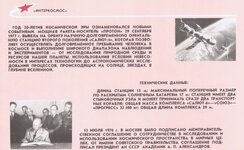
«Интеркосмос» Год 20-летия космической эры ознаменовался новыми событиями. Мощная ракета-носитель «Протон» 29 сентября 1977 г. вывела на орбиту научную долговременную орбитальную станцию второго поколения «Салют-6», которая позволяет осуществлять долговременное пребывание человека в космосе и выполнение широкого диапазона наблюдений и экспериментов — от исследования природной среды и ресурсов нашей планеты, использования условий невесомости в интересах технологии до астрономических исследований процессов, происходящих на Солнце, звездах, в глубине Вселенной.
Технические данные:
Длина станции 15 м; максимальный поперечный размер по раскрытым солнечным батареям 17 м; станция имеет два стыковочных узла и может принимать сразу два транспортных корабля; общая масса комплекса «Салют-6» — «Союз» — «Прогресс» 32 500 кг; общая длина комплекса 29 м. 13 июля 1976 г. в Москве было подписано межправительственное соглашение о сотрудничестве в исследовании и использовании космического пространства в мирных целях. От имени Советского правительства соглашение подписал президент АН СССР академик А. П. Александров. Intercosmos The 20th anniversary year of the space age was marked by new events. On September 29, 1977, the powerful Proton launch vehicle placed into orbit the second-generation long-duration scientific orbital station Salyut-6. The station made it possible to carry out long-term human presence in space and to perform a wide range of observations and experiments — from studies of the natural environment and the resources of our planet and the use of weightlessness for technological purposes to astronomical investigations of processes occurring on the Sun, stars, and in the depths of the Universe.
Technical data:
Station length — 15 m; maximum transverse dimension across deployed solar arrays — 17 m; the station has two docking ports and can receive two transport spacecraft simultaneously; total mass of the Salyut-6 — Soyuz — Progress complex — 32,500 kg; total length of the complex — 29 m. On July 13, 1976, an intergovernmental agreement on cooperation in the exploration and use of outer space for peaceful purposes was signed in Moscow. On behalf of the Soviet government the agreement was signed by the President of the USSR Academy of Sciences, Academician A. P. Aleksandrov.
Intercosmos El año del 20.º aniversario de la era espacial estuvo marcado por nuevos acontecimientos. El 29 de septiembre de 1977, el potente cohete portador Protón puso en órbita la estación orbital científica de larga duración de segunda generación Salyut-6, que permite la permanencia prolongada del ser humano en el espacio y la realización de una amplia gama de observaciones y experimentos: desde el estudio del medio natural y de los recursos de nuestro planeta, el aprovechamiento de las condiciones de ingravidez para fines tecnológicos, hasta investigaciones astronómicas de los procesos que tienen lugar en el Sol, en las estrellas y en las profundidades del Universo.
Datos técnicos:
Longitud de la estación — 15 m; dimensión transversal máxima con los paneles solares desplegados — 17 m; la estación dispone de dos puertos de acoplamiento y puede recibir simultáneamente dos naves de transporte; masa total del complejo Salyut-6 — Soyuz — Progress — 32 500 kg; longitud total del complejo — 29 m. El 13 de julio de 1976 en Moscú se firmó un acuerdo intergubernamental sobre la cooperación en la exploración y utilización del espacio ultraterrestre con fines pacíficos. En nombre del Gobierno soviético el acuerdo fue firmado por el presidente de la Academia de Ciencias de la URSS, el académico A. P. Aleksándrov
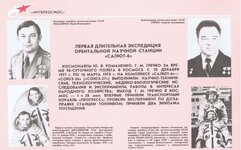
«Интеркосмос» ПЕРВАЯ ДЛИТЕЛЬНАЯ ЭКСПЕДИЦИЯ
ОРБИТАЛЬНОЙ НАУЧНОЙ СТАНЦИИ
«САЛЮТ-6»
Космонавты Ю. В. Романенко, Г. М. Гречко за время 96-суточного полёта в космосе с 10 декабря 1977 г. по 16 марта 1978 г. на комплексе «Салют-6» — «Союз-26» и «Союз-27» выполнили: научно-технические, технологические, медико-биологические исследования и эксперименты, работы в интересах народного хозяйства; выход Г. М. Гречко в космос — 1 ч 28 мин; впервые приняли транспортный корабль «Прогресс»; провели эксперимент по дозаправке станции топливом; приняли два экипажа посещения.
На верхнем фото слева: Командир корабля лётчик-космонавт СССР
РОМАНЕНКО Юрий Викторович.
На верхнем фото справа: Бортинженер лётчик-космонавт СССР
ГРЕЧКО Георгий Михайлович
На нижнем фото слева: Первый экипаж посещения.
Космонавты Владимир Александрович Джанибеков, Олег Григорьевич Макаров, стартовав 10 января на корабле «Союз-27», 11 января 1978 г. осуществили стыковку с орбитальной станцией «Салют-6» — «Союз-26». Впервые состоялся полёт станции с двумя пристыкованными кораблями. Посадку выполнили 16 января 1978 г. на корабле «Союз-26».
На нижнем фото справа: Первый международный экипаж посещения. Командир корабля «Союз-28» лётчик-космонавт СССР, дважды Герой Советского Союза Алексей Александрович Губарев и космонавт-исследователь Владимир Ремек (ЧССР) совместно с основным экипажем в период 2–10 марта 1978 г. выполнили ряд технических и медико-биологических экспериментов, подготовленных учёными и специалистами СССР и ЧССР.
Intercosmos FIRST LONG-DURATION EXPEDITION
OF THE ORBITAL SCIENTIFIC STATION
SALYUT-6
Cosmonauts Yu. V. Romanenko and G. M. Grechko, during their 96-day space flight from December 10, 1977, to March 16, 1978, aboard the Salyut-6 — Soyuz-26 — Soyuz-27 complex, carried out scientific-technical, technological, and biomedical research and experiments, as well as work in the interests of the national economy.
G. M. Grechko performed a spacewalk lasting 1 hour 28 minutes.
For the first time the Progress transport spacecraft was received; an experiment on refueling the station with propellant was conducted; and two visiting crews were received.
In the top photo on the left:
Spacecraft Commander, USSR pilot-cosmonaut
Yuri Viktorovich Romanenko
In the top photo on the right:
Flight Engineer, USSR pilot-cosmonaut
Georgy Mikhailovich Grechko
In the bottom photo on the left: First visiting crew.
Cosmonauts Vladimir Aleksandrovich Dzhanibekov and Oleg Grigoryevich Makarov, launched on January 10 aboard Soyuz-27, docked on January 11, 1978, with the orbital station Salyut-6 — Soyuz-26 complex. For the first time a station operated with two docked spacecraft simultaneously. They landed on January 16, 1978, aboard Soyuz-26.
In the bottom photo on the right: First international visiting crew.
Commander of Soyuz-28, USSR pilot-cosmonaut and twice Hero of the Soviet Union Aleksei Aleksandrovich Gubarev, and research cosmonaut Vladimír Remek (Czechoslovakia), together with the main crew, carried out a number of technical and biomedical experiments from March 2 to March 10, 1978, prepared by scientists and specialists of the USSR and Czechoslovakia. Intercosmos PRIMERA EXPEDICIÓN DE LARGA DURACIÓN DE LA ESTACIÓN ORBITAL CIENTÍFICA
SALYUT-6
Los cosmonautas Yu. V. Romanenko y G. M. Grechko, durante el vuelo espacial de 96 días realizado entre el 10 de diciembre de 1977 y el 16 de marzo de 1978 a bordo del complejo Salyut-6 — Soyuz-26 — Soyuz-27, llevaron a cabo investigaciones y experimentos científico-técnicos, tecnológicos y médico-biológicos, así como trabajos en interés de la economía nacional.
G. M. Grechko realizó una caminata espacial de 1 hora y 28 minutos.
Por primera vez se recibió la nave de transporte Progress; se realizó un experimento de repostaje de combustible de la estación; y se recibieron dos tripulaciones visitantes.
En la foto superior de la izquierda:
Comandante de la nave, piloto-cosmonauta de la URSS
Yuri Viktorovich Romanenko
En la foto superior de la derecha:
Ingeniero de vuelo, piloto-cosmonauta de la URSS
Georgy Mikhailovich Grechko
En la foto de abajo a la izquierda: Primer equipo visitante.
Los cosmonautas Vladimir Aleksandrovich Dzhanibekov y Oleg Grigoryevich Makarov, lanzados el 10 de enero a bordo de Soyuz-27, realizaron el 11 de enero de 1978 el acoplamiento con el complejo orbital Salyut-6 — Soyuz-26. Por primera vez una estación orbital operó con dos naves acopladas simultáneamente. Aterrizaron el 16 de enero de 1978 a bordo de Soyuz-26.
Foto inferior a la derecha: Primer equipo internacional visitante.
El comandante de Soyuz-28, piloto-cosmonauta de la URSS y dos veces Héroe de la Unión Soviética Aleksei Aleksandrovich Gubarev, y el cosmonauta-investigador Vladimír Remek (Checoslovaquia), junto con la tripulación principal, realizaron entre el 2 y el 10 de marzo de 1978 varios experimentos técnicos y médico-biológicos preparados por científicos y especialistas de la URSS y Checoslovaquia.
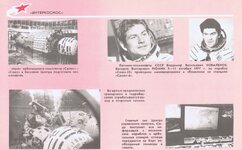
«Интеркосмос» На верхнем фото слева: Макет орбитального комплекса «Салют» — «Союз» в бассейне Центра подготовки космонавтов.
На верхнем фото справа: Лётчики-космонавты СССР Владимир Васильевич Ковалёнок, Валерий Викторович Рюмин 9—11 октября 1977 г. на корабле «Союз-25» проводили маневрирование и сближение со станцией «Салют-6».
На нижнем фото слева: Во время предполётных тренировок в гидробассейне отрабатывается выход в открытый космос. На нижнем фото справа: Главный зал Центра управления полётом. Сюда поступает вся информация с космических кораблей и орбитальных станций, отсюда передаются на борт необходимые команды и советы.
Intercosmos
In the top photo on the left: A model of the Salyut — Soyuz orbital complex in the pool of the Cosmonaut Training Center.
In the top photo on the right: USSR pilot-cosmonauts Vladimir Vasilievich Kovalenok and Valery Viktorovich Ryumin, from October 9 to 11, 1977, aboard Soyuz-25, carried out maneuvering and rendezvous operations with the Salyut-6 station.
In the bottom photo on the left: During pre-flight training in the hydrolaboratory pool, spacewalk procedures are practiced.
In the bottom photo on the right: The main hall of the Mission Control Center. All information from spacecraft and orbital stations is received here, and the necessary commands and recommendations are transmitted from here to the spacecraft. Intercosmos En la foto superior de la izquierda: Maqueta del complejo orbital Salyut — Soyuz en la piscina del Centro de Entrenamiento de Cosmonautas. En la foto superior de la derecha: Los pilotos-cosmonautas de la URSS Vladimir Vasilievich Kovalenok y Valery Viktorovich Ryumin, del 9 al 11 de octubre de 1977 a bordo de Soyuz-25, realizaron maniobras y aproximación con la estación Salyut-6. En la foto de abajo a la izquierda: Durante los entrenamientos previos al vuelo en la piscina hidrolaboratorio se practica la salida al espacio abierto. Foto inferior a la derecha: Sala principal del Centro de Control de Vuelo. Aquí llega toda la información procedente de las naves espaciales y estaciones orbitales, y desde aquí se transmiten a bordo los comandos y recomendaciones necesarios.
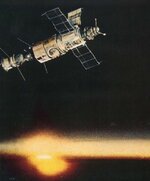
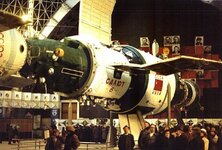
Станция "Салют - 6" в космосе. Фото из книги - альбома "Советская космонавтика". Москва/ Издательство "Машиностроение"/ 1981 год The Salyut 6 space station in space. Photo from the book/album "Soviet Cosmonautics." Moscow / Mashinostroenie Publishing House / 1981 La estación espacial Salyut 6 en el espacio. Fotografía del libro/álbum «Cosmonáutica soviética». Moscú / Editorial Mashinostroenie / 1981
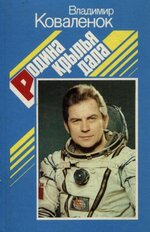
"Валерий показывает на перекрестие визира и видеоконтрольное устройство телевизионной системы и поднимает большой палец — всё идёт отлично. Ждём касания… Ощущаем толчок. Ждём желанного зелёного транспаранта: «Механический захват». Вместо него загорелся другой: «Отвод». Стыковки не произошло. Принимаем решение повторить её. <…> Но и на этот раз всё повторилось: соударение и страшная надпись на транспаранте: «Отвод». <…> И снова взялся за ручки управления. Режим сближения был организован просто идеально. Корабль шёл на станцию с нулевыми боковыми и угловыми скоростями. Не было даже необходимости держаться за ручки управления. <…> У меня же кошки скребли на душе: два предыдущих режима были такими же, но сцепки не произошло. По какой-то причине, думал я, защёлки стыковочного механизма не проходят в приёмное гнездо стакана конуса… В подтверждение моих мыслей после третьего соударения корабль стал отходить от станции: пружины стыковочного механизма оттолкнули нас. Затормозить корабль было нечем: топливо в основной системе выработано. <…> Земля поинтересовалась положением станции. Я вплыл в бытовой отсек и глазам своим не поверил: «Салют-6» — в 8—10 метрах от нашего корабля. Такая близость опасна. Дело в том, что по законам небесной механики два тела, побывавшие вместе, то есть в составе одной массы, после расхождения могут встретиться в определенной точке снова, если гравитационные силы будут действовать на «стягивание». Алексей Елисеев в течение двух витков выяснил, на сближение или на расхождение действуют эти силы, но они, к счастью, разводили наши объекты. Мы стали готовиться к посадке" (В. Коваленок. "Родина крылья дала").
.........................................................................
Цит.по: КОВАЛЕНОК ВЛАДИМИР ВАСИЛЬЕВИЧ
РОДИНА КРЫЛЬЯ ДАЛА
Документальная повесть
Рецензент: академик АН СССР Л. И. Киселевский
Художник: А. В. Ружо Минск/ Издательство "Юнацтва"/1989 год
“Valery points to the crosshairs of the sight and the video monitoring device of the television system and raises his thumb — everything is going perfectly. We wait for contact… We feel a jolt. We wait for the desired green indicator: ‘Mechanical capture.’ Instead, another one lights up: ‘Retreat.’ The docking did not occur. We decide to try again. <…> But this time everything repeats itself: a collision and the terrible message on the indicator panel: ‘Retreat.’ <…> Once again I take hold of the control handles. The rendezvous mode had been organized simply perfectly. The spacecraft was approaching the station with zero lateral and angular velocities. There was not even any need to hold the control handles. <…>
But inside I felt deeply uneasy: the two previous approaches had been just as perfect, yet docking had not occurred. For some reason, I thought, the latches of the docking mechanism were not entering the receiving socket of the cone.
Confirming my thoughts, after the third impact the spacecraft began to move away from the station: the springs of the docking mechanism pushed us back. There was nothing to brake the spacecraft with: the propellant in the main system had been exhausted. <…>
Mission Control asked about the station’s position. I floated into the habitation module and could hardly believe my eyes: Salyut-6 was only 8–10 meters from our spacecraft. Such proximity is dangerous. The fact is that, according to the laws of celestial mechanics, two bodies that have once been together — that is, as part of a single mass — after separating may meet again at a certain point if gravitational forces act to draw them together.
Alexei Yeliseyev determined during two orbits whether those forces were causing convergence or divergence, but fortunately they were separating our objects. We began preparing for landing.”
(V. Kovalenok. "The Motherland Gave Me Wings").
.........................................................................
Quoted from: VLADIMIR VASILIEVICH KOVALENOK
THE MOTHERLAND GAVE ME WINGS
Documentary novel
Reviewer: Academician of the USSR Academy of Sciences L. I. Kiselevsky
Illustrator: A. V. Rouzho
Quoted from:
Vladimir Vasilievich Kovalenok — The Motherland Gave Me Wings Documentary narrative, Minsk, Publishing House “Yunatstva”, 1989.
“Valeri señala la retícula del visor y el dispositivo de control de vídeo del sistema de televisión y levanta el pulgar: todo marcha perfectamente. Esperamos el contacto… Sentimos un golpe. Esperamos el deseado indicador verde: «Captura mecánica». En lugar de él se enciende otro: «Retirada». El acoplamiento no se produjo. Decidimos intentarlo de nuevo. <…> Pero esta vez todo se repite: un choque y la terrible inscripción en el panel: «Retirada». <…> Vuelvo a tomar las palancas de control. El modo de aproximación estaba organizado de manera simplemente perfecta. La nave se dirigía hacia la estación con velocidades laterales y angulares iguales a cero. Ni siquiera era necesario sostener las palancas de control. <…>
Pero en mi interior sentía una gran inquietud: los dos intentos anteriores habían sido exactamente iguales, y sin embargo el acoplamiento no se produjo. Por alguna razón —pensé— los pestillos del mecanismo de acoplamiento no entran en el receptáculo del cono.
Confirmando mis pensamientos, después del tercer choque la nave comenzó a alejarse de la estación: los resortes del mecanismo de acoplamiento nos empujaron hacia atrás. No había nada con qué frenar la nave: el combustible del sistema principal se había agotado. <…>
Desde la Tierra preguntaron por la posición de la estación. Floté hacia el compartimento habitable y no podía creer lo que veía: Salyut-6 estaba a tan solo 8–10 metros de nuestra nave. Una proximidad así es peligrosa. Según las leyes de la mecánica celeste, dos cuerpos que han estado juntos —es decir, como parte de una misma masa— después de separarse pueden volver a encontrarse en cierto punto si las fuerzas gravitatorias actúan para acercarlos.
Alexéi Yeliseyev determinó durante dos órbitas si esas fuerzas provocaban acercamiento o alejamiento, pero afortunadamente estaban separando nuestros objetos. Empezamos a prepararnos para el aterrizaje.”
(V. Kovalenok. «La patria me dio alas»).
................................................................................
Citado de: VLADIMIR VASILIEVICH KOVALENOK
LA PATRIA ME DIO ALAS
Novela documental
Reseñador: L. I. Kiselevsky, académico de la Academia de Ciencias de la URSS
Ilustrador: A. V. Ruzho Minsk / Editorial Yunastva / 1989
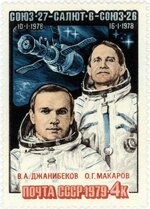
Почтовая марка СССР посвящённая полёту Союз-27-Салют-6-Союз-26. На марке изображены космонавты В. Джанибеков и О. Макаров. A USSR postage stamp dedicated to the Soyuz-27-Salyut-6-Soyuz-26 flight. In the brand isolated from cosmonautics. Джанибеков и О. Makarov. Un sello postal de la URSS dedicado al vuelo Soyuz-27-Salyut-6-Soyuz-26.El sello representa a los cosmonautas V. Dzhanibekov y O. Makarov.
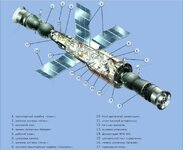
Космическая станция "Салют - 6". 1.Транспортный корабль «Союз»
2.Антенны системы «Игла»
3.Выходной люк
4.Панели солнечных батарей
5.Рабочий отсек
6.Шлюзовая камера
7.Антенны системы «Игла»
8.Грузовой транспортный корабль «Прогресс»
9.Стыковочный узел
10.Блок двигателей ориентации
11.Отсек научной аппаратуры
12.Бегущая дорожка
13.Душевая установка
14.Фотоаппарат МКФ-6М
15.Центральный пост управления
16.Панели солнечных батарей 17.Переходный отсек Space station "Salyut 6". 1.Soyuz transport spacecraft
2.Antennas of the Igla rendezvous system
3.Hatch
4.Solar array panels
5.Working compartment
6.Airlock chamber
7.Antennas of the Igla system
8.Progress cargo transport spacecraft
9.Docking port
10.Attitude control thruster unit
11.Scientific equipment compartment
12.Treadmill
13.Shower unit
14.MKF-6M camera
15.Central control station
16.Solar array panels 17.Transfer compartment Estación espacial "Salyut 6". 1.Nave de transporte Soyuz
2.Antenas del sistema Igla
3.Escotilla de salida
4.Paneles solares
5.Compartimento de trabajo
6.Cámara de esclusa
7.Antenas del sistema Igla
8.Nave de carga Progress
9.Puerto de acoplamiento
10.Bloque de motores de orientación
11.Compartimento de equipos científicos
12.Cinta de correr
13.Instalación de ducha
14.Cámara fotográfica MKF-6M
15.Puesto central de control
16.Paneles solares 17.Compartimento de transición
This site uses cookies to help personalise content, tailor your experience and to keep you logged in if you register.
By continuing to use this site, you are consenting to our use of cookies.