Fires in Western Russia

I'm a little concerned by the possiblilty of radioactive particles being sent in the atmosphere by the fire. Especially when the russian "Institute for Safe Development of Nuclear Energy" says there is no danger. We remember 1986, the "local" radioactive cloud of Chernobyl spreaded over the whole globe. :rolleyes:

Well, probably the same isotopes that were ejected during Chernobyl disaster are at risk of being lifted up in the air again, when the forests containing them burn. However, due to the amount of time passed and progressing of decay, they shouldn't be just as "hot" already.

I don't like this developement, and Saratov research institute is probably filled with thousands of barrels containing the worst radioactive isotopes possible :shifty:

That's Sarov, not Saratov. And ah, it's not the only concern: Residents evacuated after fire at UK's main nuclear weapons factory

Also I hope things will go better in Moscow, the situation looks bad there... Maybe they could distribute gas masks ? They are probably plenty of them stockpiled during the cold war...

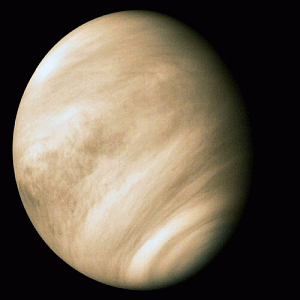
It looks like on Venus and feels like on Venus. Too bad I'm not a native Venusian... :idk: They promise the smoke to become even thicker through the night.

Giving people masks would make little sense. The purpose of a gas mask is to provide a temporary protection until evacuation to a breathable place. They also have a limited list of agents they prevent from filtering (or are equipped with an oxygen bottle). But you can't live (eat, sleep, work) in a gas mask, when it's just there is no hiding place from the foul air.

I, for one, figured out that CO2 intoxication is less nasty than CO intoxication and decided against opening my windows this night. I don't think this night won't take a death toll here.

---------- Post added at 00:48 ---------- Previous post was at 00:41 ----------


Wondering, why there's no wildfires data from the Meteor-M. Is it still in working shape?..

---------- Post added at 21:03 ---------- Previous post was at 00:48 ----------

A little digest update on the wildfires.

How space technology is involved in firefighting this summer:
http://www.vesti.ru/doc.html?id=383708&cid=549
shortly:
Resurs-DK remote sensing satellite allows daily survey of wildfire data across the regions; Beriev-200 pilots use GLONASS navigation signals to home on fire for water dropping in zero visibility conditions.

Sergey Shoigu, the head of Russian Emergency Command, suggests that if wildfires spread to Bryansk territory, re-spreading of radioactive isotopes left over from Chernobyl disaster is a dangerous possibility
(http://top.rbc.ru/special/fires/05/08/2010/446040.shtml)

Several firefighting robots were deployed to defense of the national nuclear centre in Sarov. They can be used for putting fire off in dangerous industrial installations. Watch video by the link: (http://www.rian.ru/video/20100804/261671980.html)

mashina-dlya-tusheniya-177318.jpg


Impact and benefit of wildfires on natural environment are discussed in this article in English: http://en.rian.ru/analysis/20100804/160072365.html

Forty people have been killed, while the survivors have lost their property and homes. But there are no wildlife losses statistics available now, and there may never be.
[...]
But nature is wise. It responds to each disaster, large or small, so as to compensate for the damage done. It turns out in the longer run that even wildfires can have some benefits.
New growth will cover the burnt areas within 8 to 10 years. For example, berry bushes grow, providing raspberries and cowberries. These areas, covered with bushes, young birches and asps, give animals food and shelter.

Burial services in Moscow are overworking, as death rate booms this hot summer months; the workers can't dig graves as fast as required
(http://rian.ru/hs_news/20100805/262165011.html)

Russia completely halts grain exports till the mid-December, causing commodity market panic (and for benefit of U.S. farmers).
(http://www.hurriyetdailynews.com/n....-to-russian-drought-buyers-worried-2010-08-05)
Wheat extended gains to the highest price in 23 months on concern that the worst drought in at least half a century in Russia, the world’s third-biggest grower, will wilt crops, threatening to push food inflation higher.
There’s “a little bit of panic,” said Michael Pitts, director for commodity sales at National Australia Bank. Russian officials are discussing limits to exports, according to Arkady Zlochevksy, president of the Grain Union, which represents producers and traders.
Wheat has surged about 80 percent since this year’s low on June 9 to $7.68 a bushel.
A heat wave in Russia, dry weather in Kazakhstan, Ukraine and the European Union and excess rain in Canada are draining wheat stockpiles and dragging up prices of rice, soybeans and corn. Wheat has jumped faster than in the first two months of 2008 when a 41 percent gain to a record $13.495 spurred concern over a global food crisis and sparked riots from Haiti to Egypt.

Prime importers of Russian grain are Saudi Arabia, Iran, Italy, Spain, Israel, Tunisia, Morocco, Greece, Egypt, Algeria, Libya. But not only these countries get affected, the current wheat crisis may push the worldwide economy crisis off balance, experts say.

Along stopping its own exports, Russia is dealing with Kazakhstan and Belarus, its partners by the customs union, about them stopping their exports too (http://en.rian.ru/russia/20100805/160085751.html):
MOSCOW, August 5 (RIA Novosti) - Moscow has moved to request that Kazakhstan and Belarus suspend grain exports due to the worsening drought, the Russian government said on Thursday.
The Economic Development Ministry has been instructed to submit a proposal to the relevant commission of the Russian-Belarusian-Kazakh customs union, the government press release said.
[...]
The government will distribute grain from the state intervention fund without auctions to regions suffering from the heat wave, Putin said.
"We will not auction off grain, we will distribute it according to requests from regions. The regions will have to help [farmers] in accordance with objective criteria developed by the Agriculture Ministry," he said.
Russia's grain intervention fund currently holds 9.5 million tons of grain.
During the past agricultural season (July 2009-July 2010), Russia exported 21.4 million tons of grain. It has shipped more than 1 million tons since the start of the new season.

A historical analysis of Russian grain exports is available here (but in Russian): http://rian.ru/hs_spravka/20100805/262152122.html

By the moment, many countries offered help to Russian government for overcoming the ongoing disaster. Urkaine has provided several aircraft and experiences firefighting air crews to reinforce Russian efforts, Azerbaijan did the same. Much help or offers of help comes from Germany, Italy, Poland, Lithuania, Estonia, Iran, Belarus, Armenia, Tunisia, Bulgaria, Abkhazia.

262122126.jpg
 
Sorry to hear about these terrible fires and the lives lost :(

I must admit I didn't hear much about these in the local news until this story:
Russian fires could hit Aussie beer bill
Australians may soon be paying more for their bread and beer because of the devastating wildfires and drought in Russia.
 
Last edited:
http://www.physorg.com/news200228786.html


firesandsmok.jpg


Intense fires continued to rage in western Russia on August 4, 2010. Burning in dry peat bogs and forests, the fires produced a dense plume of smoke that reached across hundreds of kilometers. The Moderate Resolution Imaging Spectroradiometer (MODIS) captured this view of the fires and smoke in three consecutive overpasses on NASA’s Terra satellite.

The smooth gray-brown smoke hangs over the Russian landscape, completely obscuring the ground in places. The top image provides a close view of the fires immediately southeast of Moscow, while the lower image shows the full extent of the smoke plume.

The fires along the southern edge of the smoke plume near the city of Razan, top image, are among the most intense. Outlined in red, a line of intense fires is generating a wall of smoke. The easternmost fire in the image is extreme enough that it produced a pyrocumulus cloud, a dense towering cloud formed when intense heat from a fire pushes air high into the atmosphere.

1-firesandsmok.jpg


The lower image shows the full extent of the smoke plume, spanning about 3,000 kilometers (1,860 miles) from east to west. If the smoke were in the United States, it would extend approximately from San Francisco to Chicago.
[...]
Early analyses of data from the Multi-angle Imaging Spectroradiometer (MISR), another instrument on the Terra satellite, indicates that smoke from previous days has at times reached 12 kilometers (six miles) above Earth’s surface into the stratosphere. At such heights, smoke is able to travel long distances to affect air quality far away. This may be one reason that the smoke covers such a large area. The pyrocumulus cloud and the detection of smoke in the stratosphere are good indicators that the fires are large and extremely intense.

According to news reports, 520 fires were burning in western Russia on August 4. MODIS detected far fewer. It is likely that the remaining fires were hidden from the satellite’s view by the thick smoke and scattered clouds.

These pyrocumulus cloud usually form as result of volcano eruptions or atmospheric nuclear explosions.

Today Moscow is engulfed in smoke even more badly that on 4th. From my window, I can barely see another side of the street, and it's not a wide street at all. Even in an air conditioned office I can feel my eyes sting due to smoke.

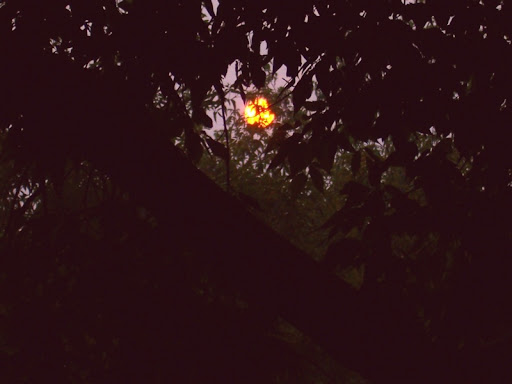
This image I've taken at 8 a.m. just before the current onset of smog, the Sun looked like a red dwarf despite already staying high above horizon:
ssvdmImage%20002_cr.jpg


All Moscow airports are shut down due to unsuitable visibility.

People from Komsomolsk-on-Amur laugh at us, because they had ten such crappy summers in row and their town got smoked badly too. They say, now it's our turn!
 
Very impressive. The satellite pics show very well how far the smoke is spreading.

Hold on. The temperatures should fall to "only" 35-30°C in the middle of next week. Should help a little to make the air more "breathable".

I've heard that Italy sent 2 Canadair planes. It's not much, but everything helps. I wish France will do the same.
 
Hold on. The temperatures should fall to "only" 35-30°C in the middle of next week. Should help a little to make the air more "breathable".

Good, but not enough. Only proper raining can help to put the fires down, and I'm not sure what weather change can produce that. I'm afraid that fires have become local weather drivers themselves and aren't allowing cyclones and cold fronts to push through. Some scientists say it may be related to high Solar activity.
 
Yeah, those fires are probably creating a local greenhouse effect...

1396436_3_6695_le-centre-ville-de-moscou-recouvert-d-un-nuage.jpg


Picture : REUTERS/MIKHAIL VOSKRESENSKY

Moscow downtown, the 6th of August
 
Last edited:
Surely yes. :) Watching out for some zombies...

---------- Post added 07-08-10 at 00:50 ---------- Previous post was 06-08-10 at 21:31 ----------

The first good news on this week: wildfires have been completely extinguished in Voronezh territory! :cheers:
 
1396680_7_4f84_indendies-en-russie.jpg

AP/Misha Japaridze

From "Le Monde.fr" :

The situation isn't better, but life goes on. The 3 airports are open, even if some flights have been routed elsewhere. Visibility is lower than 300 meters.

Meteologists are forecasting a change in the winds direction, that shoud make things a little better. However, dried marshes all around the city are still burning, for an area of 229 ha Friday. Most shops and industries are running normally, construction workers do what they can. Temperature was 37°C today.

However, tourists are still walking on the Red Square. A famous museum is closed, because it's smoke detectors are continously triggering !

The mayor of the town seems to be in holidays, his representative Sergueï Tsoï said "What problems in Moscow ? The region is concerned, not the town !". "We'll tell you where is the mayor when we want !".

Meanwhile, the death toll in the hospitals is 50% higher than usual. Crematoriums can't incinerate the bodies as fast as they arrive.
 
Being from Southern California originaly I know something of what you guys are going through out there. My heart goes out to the Russian people.
 
Last edited:
The mayor of the town seems to be in holidays, his representative Sergueï Tsoï said "What problems in Moscow ? The region is concerned, not the town !". "We'll tell you where is the mayor when we want !".

This fat pig has always been playing it up how much he cares about his city. He won election after election due to honestly high his popularity among Muscovites. Now, he is drinking fresh on his villa in Greece (so people say), trying to control his city remotely.

Outrageous! :chainsaw:

Even the "tandemocrats" are sitting here, smelling the smoke like any other living being still left here. But both of them are apparently not as rich as Mister Luzhkov, if such comparisons can be drawn at all.

http://www.reuters.com/article/idUSTRE6751T820100806

"It feels like I'm in a burning house and I can't escape," said Yelena Petrenko, 32, who used a handkerchief to cover her mouth because drugstores she visited had run out of facemasks.

The size of peat fires burning in the Moscow region almost doubled from 37.5 hectares on Thursday to 65.7 hectares on Friday, the regional Emergencies Ministry branch said.

The emergency has prompted the country's enfeebled opposition to complain of poor fire safety readiness and a slow, ineffective government response.

President Dmitry Medvedev visited an ambulance station in Moscow on Friday and expressed solidarity with smoke-choked Muscovites.

"I woke up this morning and looked around -- it's a monstrous situation," Medvedev said. "Have patience, because I hope this will all end."

http://www.reuters.com/article/idUSTRE6751T820100807

Echo Moskvy radio station said army troops excavated the canal to prevent the flames from advancing into the Sarov nuclear arms facility, ringed by forest in the Niznhy Novgorod region around 350 km (220 miles) east of Moscow.QUOTE]

Air pollution surged to more than six times the normal reading in Moscow, a city of 10.5 million, the highest sustained contamination since the heatwave began a month ago, Moscow's pollution monitoring agency said.

The Russian Football Premier League postponed two scheduled weekend soccer matches in Moscow due to high air pollution. A friendly soccer match between Russia and Bulgaria scheduled for August 11 was switched from Moscow to smoke-free St Petersburg.

President Dmitry Medvedev donated 350,000 roubles ($11,740) of his own cash to help the fire victims, local media reported -- equal to about two years' of wages for an average Russian but enough to cover only one sixth of the cost of rebuilding a burned-down home. He urged other officials to chip in as well.

The last thing sounds good.

---------- Post added at 21:32 ---------- Previous post was at 21:28 ----------

Being from Southern California originaly I know something of what you guys are going through out there. My heart goes out to the Russian people.

Thank you - and I can see our experience is not unique across the globe even the at the present day:

http://www.cbc.ca/canada/british-columbia/story/2010/08/04/bc-lower-mainland-air-quality-fires.html

Air quality in Metro Vancouver and the Fraser Valley Regional District has deteriorated due to smoke from forest fires in B.C.'s interior, Metro Vancouver officials said as they issued an air quality advisory Wednesday.
[...]
More than 400 wildfires were burning in the province Wednesday.
 
Was just thinking ( I know that can be dangerous). We have had a lot of crap put into the atmosphere this year with the Volcano in Iceland and all the wild fires all over the world. I wounder how this will effect the global weather. Will we have a colder winter?
 
Hard to say anything aside from "let's wait and see". It's quite possible that the greenhouse gases erupted during both events, will negate the overall cooling caused by small carbon & silicon oxide particles obscuring light. Although I personally would expect regional effects, rather then global ones.
 
Maybe the Earth will look like that in a few centuries, or even before, when you will have fires like the ones around Moscow on every continent, at the same time :

planet_venus_300x300.gif


:uhh:
 
Back
Top