Launch News (Failure!) Triple GLONASS-M atop Proton-M / Block-DM03 on December 5, 2010

Friendly request for Orbinauts: what if we try to simulate the launch failure mode in Orbiter? I welcome everybody's help here. I spend most of my time at work and installing Orbiter is not welcome here. I assume Thornton's Proton vehicles addon plus some launch control MFD might be good for that. However, I'm not sure if we have a fitting Block-DM addon.
 
Why is it called a Proton-M, if it actually used a DM stage (which would mean it is a K-version)?

I didn't do a Block-DM mesh yet, also I don't know the changes in the control system... the sea launch version still used a rather primitive one, that was similar to old Soyuz control systems.
 
I gave a quick whirl to Thorton's stock Glonass scenario, the Hawaii touchdown location is consistent with at least two things:
a) three stages working as normal, DM misfiring in the wrong direction
b) the last stage botching the flight path angle at burnout

Considering the uncertainty about so many parameters all I can say as a diletant is Proton can, when situation arises, fulfill its original role (carrying v.large payloads to at least Hawai'i if not the West Coast).
 
Why is it called a Proton-M, if it actually used a DM stage (which would mean it is a K-version)?

Shortly, because it's a 8K82KM and not a 8K82K. ;) There is a set of differences which don't boil down to the type of upper stage:

  • Augmented version of RD-253 engine, called RD-275 on the 1st stage with better thrust.
  • New digital guidance system with terminal control algorithms.
  • Lesser empty mass of stages 2, 3.
  • Lesser fuel left in the tanks after engine burnout (what's the correct English term?)
  • Propellant tanks can vent after separation to reduce environment damage at the point of impact.
 
By the way, according to marks on its body, this is most probably the same DM whose mission was so unfortunately brief yesterday (and still one of the suspects):

11C861-03.jpg


Edit: No, I'm wrong. That's just a real scale mock-up.
 
Last edited:
  • Lesser fuel left in the tanks after engine burnout (what's the correct English term?)

It is called "Residuals" or "Residual propellants". It can also be called "shutdown reserve", in some contexts.
 
Interesting... :coffee:

http://www.rian.ru/science/20101206/305209655.html

16:08 06/12/2010

Moscow, Dec 6 - RIA Novosti. Laucnhes of Proton-M LV's from Baikonur won't be stopped because of loss of GLONASS-M satellites, told RIA Novosti official representative of Khrunichev Space Centre Alexander Bobrenyov. Past times, when accidents with loss of spacecraft happened, an investigatory interdepartmental committee grounded launch vehicles until reaching a conclusion on failure.

"There's no word of grounding Protons yet. The launch planned for December will be commenced" - he told.

I think Eutelsat must be feeling reassured now.
 
They have a good insurance... likely of the same kind as the Cryosat insurance, which eventually had been good enough for financing a few upgrades to the failed Cryosat. ;)
 
Interfax: Proton-M LV systems did not cause space rocket accident - manufacturer:
MOSCOW. Dec 6 (Interfax-AVN) - The Moscow-based Pilyugin Automation and Instrumentation Production Center has denied reports that failures in the control system caused the accident with the Proton-M launch vehicle carrying three Glonass-M satellites.

"We have already checked that the control system and the software operated regularly. The accident must have been caused by some outside factors," said a spokesman for the center that developed the control systems of the Proton-M LV and the DM upper stage used for launching Glonass-M satellites.

That was his comment on media reports that a failure in the control system and control software caused the satellite accident.

Among outside factors he named "low-quality fuel or erroneous data concerning the weight of the head part of the rocket."
 
I would like to see his evidence for his claims... currently he has the buck, and passing it is not that easy.
 
Bringing in prosecutor general is IMHO uncalled for. Whatever the immediate reason for the failure, cloak-n-dagger, frothy-mouth, Mauser-toting types are a nuisance in most investigations (unless forensics experts are brought in, but those are real professionals).

EDIT and possibly OT: only now have noticed SibTiger's new sigpic. ROTFL, and a new keyboard may be required.
 
Last edited:
Bringing in prosecutor general is IMHO uncalled for. Whatever the immediate reason for the failure, cloak-n-dagger, frothy-mouth, Mauser-toting types are a nuisance in most investigations (unless forensics experts are brought in, but those are real professionals).

It looks like they have questions for JSC Russian Space Systems which is somehow involved in designing and producing GLONASS equipment (I think they make parts of Uragan sats payload too, but I may mistake here). And they have been looking for missing 40% of funds since August: http://marker.ru/news/2857

However, I also think it's not directly related to the recent accident. Unless they want to commence a public "Matematicians Suit" and coop up everybody.

EDIT and possibly OT: only now have noticed SibTiger's new sigpic. ROTFL, and a new keyboard may be required.

Sorry for your keyboard... :rofl:
 
Looks like yesterday's suspected villains are more like heroes today, and vice-versa:

http://www.interfax.ru/politics/txt.asp?id=168014

December 7, 2010, 10:20

Why the Proton could not make it

One extra tonne of fuels: specialists now regard an error made during tanking a most probable version of the accident that send Proton-M rocket off-course.

Moscow, Dec 7, INTERFAX.RU - Specialists have determined that during tanking a Proton was filled with an excessive tonne of fuel. As an informed source told INTERFAX, this version becomes primary in the committee's investigation. "We have an assumption that DM-03 upper stage was filled with one tonne of fuel more than necessary during tanking at Baikonur" - told us the source.

He also noted that this explains well the telemetry information the specialists now study, which tells that by the moment of the upper composite (the upper stage plus triple GLONASS satellites) separation, velocity of the rocket was short by 100 m/s off nominal. They have simulated a situation with extra load of fuel and obtained a failure scenario identical to what has actually happened last Sunday.

At present moment, Roscosmos officially disallowed launching Proton rockets until the final assessment on the failure is made.

Nothing could save the satellites

A Proton-M LV's flight program does not allow a separation of the upper composite ahead of the preset time. "The rocket guidance system is nonadjustable when already in flight, so we could not order separation of the upper composite from the third stage ahead of time" - told us the person.

It was his comment on assumptions made by some mass media yesterday that the GLONASS satellited could have been saved, if a timely command to separate the upper composite was sent up.

He explained, that "the guidance system just does not respond to commands from Earth, it simply follows the onboard computer's program to deliver the upper stage and satellites at a specific point in space and separate them by reaching a preset speed and preset altitude."

Moreover, he added, even if the upper stage had been separated shortly after the rocket wandering off-course, it had no chance of compensating for the change of velocity lost with the remainder of the 3rd stage's intended work. "Such abnormal mode is not programmed into memory of the upper stage's onboard computer, and also, it would have run short of fuel".

It should be noted that this launch was a joint cooperation of various parts suppliers, and therefore we now have several sides throwing blame at each other. Some assume that the disaster scenario ran like:

  1. RKK Energia decides to introduce new DM-03 upper stage in use and has to pick out of few Governmental Proton launches in 2010.
  2. Circumstances are such that RKK Energia has to pick this GLONASS launch.
  3. Krhrunichev SC agrees to the deal and supplies a rocket core to Roscosmos for the launch.
  4. The DM-03 has larger tanks than DM2, which was used to launch GLONASS sats before and RKK Energia compensates for that by lessening the amount of fuel for the launch.
  5. Documents on that goes to Khrunichev SC and its subcontractor NPTs AP who program the guidance.
  6. At some moment, RKK Energia decides to undertake something like additional testing, or deorbiting the DM-03 post-separation, or top trial by sending it to a hyperbola trajectory, whatever. They decide to increase fuel amount to nominal.
  7. A document on that is either not sent or got chewed up by bureaucracy monster feeding on paper.
  8. Krhrunichev SC don't know they need to change the guidance program and...
  9. We've broken the favourite toy of you-know-the-man :facepalm:
 
Some numbers from nasaspaceflight.com for reference:

Standard Block-DM (also DM2) propellant amount is 15 000 kg.
Increased DM-03 propellant capacity 18 700 kg

Edit: some more numbers per 11S861-03 from RKK Energia's book (thanks Salo from novosti-kosmonavtiki.ru forum):

Total propellant mass|18 700 kg
Detachable mass before the 1st burn of main engine|1 090 kg
Final upper stage mass|2 340 kg
Thrust in vacuum|8 tonnes of force
Specific impulse|353 s
Delta V for transfer from LEO to GEO on 7 hrs profile|4 880 m/s
Mass of payload deliverable to GEO:|
- when launched on Proton-K|2 950 kg
- when launched on Proton-M|3 440 kg
 
Last edited:
It's still unconfirmed, but Energia acknowledged pouring excess of 1.6 tonnes of LOX into the upper stage. A final resolution will be published on Thursday.

This accident also triggered uncovering of a very interesting circumstances surrounding how this launch was insured... That's why GP office is involved. We might be nearing some really big changes in Russian space industry and management.
 
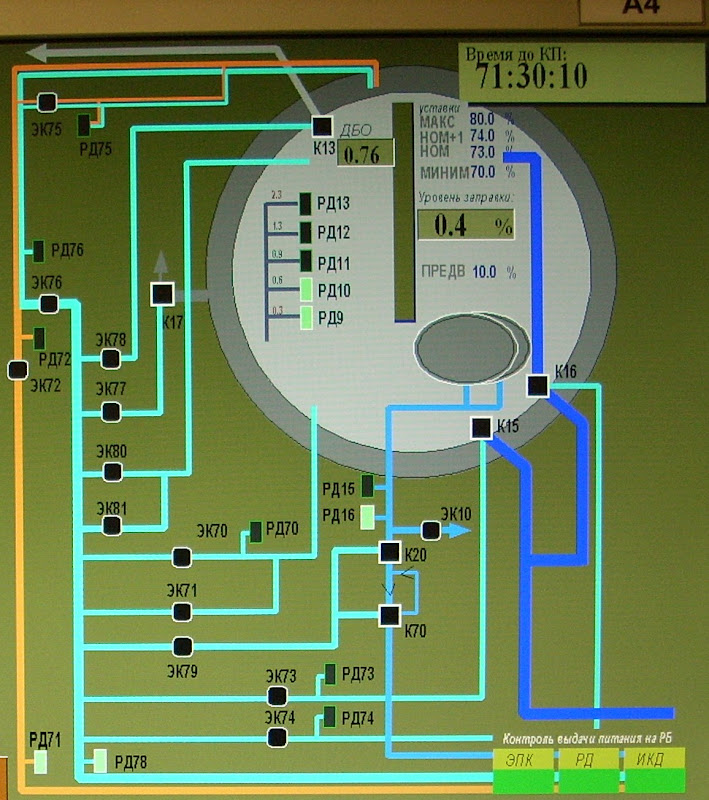
By the way, a screenshot of the DM-SLB tanking control terminal at site 45 in Baikonur (Land Launch facility for Zenit-3SLB rockets):

684a119e99c5.jpg


The round body is a representation of the LOX tank of a DM-SLB atop Zenit standing on launch pad in side-section view.

Blue are LOX lines, light-blue are cold Helium lines, cyan are Nitrogen lines (the entire system is pneumatically-driven by Nitrogen), and orange lines represent ducts that provide ullage "hot" Helium in flight.

K16 valve is for filling the tank in and K15 is for draining.

At courtesy of Vovan from novosti-kosmonavtiki.ru.

Probably, if Proton launch complex was as rich with sensors at Zenit's, such a huge discrepancy in filling ratio would not be missed.
 
http://www.bfm.ru/news/2010/12/08/rosstrahnadzor-zanjalsja-strahovshhikom-sputnikov-glonass.html

Russian Federal Insurance Supervision Service is undertaking audit in "Sputnik Insurance Centre" which insured the lost GLONASS satellites.

According to a source from the Supervision Service, the supervisors are interested in finding out the actual financial standing of the company and how likely it is going to pay out the recovery amount for the lost hardware.

According to the information from "Sputnik" agency website, last June the organization acquired membership of Russian Association of Air and Space Transportation Insurers. One of the indicated insurance activity taken up by the company was insuring risks of space launches and activities. The charter capital of the company of 90 million roubles. It's noticeable that it's physically located in the same building in Moscow as TSENKI Federal State Unitary Enterprise, which is the primary contractor for organization and carrying out of launch of GLONASS satellites from Baikonur Cosmodrome. Over 9 past months of 2010, the insurance premium earned by the company has accrued to 179 million roubles, out of which 74 million roubles were received from asset insuring of individuals and legal entities.

As was already quoted, the real cost of loss for this failed launch measures in range of 3-5 billion roubles.

Among Russian insurers community, there's no clear knowledge of nature of "Sputnik" company. Market knows nothing about any counter-insurance activities performed by this company.

To quote Anatoly Perminov (http://allnewspoint.com/news/449128),

The lost GLONASS satellites were insured, but partly. This what head of Roscosmos Anatoly Perminov said in his interview for Rossiya 24 TV channel. "A part of the lost funds can be reimbursed, but it's a lengthy process", he said.

So it looks like the old guy was just going to collect some cushioning wealth for his happy rocking chair days, but bad days happen, and the fraud insurance firm strategy has suddenly played against him. :dry:
 
Space News: Proton To Return to Flight in December:
PARIS — Russia’s Proton rocket will return to service at the end of December to launch a large commercial telecommunications satellite following a government inquiry that found the vehicle’s Dec. 5 failure was caused by overfueling of its upper stage, Russian and International Launch Services (ILS) officials said Dec. 10.

The state commission investigating the failure, in which three Russian Glonass timing and navigation satellites were destroyed, has cleared Proton’s three lower stages from any involvement in the malfunction. Commercial Proton rockets marketed by Reston, Va.-based ILS use the same lower three stages but a different upper stage, called Breeze M. The Glonass launch used a new version of the Russian Block DM upper stage.

The Russian space agency, Roskosmos, on Dec. 10 confirmed the commission’s preliminary finding that the three Proton stages need not be grounded. A final report is due as soon as the week of Dec. 13.

{...}
 
Back
Top