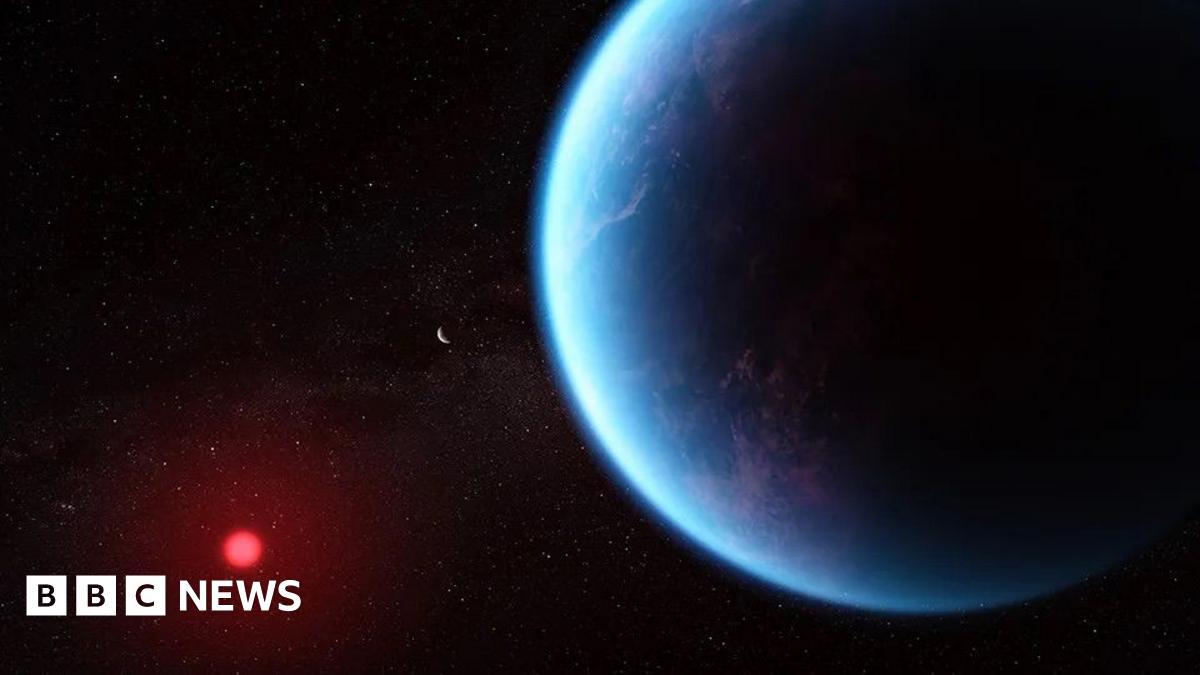
Controversial ocean world one hundred and twenty light years away in constellation Leo, may support life

richfororbit

Active member
Joined
Jul 8, 2013
Messages
686
Reaction score
52
Points
43
Location
Greater London
Hello,

I thought I'd post the link.

Scientists have found new but tentative evidence that a faraway world orbiting another star may be home to life.

A Cambridge team studying the atmosphere of a planet called K2-18b has detected signs of molecules which on Earth are only produced by simple organisms.

This is the second, and more promising, time chemicals associated with life have been detected in the planet's atmosphere by Nasa's James Webb Space Telescope (JWST).

But the team and independent astronomers stress that more data is needed to confirm these results.

The lead researcher, Prof Nikku Madhusudhan, told me at his lab at Cambridge University's Institute of Astronomy that he hopes to obtain the clinching evidence soon.

"This is the strongest evidence yet there is possibly life out there. I can realistically say that we can confirm this signal within one to two years."
There are lots of "ifs" and "buts" at this stage, as Prof Madhusudhan's team freely admits.

Firstly, this latest detection is not at the standard required to claim a discovery.

For that, the researchers need to be about 99.99999% sure that their results are correct and not a fluke reading. In scientific jargon that is a five sigma result.

These latest results are only three sigma, 99.7%. Which sounds a lot, but it is not enough to convince the scientific community. But it is much more than the one sigma result of 68% the team obtained 18 months ago,, which was greeted with much scepticism at the time.

But even if the Cambridge team obtains a five sigma result, that won't be conclusive proof that life exists on the planet, according to Prof Catherine Heymans of Edinburgh University and Scotland's Astronomer Royal, who is independent of the research team.

"Even with that certainty, there is still the question of what is the origin of this gas," she told BBC News.

"On Earth it is produced by microorganisms in the ocean, but even with perfect data we can't say for sure that this is of a biological origin on an alien world because loads of strange things happen in in the Universe and we don't know what other geological activity could be happening on this planet that might produce the molecules."

That view is one the Cambridge team agree with; they are working with other groups to see if DMS and DMDS can be produced by non-living means in the lab.

Other research groups have put forward alternative, lifeless, explanations for the data obtained from K2-18b. There is a strong scientific debate not only about whether DMS and DMDS are present but also the planet's composition.


It only orbits thirty three days its star.
 
They discovered strong hints that two gasses that are produced by life, but that they discovered none of the other gasses or liquids associated with it, is indeed a reason to remain sceptical. The planet is actually no simple water world, but actually a smaller Neptune or Uranus. As the atmosphere of that exoplanet is mostly made of hydrogen, applying knowledge of the sources on Earth could be misleading.

Also, two substances do not fit the measurements too well:

Exoplanet_K2-18_b_Atmosphere_Composition.jpg
 
There are several ways to observe exoplanets, all of them are not accurate. Methods are so imprecise that the search for habitable planets is just a tabloid headline

K2-18b orbits a red dwarf (we don't see any other exoplanets), which already makes it uninhabitable.
 
Last edited:
Some more context about the this planet from 2023 and the quality of detection of DMS by the same time before:


Here is also the 2023 paper by that team:


I find it especially noteworthy, that the team seems to be using a custom processing pipeline for the JWST data to get to such detection, that seems to be not used by other teams. While I don't think the processed data is extraordinary, it might result in higher confidence values than possible by more common processing. I can't find much data on how this custom processing pipeline works on a planet with known Methane and DMS concentrations.
 
What is also very astounding, they can really measure the spectrum of a planet in a solar system, that covers not even one pixel in the JWST instruments. The planet orbits Sma is less than 0.16 AU, but one pixel covers a circle of about 2 AU diameter in 121 LY distance.
 
In the past it was Earth size, now more Earth like exoplanets, but sure, the measurements are done when the planet is seen through its star or orbital area from behind the star, so the atmosphere can be scanned using infrared.

There were a few other planets, trappist, so far not much on that. A few of them were very poor.

But they aren't very far away compared to this example, and yes, the studied it back two years ago, even though it was known ten years ago.
 
Last edited:
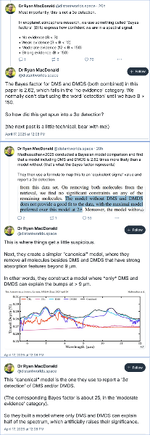
Yesterday, another exoplanet researcher, Dr. Ryan MacDonald, analysed the paper and found out how they managed to get to 3 sigma. And its more dire than I thought. They simply invented a "canonical atmosphere model" where all gases, that absorp light with strongly beyond 9 microns, are removed except DMS and DMDS. And in this model, they than had, as constructed, 3 sigma for DMS and DMDS, since all other gases that could compete with DMS and DMDS had been removed. Without this constructed model, the confidence for DMS and DMDS is down to 2 sigma and the data showing no strong evidence that DMS or DMDS exist in that atmosphere.

The race for the discovery of the first extrasolar life is a tiny bit too heated, maybe....

837f418ada523c27.png
 
There is also a lot of BS research these days, see Sabine Hossenfelder on that topic. So the good stuff is bathed into a lot of meaningless crap.
 
There is also a lot of BS research these days, see Sabine Hossenfelder on that topic. So the good stuff is bathed into a lot of meaningless crap.

Yeah, and I fear, with Gen AI everywhere, it will only get worse. But I don't think that this one is actually bad or bullshit science. The majority of the paper does bear actually solid results and improve our knowledge of this exoplanets composition.

But the tiny part that they gave to the media (Yes BBC, I look at you there) and which actually made it into the big news, might be completely fabricated and yes, that destroys trust in science.
 
Back
Top