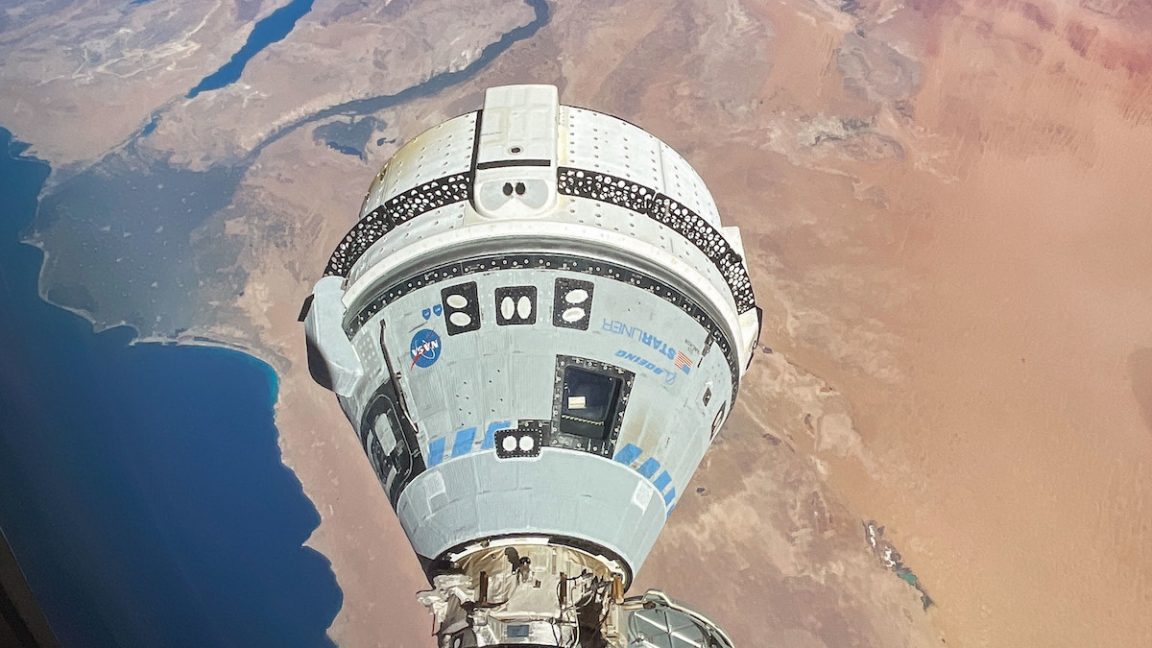
Updates Boeing's CST-100 Starliner

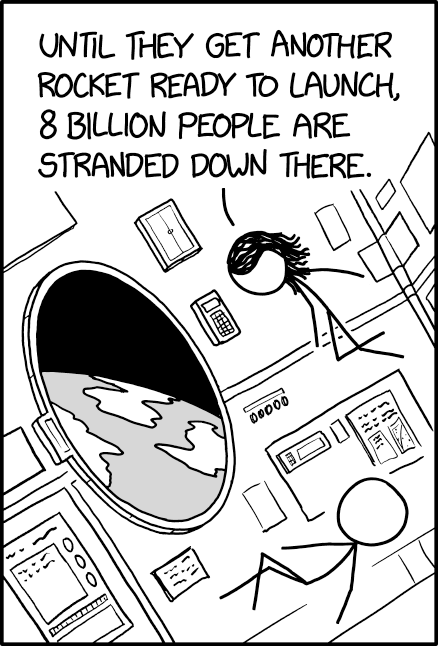
stranded_2x.png
At least the two astronauts are not alone. There are currently 9 people in the station, which will reduce to 7 people after the next SpaceX crew rotation.
Also, more people are on Earth than in space, so we can make the most of our time while being stranded on Earth, similar to what Williams and Wilmore do in space.
 
Last edited:
At least the two astronauts are not alone. There are currently 9 people in the station, which will reduce to 7 people after the next SpaceX crew rotation.
I wonder if we have a record in the making for most humans in Earth orbit. 9 on the ISS, 3 on Tiangong, and there will be 2 more with the arrival of Crew-9 in September before Williams and Wilmore return for a total of 14.

EDIT: It will tie the previous record with 11 at the ISS during the Axios mission and 3 on Tiangong.
 
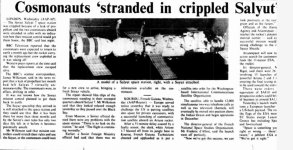
For those who still think that the former Starliner crew are stuck on the space station without any means of return, may I remind you of that one old BBC article from 1983 claiming that the crew aboard Salyut 7 at the time were "stranded" in space after a Soyuz rocket exploded (T-10-A) on the launch pad, when in reality their Soyuz (T-9) is docked to the station this whole time
IMG_20240907_062537.jpg
 
I think the Soviet Union was ahead of the US in this aspect. In fact, Gagarin never flew his own spacecraft.

Same goes for Buran. But, then again, it wasn't necessarily a technological issue, but more of a case of the US always wanting to keep humans in the loop, while the Soviets wanted the complete opposite, lest someone decided to land in the USA or something
 
I think the Soviet Union was ahead of the US in this aspect. In fact, Gagarin never flew his own spacecraft.

Is that really an achievement? :unsure:

Mercury, Gemini and Apollo could and did fly unmanned with additional systems installed during the testing phase. But the production spacecraft didn't waste mass on such a feature, the Space Shuttle didn't get the functionality in first place. Only later a minimal system was provided to deorbit and land a crippled orbiter.

Mercury actually was simple enough to program a whole mission into it before launch just by setting timers. Crew comfort came second.
 
Nope...Soyuz 32 (1979) and Soyuz MS-22 (2022–2023) did it first

Soyuz 32's crew returned aboard Soyuz 34 as a precaution in the aftermath of Soyuz 33's in-orbit engine failure on the final rendezvous/docking approach to Salyut 6

And we all know Soyuz MS-22 suffered a coolant leak last year
 
Last edited:
Same goes for Buran. But, then again, it wasn't necessarily a technological issue, but more of a case of the US always wanting to keep humans in the loop, while the Soviets wanted the complete opposite, lest someone decided to land in the USA or something
I'm not even sure if Buran was really meant to be flown with a crew onboard on a regular basis. It had a crew module, but wasn't scheduled to fly with people onboard on its second flight as well. IMHO the Buran program seemed to be one of these things to politically show that "we can do such things as well!". It rots in the hangar for three decades now, being a symbol for the political/sociopolitical condition of Russia.

I think the great achievement of the USSR/Russia was the robotic landings on the Moon, Soyuz and Mir.
 
Yeah, but, well, I would expect this from Boeing/NASA in 2024 🤷‍♂️
Yes, but if you are an aerospace company and can't convince NASA that your hardware is safe to fly, you might have big problems.

Boeing's reputation is in tatters and they need to get humble and start demonstrating that they are qualified to make spacecraft. They seem to be busy pointing fingers at everyone except themselves.
 
It seems that a thruster on the crew module failed during reentry, and they had some glitch with the navigation system:

 
Back
Top