The world's best Earth imaging satellite ever to reach your fingertips. One-foot (30 cm) resolution photos from 600 km above the Earth - and photos you can buy. Maybe better than the best spysats during the Cold War. No doubt about it - Worldview-3, the latest member of DigitalGlobe's imaging satellite fleet, is cool! :hotcool:
And it's going to space today!
The world's leading satellite imaging company, well known for photos you can see on Google Maps and other mapping websites, as well as exclusive photos of events around the world from above (as recently as the MH17 crash), will get yet another telescope in their fleet after today's liftoff of the Atlas V. Joining Quickbird, Ikonos, Geoeye-1, Worldview-1 and Worldview-2, Worldview-3 has a very similar design to the launched-in-2009 Worldview-2, but manages to push the maximum resolution down to 30 cm (one-foot!) by using a slightly lower orbit of 610 km altitude. I am pretty sure imaging experts of the Cold War era would love to get such capabilities, much less available to the general public!

And they are claiming that they are well ahead of their competitors.....

So, get ready to be spied by anyone in this world! :rofl:
 |
|
Launch date:
|
August 13, 2014
Window open:
|
18:30 UTC / 11:30 a.m. PDT
Window close:
|
18:45 UTC / 11:45 a.m. PDT
Launch site:
|
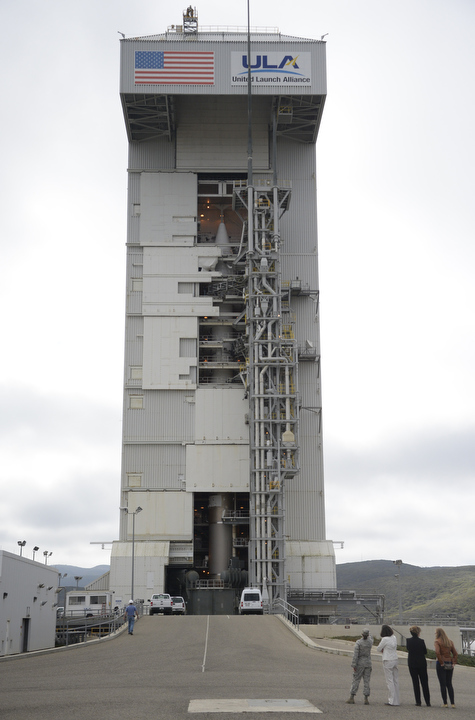
SLC-3E, VAFB, California
{colsp=2}
[highlight]L[eventtimer]2014-8-13 18:30:00;%c%%ddd%/%hh%:%mm%:%ss%[/eventtimer][/highlight]

[table="head"]{colsp=2}
 |
|
 [/table]
Mission Insignia
Launch coverage: (starts 11:10 am PDT / 18:10 UTC)
- ULA webcast: http://www.ulalaunch.com/webcast.aspx
- ULA webcast 2: http://cmc-i.akamaihd.net/hls/live/201845/launch/index-launch.m3u8
- Spaceflight Now: http://www.spaceflightnow.com/atlas/av047/status.html
Payload:
WorldView 2 is an eart observation satellite operating at an altitude of 770 kilometers. WorldView 2 will enable DigitalGlobe to offer half-meter panchromatic resolution and 1.8 meter multispectral resolution. The WorldView 2 system will allow DigitalGlobe to substantially expand its imagery product offerings to both commercial and international customers with a more commercially desirable, higher performance product. Added spectral diversity will provide the ability to perform precise change detection and mapping. WorldView 2 will incorporate the industry standard four multispectral bands (red, blue, green and near-infrared) and will also include four new bands (coastal, yellow, red edge, and near-infrared).
The WorldView 2 telescope will have a 110 cm aperture and fly at a higher altitude of 770 km. It will provide the same panchromatic half-meter resolution imagery as WorldView 1, in addition to 1.8 meter multispectral resolution imagery.
In August 2010 a mostly identical WorldView 3 was ordered for launch in 2014. This satellite has an additional infra-red capability. From its lower orbit of 617 km, it has a ground resolution of 0.31 m.

[table=head]{colsp=2}
Operator:|
Contractors:|
Equipment:|
Configuration:|
Dimensions:|
Imaging resolution:|
Power:|
Launch Weight:|
Orbit:|
Designed life:|
Retargeting agility :|
The WorldView 2 telescope will have a 110 cm aperture and fly at a higher altitude of 770 km. It will provide the same panchromatic half-meter resolution imagery as WorldView 1, in addition to 1.8 meter multispectral resolution imagery.
In August 2010 a mostly identical WorldView 3 was ordered for launch in 2014. This satellite has an additional infra-red capability. From its lower orbit of 617 km, it has a ground resolution of 0.31 m.
[table=head]{colsp=2}
Specifications
Type / Application:
|- Earth imaging
Operator:|
- DigitalGlobe
Contractors:|
- Ball Aerospace
Equipment:|
- 110 cm aperture telescope
Configuration:|
- BCP-5000
Dimensions:|
- 5.7 x 2.5 x 7.1 m (deployed)
Imaging resolution:|
- 0.31 m panchromatic, 1.24 m multi-spectral for visible light/near infrared (400-1040 nm), 3.70 m multi-spectral for far infrared (1195-2365 nm)
Power:|
- 2 deployable solar arrays
- batteries
- 3100 watts (end of life)
Launch Weight:|
- 2800 kg
Orbit:|
- 617 km SSO
Designed life:|
- >7.25 years
Retargeting agility :|
- Time to slew 200 km: 12 s
[/table]

Launch Vehicle:
The Atlas 5 was developed by Lockheed Martin Commercial Launch Services as part of the US Air Force Evolved Expendable Launch Vehicle (EELV) program. Each Atlas 5 rocket uses a Russian-built RD-180 engine burning kerosene and liquid oxygen to power its first stage and an American-built RL10 engine burning liquid hydrogen and liquid oxygen to power its Centaur upper stage.

The Atlas 5 launcher will fly in the so-called 401 configuration, denoting a 4-meter payload fairing, no strap-on solid rocket boosters and a single-engine Centaur upper stage.
[table=head]{colsp=2}
Specifications
Gross mass:
|- 338640 kg (746570 lb)
Payload:
|- 7095 kg (15641 lb) SSO
- 4950 kg (10910 lb) GTO
Height:
|- 58.30 m (191.20 ft)
Diameter:
|- 3.81 m (12.49 ft)
Span:
|- 3.81 m (12.49 ft)
Thrust:
|- 3827.00 kN (860343 lbf)
Launch Timeline & Ground Track:
(to be posted later when I can find one)
Weather forecast for Lompoc, California on August 13, 2014 (11 a.m.)
Cloudy early with peeks of sunshine expected late. High near 20C. Winds NW at 15 to 25 km/h.
11 AM|18°C|14°C|76%|2%|0%|22%|1015 hPa|11 km/h WNW|

Links:
Last edited: