

Remember good old Palladium At Night (a.k.a. PAN), the US military comsat that no-one has stepped out and claim as their own? Since its launch 5 years ago it seems to be very busy in the sky, as it has been moving to and fro in geostationary orbit since launch - though only within the region of 35 - 55 degrees East, maintaining all-time coverage of good old Middle East (and now you-know-what-nation-is-east-of-Europe :rofl .
.
Back in those years people got puzzled by its mission - one expert thinks that it may have something to do with coveted UAV operations in all major battle arenas, which does not fall into the operation areas of the USAF and NRO, yet require major data transfer capabilities. Strange? This is already the most convincing idea out there...
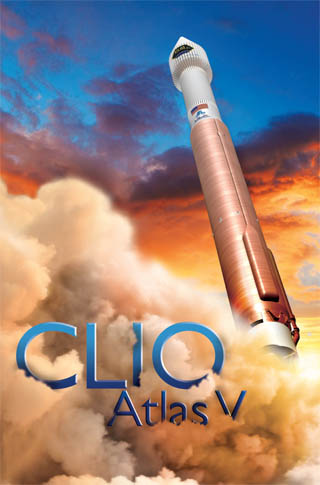
Today, the mystery deepens. Enter CLIO, yet another Lockheed Martin-built communication satellite built for an unnamed US government customer. What's even strange is that the orbit it is going dropped into does not seems to be geostationary - from the press kit released, observers are measuring a transfer orbit with apogee at around 19000 km. If this thing is really going to geostationary, this is the most weird way to do so...
And the name is...um interesting. While in old Greek mythology good old Pan is the god of flocks and nature, Clio is the muse of history. And now this launch will just happen after the final selections of future transportation of ISS crew is announced, which most probably will involve the Atlas V.
Hmm..... :hmm:
 |
|
{colsp=2}
|
Launch coverage: (starts 5:22 pm EDT / 21:22 UTC)
Payload:
[/table]
Launch Vehicle:
The Atlas 5 was developed by Lockheed Martin Commercial Launch Services as part of the US Air Force Evolved Expendable Launch Vehicle (EELV) program. Each Atlas 5 rocket uses a Russian-built RD-180 engine burning kerosene and liquid oxygen to power its first stage and an American-built RL10 engine burning liquid hydrogen and liquid oxygen to power its Centaur upper stage.

The Atlas 5 launcher will fly in the so-called 401 configuration, denoting a 4-meter payload fairing, no strap-on solid rocket boosters and a single-engine Centaur upper stage.
[table=head]{colsp=2}
Launch Timeline & Ground Track:


Weather forecast for Titusville, Florida on September 16, 2014 (6 p.m.)
Mixed clouds and sun with scattered thunderstorms. High 32C. Winds W at 10 to 15 km/h. Chance of rain 50%.
Time|Temps|Dew Point|Relative Humidity|Precip|Snow|Cloud cover|Pressure|Wind|Weather
6 PM|27°C|22°C|78%|49%|0%|85%|1014 hPa|11 km/h NW|
 Chance of a Thunderstorm
Links:
.Back in those years people got puzzled by its mission - one expert thinks that it may have something to do with coveted UAV operations in all major battle arenas, which does not fall into the operation areas of the USAF and NRO, yet require major data transfer capabilities. Strange? This is already the most convincing idea out there...
Today, the mystery deepens. Enter CLIO, yet another Lockheed Martin-built communication satellite built for an unnamed US government customer. What's even strange is that the orbit it is going dropped into does not seems to be geostationary - from the press kit released, observers are measuring a transfer orbit with apogee at around 19000 km. If this thing is really going to geostationary, this is the most weird way to do so...
And the name is...um interesting. While in old Greek mythology good old Pan is the god of flocks and nature, Clio is the muse of history. And now this launch will just happen after the final selections of future transportation of ISS crew is announced, which most probably will involve the Atlas V.
Clio, second-born of the nine muses, was the muse of history. The name derives from the Greek kleô: to make famous (or perhaps more generally, to make known). She is often depicted with a scroll. Famously, the German philosopher Arthur Schopenhauer is attributed the quote, “Clio, the muse of history, is as thoroughly infected with lies as a street whore with syphilis.”
Hmm..... :hmm:
|
Launch date:
|
September 16, 2014
Window open:
|
21:44 UTC / 5:44 p.m. EDT
Window close:
|
00:10 UTC / 8:10 p.m. EDT
Launch site:
|
SLC-41, CCAFS, Florida
{colsp=2}
[highlight]L[eventtimer]2014-9-16 21:44:00;%c%%ddd%/%hh%:%mm%:%ss%[/eventtimer][/highlight]
[table="head"]{colsp=2}
 |
|
 [/table]
Mission Insignia
Launch coverage: (starts 5:22 pm EDT / 21:22 UTC)
- ULA webcast: http://www.ulalaunch.com/webcast.aspx
- ULA webcast 2: http://cmc-i.akamaihd.net/hls/live/201845/launch/index-launch.m3u8
- Spaceflight Now: http://www.spaceflightnow.com/atlas/av049/status.html
Payload:
CLIO is a secret satellite procured by an unidentified US Government Agency from Lockheed Martin. The satellite is likely based on a commercial A2100A bus. Purpose and mission is not known.
There is some speculation, that it might be a follow on to the PAN (P360) mission. Otherwise, some pre launch information hints, that it might not be a geostationary satellite, but will end up in a low inclination 20000 km circular orbit.
[table=head]{colsp=2}
Operator:|
Contractors:|
Equipment:|
Configuration:|
Dimensions:|
Propulsion:|
Power:|
Launch Weight:|
On-orbit Weight:|
Orbit:|
There is some speculation, that it might be a follow on to the PAN (P360) mission. Otherwise, some pre launch information hints, that it might not be a geostationary satellite, but will end up in a low inclination 20000 km circular orbit.
[table=head]{colsp=2}
Specifications
Type / Application:
|- Navigation
Operator:|
- ? (US Government)
Contractors:|
- Lockheed Martin
Equipment:|
- ?
Configuration:|
- A2100A
Dimensions:|
- ?
Propulsion:|
- ?
Power:|
- 2 deployable solar arrays
- batteries
Launch Weight:|
- ?
On-orbit Weight:|
- ?
Orbit:|
- GEO (?)
[/table]
Launch Vehicle:
The Atlas 5 was developed by Lockheed Martin Commercial Launch Services as part of the US Air Force Evolved Expendable Launch Vehicle (EELV) program. Each Atlas 5 rocket uses a Russian-built RD-180 engine burning kerosene and liquid oxygen to power its first stage and an American-built RL10 engine burning liquid hydrogen and liquid oxygen to power its Centaur upper stage.
The Atlas 5 launcher will fly in the so-called 401 configuration, denoting a 4-meter payload fairing, no strap-on solid rocket boosters and a single-engine Centaur upper stage.
[table=head]{colsp=2}
Specifications
Gross mass:
|- 338640 kg (746570 lb)
Payload:
|- 7095 kg (15641 lb) SSO
- 4950 kg (10910 lb) GTO
Height:
|- 58.30 m (191.20 ft)
Diameter:
|- 3.81 m (12.49 ft)
Span:
|- 3.81 m (12.49 ft)
Thrust:
|- 3827.00 kN (860343 lbf)
Launch Timeline & Ground Track:
Weather forecast for Titusville, Florida on September 16, 2014 (6 p.m.)
Mixed clouds and sun with scattered thunderstorms. High 32C. Winds W at 10 to 15 km/h. Chance of rain 50%.
6 PM|27°C|22°C|78%|49%|0%|85%|1014 hPa|11 km/h NW|
Links:


