
Ares or DIRECT?

Which launch system should NASA persue?


  • Total voters
    88
You simply cannot make the structure of a winged spacecraft as solid as that of an aircraft with current propulsion technology,

Please explain to me your reasoning behind this statement.

At least two Soyuz have re-entered backwards due to the service module failing to separate from the descent capsule; as soon as the service module broke up, aerodynamic forces reoriented them to the correct angle for reentry.

That's good designing on the part of the Russians... but a vehicle that doesn't throw away most of itself wouldn't be capable of that.

I very much doubt that any realistic near-term winged spacecraft could survive the same, though they're less likely to get into that situation if they're a single stage.

I would tend to say - very nearly completely unlikely. :cheers:
 
I have been asking for the DIRECT since before anyone came up with the name! Wayy back in the day on the old forums, I was explaining my point like this... The problem is, with 2 launchers, we are over complicating things and just asking for more problems, both with safety and budget. What makes more sense, is using DIRECT with perhaps some slight modifications. There should be 2 configurations made possible with the same vehicle
1. A lighter launcher with a smaller ET and smaller SRBs for simple human orbital trips. 2. A fully loaded, giantic configuration capable of pushing the limits of lifting capacity for heavy manned or unmanned launches.

We should still have 2 methods, but only 1 basic lifter. This way, you dont have to deal with each one so differently that it becomes unmanagable. Its essentially the same vehicle, sort of like a medium and a large, rather than the stick and the fatty.
 
Last edited:
My opinion is a little complicated:


  1. For the Orion missions, my preference is DIRECT, but slightly modified for allowing heavier payloads (a fifth motor in Jupiter 2(4+1=5)1 or Jupiter 2(4+1=5)6/7 or two extra SRBs, with these two solutions i pretend closing Peter (eh Michael :P) Griffin's mouth). The DIRECT Solution didn't came too late for me. It's a shame that NASA had an administrator with a mind more closed than a light bulb, he tried to do something, but -at least for me- in the wrong way.
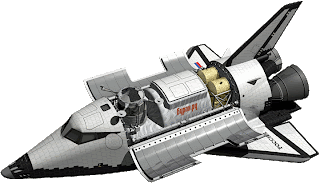
  1. For LEO Missions honestly i prefer a space plane... but not of the same way that the STS. But, a on-top-of-launcher one. Smaller than the STS, but preserving -at least some of- the functionality. A space plane of the size of Molniya's MAKS (but without the RD 701 engines, please) could be launched with full payload to LEO atop a Falcon 9 Rocket (requiring an OMS burn at apogee) or a Rus MT35 (Directly into orbit). The system coud evolve to an air-launched (TSTO) strange hybrid between an Interim HOTOL and a MAKS-M... But my hopes of having a Russian or European version of COTS are more remote than a democracy on North Korea :P (At least in Orbiter i could have it, and i'm workin' on).
Details about the spaceplane?:

maks_os-last2.gif


  • My design is baselided on Molniya's MAKS, but without the RD 701 engines.
  • Made of composite materials like SpaceShipOne and the VSS Enterprise :P, in fact, MAKS was designed with this premise on mind :P
  • Two Versions: Manned and unmanned. No crew = More payload. :P Manned version payload: 9 tons. Unmanned version payload: 12 tons.
  • Mounted atop the launcher (SpaceX Falcon 9H / TsSKB Progress RUS MT 35 / Ariane 5 ES). Nothing about sidemounting or drop tanks.
  • The manned launcher should fly with a crew of 2-3. An habitable module with 4-crew capacity could be used for transporting crew to and from ISS.
  • For abort modes? Ejection seats... The spaceplane should have just one deck, instead of the two of the STS. (The spaceplane is 20 m long x 3.5 m diameter x 10 m of wingspan. Mass: ~20 tons). So, ejection seats could be implemented.
  • It should have the capability for depressurizing the cabin for conducting EVAs without using a bulky airlock.
  1. In other hand, for interplanetary flight, is necessary to develope a completly new spaceship. Like Buzz Aldrin's eXploration Module. http://www.popularmechanics.com/science/air_space/4322647.html
I don't know how does this post seem for you. If you could observe something, let me know :P
 
I'm a little conflicted. My most clear opinion is DIRECT, but the expensive SSMEs seem to be a problem, so I'd go with a less costly alternative (not sure what this would be; I know next to nothing about types of rocket engines). However, it seems unlikely that DIRECT will happen, and if it did, I'm guessing it there would a years-long gap in our manned flight. No matter what happens, I think we need to keep the Space Shuttle flying on a twice-a-year-minimum to keep a US manned presence.

I like the idea of Orion mainly because I wasn't around for Apollo and I would love to see Apollo-style flights in my lifetime.
 
Seeing the full capability of the Atlas V and Delta IV, I go with them. Their cheaper, which is something NASA should consider during this recession.
 
Seeing the full capability of the Atlas V and Delta IV, I go with them. Their cheaper, which is something NASA should consider during this recession.

Whenever the Centaur be not crushed by a superFAT Orion :P I'll prefer the Atlas 5 551 over the Delta 4H. The reason? Price. How much costs an Atlas 5-551 or a Delta 4H?
 
NASA should have went with the Delta IV to replace the Ares I, and kept the Ares V. Can the Atlas V carry the Altair, though?
 
Back
Top