Apollo 16 ascent module

Matte

Member
Joined
Nov 24, 2007
Messages
169
Reaction score
0
Points
16
Location
Milano
This video shows the Apollo 16 liftoff from the moon:


Before it lifts off these panels are still OK. At 30 seconds is ignition, and it looks like the blast wave bashes in the panels.
 
Before it lifts off these panels are still OK. At 30 seconds is ignition, and it looks like the blast wave bashes in the panels.

Actually, the panels already looked like that on the moon.

AS16-113-18331.jpg
 
But not like this...
AS16-122-19533.jpg


The Apollo 16 Flight journal at NASA has the details:

http://history.nasa.gov/ap16fj/23_Day8_Pt2.htm

Relevant quotes:
"177 12 20 Irwin: Okay. John, looking at the pictures of the liftoff, it appeared that something might have come loose - skin on the - the back of the vehicle so, for that reason, we want Ken to take some pictures of the LM...

177 15 26 Duke (LM): Oh, Houston. On lift-off, one of the MESA blankets flew out in front of the LM and hit the ground about 200 meters in front of the LM...

177 16 36 Mattingly: Looks like some of the thermal blanket around the ECAs ["Descent Engine" in LM transcript.] on the back end there is pretty badly chewed up.

177 16 46 CC: Okay. We copy.

177 16 47 Mattingly: Some of the stuff is torn - a couple of panels are torn off. And some of the stripping in between it is - it looks like it was struck by something, but it looks like all the mylar blankets underneath are still intact...

177 17 29 CC: Ken, can you observe whether it's possible for sunlight to directly impinge on portions of the spacecraft equipment?

177 17 40 Mattingly: No, sir; it's not possible from the back; I can't tell about the bottom; but, on the back side, the Mylar blankets are still intact - it's only that outer covering that's broken."

So the blast from the LM ascent engine blew off the panels after all.
 
oh, thanks for answer.
strange it happened just in this occasion.
 
That's what I was thinking too. I'm looking into it. If I find the answer, I'll PM you.
Let us all know, please.

In this picture from Apollo 15, there do not seem to be the obvious gaps between the panels as seen in the Apollo 16 pic posted by Urwumpe above. The panels were already loose before ascent?

AS15-87-11839.jpg
 
The anomaly explained

Looking through Apollo Lunar Surface Journal, I came across the Mission report

http://www.hq.nasa.gov/alsj/frame.html

Here's what they have to say (Section 14, p 41):

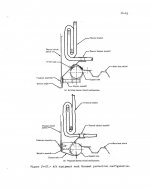
"At lunar lift-off, four vertical thermal shields (fig. 14-26 [the photo posted by me above]) on the aft equipment rack were torn loose from the lower standoffs and remained attached only at the upper standoffs. This occurrence was observed from the lunar-based television.

The most probable cause of the failure was ascent engine exhaust entering the cavity behind these thermal shields. A cross section of the lower edge of the shields is shown in figure 1h-27. Analysis shows that the thermal shield which extends below the support tube allows a pressure buildup on the closure shield which exceeds its capability. Once theclosure shield failed, the exhaust entered the cavity behind the shield, resulting in a pressure buildup exceeding the capability of the vertical thermal shields. The detailed flight configuration in this area was not tested.

In the lunar surface photographs taken prior to lift-off, some of the shields appear to have come loose from the center standoff (fig. 14-28 [the photo posted by Urwumpe above]).

Excessive gaps between some of the panels are evident. Both conditions could be caused by excessive pressure in the thermal blanket due to insufficient venting during boost. The corrective action will include a redesign of the thermal shield to eliminate the projection below the support tube, as shown in figure 14-27, and to provide additional venting to the blankets as well as additional standoffs.

This anomaly is closed."

So it never happened before because they never had "insufficient venting during boost" before (whatever that means). And then they fixed it in time for 17, as explained in figure 27:
 

Attachments

  • apollo figure 14-27.jpg
    apollo figure 14-27.jpg
    72.8 KB · Views: 22
So it never happened before because they never had "insufficient venting during boost" before (whatever that means). And then they fixed it in time for 17, as explained in figure 27:
I expect the venting arrangement would have been the same for Apollo 9 through 16 but perhaps the thermal blankets for 16 had more gas trapped in them from manufacture.

Thanks for the research.
 
Back
Top