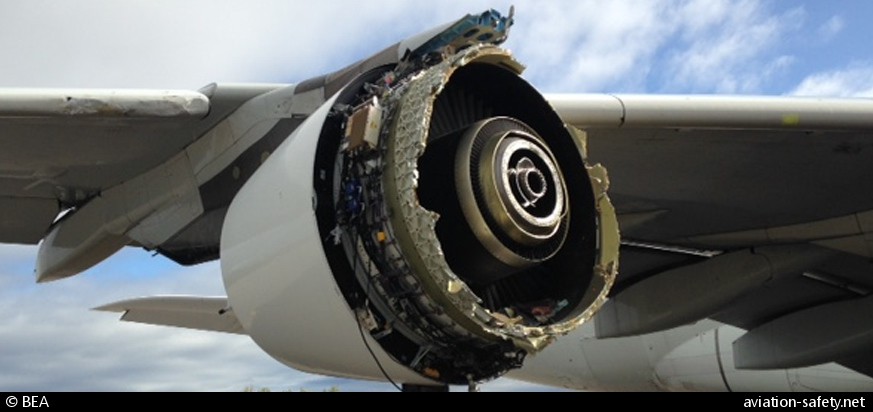
News Air France plane engine fails over Atlantic

I still think it's kind of lucky that they found it so fast. An engine fan disk is a tiny black speck in the wilderness. It fell from 30k ft or more and fluttered on its way down so you really don't know which way it was going to fall, and it may have landed edge on in the snow and buried itself. I would've expected them to spend at least a few days looking for it, over which time it might get snowed on more than once.
 
What surprises me is that ADSWNJ seems to have been right about the failure mode. I didn't think such a symmetrical failure was even possible.

:thumbup::)

Waiting to see what shape the fan disk is in, but yeah, maybe I was quite close this time. It just looked like a clean separation to me, without all the usual shrapnel holes and leading edge damage you get from a typical uncontained failure.
 
One thing I'll note is that if the fan actually left the engine axially, this probably doesn't really count as an uncontained failure. Uncontained means that parts start leaving the engine radially and the nacelle structure fails to stop them. If nothing leaves radially, the failure is contained.

If the fan did leave axially, I'm willing to bet that the cowling was blown off by a pressure surge in the inlet associated with the event.

---------- Post added at 19:34 ---------- Previous post was at 19:31 ----------

I still think it's kind of lucky that they found it so fast. An engine fan disk is a tiny black speck in the wilderness. It fell from 30k ft or more and fluttered on its way down so you really don't know which way it was going to fall, and it may have landed edge on in the snow and buried itself.

You're still more likely to find it if it lands in the middle of Greenland than if it lands in the middle of the Amazon rainforest.
 
First picture of the separated cowl. Hopefully there's a fan disk under there too.

593y3_DLd4miNWAAAkjd2.jpg


Source: cross-posted from Airliners.net.
 
Though there have been no disasters so far, the A380 engines indeed seem a bit "rebellious". :huh:

The good point is that each time the aircraft can safely land with serious damage. Its becoming the modern B-17 :P
 
Though there have been no disasters so far, the A380 engines indeed seem a bit "rebellious". :huh:

The good point is that each time the aircraft can safely land with serious damage. Its becoming the modern B-17 :P

As I said before, I think it's just luck. All modern airliners are built well, at least the ones built in western countries. But if one of those engine parts winds up flying in the right random direction, it becomes a bad day.

The fact that this has happened with two different engine types is bad luck; the fact that both times things turned out okay for the passengers is good luck.
 
20170930-1-C-1.jpg


It seems the outboard leading edge slat got damage as well, probably some of the cowling is to blame.
 
Though there have been no disasters so far, the A380 engines indeed seem a bit "rebellious". :huh:

No surprise - they are the first three spool turbofan engines for a large airliner designed in the western world - the only earlier example is the Progress D-18T engine of the An-124
 
No surprise - they are the first three spool turbofan engines for a large airliner designed in the western world - the only earlier example is the Progress D-18T engine of the An-124

No they aren't: Rolls-Royce RB211
Rolls is the only major manufacturer that makes three-spool turbofans, though. Pratt and GE avoid them because they are significantly more complex...
 
No, descendant.

The RB211 nearly finished Rolls-Royce, had to do a bailout via the government. I think it was developing carbon-fibre turbine blades that did for them?

N.
 
Looks like they're going to ferry the bird out on three operational engines and one installed but inoperative engine.
 
Back
Top