39 days to Mars possible now with nuclear-powered VASIMR.

Still 545 MW is a lot.

More so, 545 MW is a lot of electrical power, if you try to pump it into an electrical installation. That's the scale of the Baltic Cable connection (600MW), which uses the highest voltage in Germany with 450 kV (Which really means: you have to expect arcing at the scale of a spacecraft, unless you include meters of insulation and distance) It requires 1400 mm² cross section cables (or two 600 mm² cables), that is pretty huge and pretty heavy. The ISS operates with just 120 kW - about 4000 times less.

But his article is pretty much filled with wrong assumptions and poor research in many places, so I don't want to dive too deep into the math. For example, the lifetime of spaceborne nuclear reactors is still years, not hours. The mass of the nuclear fuel containers does not include container mass and shielding - or handling equipment.
 
Last edited:
From the exoscientist link:
"Since in this case the engine is always running at full power this would be 545,000,000 MW ..."

1. I guess it should mean "W", not "MW".
2. Still 545 MW is a lot. (I guess this means thermal power, not sure.)
For comparsion, a Los Angeles class submarine is powered by a 150 MW reactor (later models with 165 MW).

If you google for "Gigawatt power plant" and look at the pictures, the size of the secondary side cooling towers is overwhelming. I don't say it can't be done, but we are talking about an enormous installation in orbit.

Thanks for that correction. I fixed that. About the large amount of power, this has been done for ground tests of the NERVA nuclear thermal engine. The key step is turning this propulsive engine into a power generator. Note that this has been done for jet engines where they have been turned into gas turbine power generators, called aeroderivative gas turbines.

However, because of the reduced size of the habitat due to the shorter flight time, the power requirements also become much reduced. I estimate less than 10 MW would do it.

Bob Clark
 
Last edited:
I like that you did a lot of research for this topic. But to me the technologies seem a little mixed up. Nerva was thermal engine. The propellant was heated up and exited through the nozzle, a simple open cycle. High power was easy to achive as most of the excess heat went away with the exhaust gases.

For an electric engine (like the Vasimr) the raw thermal power of the reactor first has to be converted to electric energy. This is a major task by itself, requiring turbines, a lot of plumbing and a heat sink (radiators).

The travel time of 39 days is pretty ambitious. The ship has to cover a minimum distance of 55 million kilometers in this time. A rough calculation shows this requires a speed of 32 km/s at midpoint with a continous acceleration of 0,02 m/s² (not counting maneuvers in the vicinity of the planets). A VF-200 Vasimr engine consumes 200 kW electrical power to produce 5 N thrust. For a 100 ton spaceship this results in 388 engines, consuming 77 MW (electrical). Hope I got my math right :)
 
Well, in reality the trajectory with such low accelerations would be like a spiral with low flight path angle during thrust. If you assume such a model, you can calculate the DV and the burn time easily:

DV = twice the (average) velocity difference between the planets.
Burn time = Time it takes to reach this DV

In case for Mars: DV = (29.78 - 24.07) * 2 = 5.71 * 2 = 11.42 km/s DV
 
Thanks for that correction. I fixed that. About the large amount of power, this has been done for ground tests of the NERVA nuclear thermal engine. The key step is turning this propulsive engine into a power generator. Note that this has been done for jet engines where they have been turned into gas turbine power generators, called aeroderivative gas turbines.

However, because of the reduced size of the habitat due to the shorter flight time, the power requirements also become much reduced. I estimate less than 10 MW would do it.

The short flight times made possible by nuclear-powered plasma propulsion also make possible manned flights to the Jovian system.

They also make possible actual robotic lander missions to Pluto.

Bob Clark
 
Last edited:
The short flight times made possible by nuclear-powered plasma propulsion also make possible manned flights to the Jovian system.

They also make possible actual lander missions to Pluto.

Bob Clark

Why?
 
The short flight times made possible by nuclear-powered plasma propulsion also make possible manned flights to the Jovian system.

Not unless the interplanetary travel "radiation problem" is solved... and then very well solved to deal with the huge radiation around Jupiter.
 
Anyone have any links to Earth (and other planets) radiation belt levels and human tolerance to radiation exposures, specific to space travel.

Thanks
:thumbup:

That is not that simple. :lol: You also have to include the effects of the spacecraft on the radiation. Use lead as shielding and you kill the crew much faster in space.

AFAIR, we have no detailled in-situ measurements of the radiation belts of Jupiter yet, but the Cassini measurements of it during its GA at Jupiter are pretty "annoying" and the Pioneer 10/11 fly-through before was also pretty harsh.

http://www.jpl.nasa.gov/releases/2001/belts.html

http://www.nasa.gov/mission_pages/juno/multimedia/pia03478.html

Pioneer 10 and 11 passed both through the belt and had sadly only sensors with too selective measurement range. This lecture here explains it well, how much was known about Jupiters magnetic field before Pioneer 10/11 and how wrong they were about it:

http://www-pw.physics.uiowa.edu/van90/Thomsen_lecture.pdf

While the magnitude and the nature of the belt was pretty well detected by Pioneer, the sensor only measured counts/second and did not differ between the different kinds of radiation, like Cassinis measurement later allowed.
 
Last edited:

You need the fuel to be able to slowdown on arrival. New Horizons had the highest departure speed of any interplanetary probe in order to get Pluto in 9 years. But that speed was so fast it meant it was not appreciably slowed by the Sun's gravity as it sped to its Pluto encouter. This means it had a high flyby speed.
If you wanted a lander then you would have to cancel out that high flyby speed. To accomplish this in a practical manner you would need electrical propulsion of some kind. But then you would need it to operate far away from the Sun where solar power would be too weak. This is where lightweight nuclear propulsion comes in.

Actually I don't want it to take 9 years. Using nuclear electric propulsion I think we can cut it to 5 years or less even for a lander.


Bob Clark
 
Actually I don't want it to take 9 years. Using nuclear electric propulsion I think we can cut it to 5 years or less even for a lander.

Well, actually, we can approximately calculate the DV and the travel time needed for getting to Pluto for example.

Earth: 29.78 km/s
Pluto: 4.67 km/s

Difference: 25.11 km/s

DV for spiral trajectory: 50.22 km/s

Now, you can calculate: If you for example launch a probe with a single VASIMR and a heavy nuclear reactor as power source. For simplicity, lets just scale a Russian nuclear Kosmos 1818 satellite up to 200 kW continuous power: this means we get a weight of 50 tons, 18.31 tons of that would be dry weight (10.6 tons of reactor; the rest structure, electronics, GNC and experiments) The remaining 31.68 tons would be fuel for the VASIMR.

Every second, the engine would consume 0.0001 kg of fuel to produce 5N of thrust, so for burning all the fuel needed for the DV : In 3667 days the spacecraft would reach Pluto. Almost exactly 10 years. Not 5.

Doubling the thrust would at that low accelerations still allow using a simple spiral approximation (if the thrust gets too high, we need more complex trajectories with more gravity losses than the assumed almost zero), but you would almost double the spacecraft mass: Instead of halving the ten years, you would just reduce it maybe to 9 years, and eventually approaching something around 6.66 years*, if you would strap infinite reactor/engine pairs to get a camera with a small antenna to Pluto.

My model was sure pretty unrealistic (The TOPAZ reactor only lasts for 3-5 years, little other mass available, for example for attitude control), but the coarse ballpark numbers would be valid: While you could get to Pluto in acceptable time for an unmanned mission and with entering orbit around it, you would need a huge spacecraft with very tiny payload to do so. I am not even sure if you could even hide a small lander in that tiny mass budget.

I would not even exclude the possibility, that a much smaller conventional spacecraft with 15 tons mass and a slightly longer travel time of 15 years, with two gravity assists along the route (Jupiter, Uranus) could be the better option.


* The number of the little brother of the beast
 
That is not that simple. :lol: You also have to include the effects of the spacecraft on the radiation. Use lead as shielding and you kill the crew much faster in space.

AFAIR, we have no detailled in-situ measurements of the radiation belts of Jupiter yet, but the Cassini measurements of it during its GA at Jupiter are pretty "annoying" and the Pioneer 10/11 fly-through before was also pretty harsh.

http://www.jpl.nasa.gov/releases/2001/belts.html

http://www.nasa.gov/mission_pages/juno/multimedia/pia03478.html

Pioneer 10 and 11 passed both through the belt and had sadly only sensors with too selective measurement range. This lecture here explains it well, how much was known about Jupiters magnetic field before Pioneer 10/11 and how wrong they were about it:

http://www-pw.physics.uiowa.edu/van90/Thomsen_lecture.pdf

While the magnitude and the nature of the belt was pretty well detected by Pioneer, the sensor only measured counts/second and did not differ between the different kinds of radiation, like Cassinis measurement later allowed.


To protect astronauts from radiation on long interplanetary space trips or to high radiation environments such as the Jovian system, perhaps we could use Robert Winglee's idea of a "mini-magnetosphere":

Scientists produce Star Trek-like deflector device for cancer-free interplanetary travel
By Sebastian Anthony on June 28, 2013 at 11:32 am
http://www.extremetech.com/extreme/...-device-for-cancer-free-interplanetary-travel

A nuclear reactor for propulsion could also be used to power the radiation shield.

This method might also itself may be used for the propulsion:

Hitching a Ride on a Magnetic Bubble.
"Scientists from the University of Washington and NASA are experimenting with miniature magnetospheres as an innovative form of space transportation."
http://science.nasa.gov/science-news/science-at-nasa/2000/ast04oct_1/


Bob Clark
 
A nuclear reactor for propulsion could also be used to power the radiation shield.

Means a heavier reactor with higher power demand. Look for Lorentz force to find out, how large the magnetic field has to be for making high energy electrons miss the spacecraft - there is rather simple formula for getting from particle energy and magnetic field strength to curve radius of the particles trajectory.

For some reading: http://astro.physics.uiowa.edu/~srs/2961_12/Lec31_notes.pdf

Also, magnetic fields interact: If you use a strong magnetic field to protect your spacecraft near a strong magnetic field of Jupiter, you get a force that propells your spacecraft.
 
Last edited:
Well, actually, we can approximately calculate the DV and the travel time needed for getting to Pluto for example.
Earth: 29.78 km/s
Pluto: 4.67 km/s
Difference: 25.11 km/s
DV for spiral trajectory: 50.22 km/s
Now, you can calculate: If you for example launch a probe with a single VASIMR and a heavy nuclear reactor as power source. For simplicity, lets just scale a Russian nuclear Kosmos 1818 satellite up to 200 kW continuous power: this means we get a weight of 50 tons, 18.31 tons of that would be dry weight (10.6 tons of reactor; the rest structure, electronics, GNC and experiments) The remaining 31.68 tons would be fuel for the VASIMR.
Every second, the engine would consume 0.0001 kg of fuel to produce 5N of thrust, so for burning all the fuel needed for the DV : In 3667 days the spacecraft would reach Pluto. Almost exactly 10 years. Not 5.
Doubling the thrust would at that low accelerations still allow using a simple spiral approximation (if the thrust gets too high, we need more complex trajectories with more gravity losses than the assumed almost zero), but you would almost double the spacecraft mass: Instead of halving the ten years, you would just reduce it maybe to 9 years, and eventually approaching something around 6.66 years*, if you would strap infinite reactor/engine pairs to get a camera with a small antenna to Pluto.
My model was sure pretty unrealistic (The TOPAZ reactor only lasts for 3-5 years, little other mass available, for example for attitude control), but the coarse ballpark numbers would be valid: While you could get to Pluto in acceptable time for an unmanned mission and with entering orbit around it, you would need a huge spacecraft with very tiny payload to do so. I am not even sure if you could even hide a small lander in that tiny mass budget.
I would not even exclude the possibility, that a much smaller conventional spacecraft with 15 tons mass and a slightly longer travel time of 15 years, with two gravity assists along the route (Jupiter, Uranus) could be the better option.

I'm thinking of a straight-line approximation for a high speed trajectory. Recall how New Horizons took a nearly straight-line trajectory towards Pluto because of it's high speed.

Say our nuclear-powered plasma drive vehicle launched tangentially to Earth's orbit. Because of the high speed it travels nearly straight-line along the tangent line from Earth's orbit until it intersects Pluto's orbit. The radial distance from Earth to Pluto now is about 5 billion km. So the tangential distance would be approx. the 5 billion km plus the distance from the Earth to the Sun of 150 million km, so at 5.150 billion km.

For the rocket's departure delta-v I took it to be about the same as the Earth's orbital speed of 30 km/s. Now note that we have to consider what would be the final speed when you take into account the Earth's motion around the Sun and the Sun's gravity, known as the hyperbolic excess velocity. This will be the transit speed. I'll use this equation given by Dgatsoulis in regards to a discussion about fast trips to Mars:

The ΔV for the injection burn is
chart


ΔVinj is the delta-v of the rocket, 30 km/s. Vorb is the speed of the Earth around the Sun of about 30 km/s. Vesc is the escape velocity with respect to the Sun at Earth's distance from the Sun, [math]\sqrt{2}[/math]Vorb = 42.4 km/s. And ΔVtr is the transit speed, the final speed the spacecraft will actually travel at. Unwrapping this we get Vtr = 42.4 km/s.

Then the travel time, using the straight-line approximation, will be 5,150,000,000 km/(42.4 km/s), about 3.85 years.

Note though to get this 30 km/s departure speed we already have 7.8 km/s orbital speed around the Earth. Then we can use again that equation Dgatsoulis cited to see how much delta-v we need to apply when leaving LEO to get a speed of 30 km/s. Plug into the formula now 30 km/s for ΔVtr, 11.1 km/s for Vesc, and 7.8 km/s for Vorb. Then the delta-v we need on Earth departure is: ΔVinj = 24.2 km/s.

At arrival at Pluto the spacecraft will have a speed moving approx. radially of 42.4 km/s. Pluto will be moving approx. tangentially at a speed of about 4.7 km/s. Then their relative velocity will be [math]\sqrt{42.4^2 + 4.7^2}[/math] = 42.7 km/s.

So the total delta-v we need would be 24.2 + 42.7 = 66.9 km/s.

I'll assume we're using Hall effect thrusters since they've been used on actual spacecraft for decades now and they have better T/W ratio than VASIMR. High power NASA Hall effect thrusters have been tested at the 100+ kW level and at 5,000 s Isp. Assuming 5,000 s Isp, the mass ratio would be

[math]e^{(66.9/50)}[/math] = 3.8 .

Now, keep in mind the purpose of those blog posts on nuclear powered plasma propulsion was that it is possible to get the needed high specific power using currently available technology, in fact at orders of magnitude better specific power than 60's era tech such as the TOPAZ reactor.

Say you got 1 kW/kg electric specific power, as has been estimated needed for VASIMR or other plasma propulsion methods. (I actually think the specific electric power can reach the 10's of kW per kg range.) Then at a 100 kW power level it would mass 100 kG.

Hall effect thrusters also mass at the 1 kW/kg level so would mass at 100 kg for 100 kW thrusters. The spacecraft dry mass, aside from payload, will be dominated by these mass values, since for example the tank mass using dense electric propulsion propellants such as Xenon, will be a fraction of the propellant mass.

So say the spacecraft dry mass is say about 200 kg, with the payload, lander or orbiter, at similar mass of 200 kg, then the gross mass will be 3.8 * 400 kg = 1,520 kg.

Likely you would though want a larger spacecraft for such an important mission, and there is also the question of how weight efficient a nuclear reactor could be at only a 100 kW power level. So say it was 10 times larger at 1 MW power level and 15,000 kg gross mass, with a 2,000 kg payload.

This though uses the straight-line approx. Perhaps Dgatsoulis or Keithth G could do a more accurate analysis of the travel time assuming a departure speed from Earth's solar orbit of 30 km/s.


Bob Clark

 
Last edited:
:facepalm:

You do know the requirements of a straight line trajectory?
 
:facepalm:
You do know the requirements of a straight line trajectory?

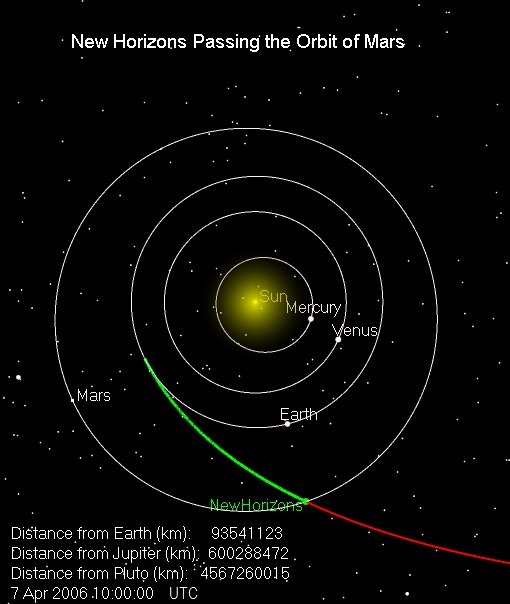
The primary requirement was high departure speed as shown by New Horizons:

Pluto-Bound Probe Passes Mars’ Orbit.
by Tariq Malik, Staff Writer | April 07, 2006 01:45pm ET
"It's pretty amazing," New Horizons principal investigator Alan Stern told SPACE.com. "It's a straight line across the Solar System. There are hardly any curves because this is so fast."
New Horizons sped past Mars' orbit some 151 million miles (243 million kilometers) from the Sun at a rate of about 13 miles (21 kilometers) per second. The red planet, however, trailed behind the spacecraft at a distance of about 186 million miles (299 million kilometers), mission managers said, adding that New Horizons was closer to Earth than Mars.
http://www.space.com/2263-pluto-bound-probe-passes-mars-orbit.html

Passing the Orbit of Mars.
New Horizons' trailblazing journey to the solar system's outermost frontier took it past the orbit of Mars at 6 a.m. EDT (1000 UTC) on April 7, 2006 - 78 days after the spacecraft launched.
http://pluto.jhuapl.edu/Mission/Where-is-New-Horizons/Passing-Planets/Passing-Planets-Mars.php

The departure speed for our probe will be even higher than for New Horizons.

Bob Clark
 
The acceleration of your spacecraft is extremely low and you have a huge DV to reach. A hall thruster with 100 kW net power will have about 75 kW beam power, which then means you will only have 1.5N thrust at 50 km/s specific impulse.

Which means, you will consume 1.5/50000 kg/s Xenon fuel: 0.00003 kg/s. Your spacecraft will need years to reach your planned instant impulse DV (2530 days, a bit less than seven years). Which is absolutely not significant smaller than a single orbit period of Earth. Quite contrary. Its significant larger than the orbit period of Earth.
 
The acceleration of your spacecraft is extremely low and you have a huge DV to reach. A hall thruster with 100 kW net power will have about 75 kW beam power, which then means you will only have 1.5N thrust at 50 km/s specific impulse.

Which means, you will consume 1.5/50000 kg/s Xenon fuel: 0.00003 kg/s. Your spacecraft will need years to reach your planned instant impulse DV (2530 days, a bit less than seven years). Which is absolutely not significant smaller than a single orbit period of Earth. Quite contrary. Its significant larger than the orbit period of Earth.

I think you left out the factor of 1/2 in your calculation of the beam power. Remember the first burn of 24.7 km/s is to leave Earth. The remaining amount of 42.7 km/s is to slow down on arrival at Pluto. I estimate for the first burn in the range of 2 months.

But it will actually be less than this since to avoid gravitational losses on departure from LEO, you will likely use first a chemical propulsion booster to get out of the vicinity of Earth, so the required delta-v by the plasma drive on the first burn will be less.


Bob Clark
 
I think you left out the factor of 1/2 in your calculation of the beam power. Remember the first burn of 24.7 km/s is to leave Earth. The remaining amount of 42.7 km/s is to slow down on arrival at Pluto. I estimate for the first burn in the range of 2 months.


Its well over 2 years, still more than two orbits of Earth. if you use a chemical booster for that first burn, you will have a much larger spacecraft to assemble in Orbit. 24.7 km/s alone is almost three times the DV needed to get from the surface of Earth to LEO.
 
Back
Top